
Bright Friday: Feast Dat--Theotokos the Life-Giving Font
On Bright Friday, the first Friday after Pascha, the Life-Giving Spring is celebrated. The Life-Giving Spring (Ζωοδόχος Πηγή) is a title given to the Mother of God, an actual miracle-working spring (Greek: αγιάσμα) at Valoukli, near the Queen City of Constantinople, to a soldier named Leo Marcellus, who later became Byzantine Emperor Leo (457-474 A.D.). Holy Emperor Leo I the Thracian oversaw the building of the church that was named in honor of the Most Holy Theotokos. For almost fifteen hundred years, this church has been one of the most important pilgrimage sites of Greek Orthodoxy.
My beloved spiritual children in Our Risen Lord Jesus Christ and Our Only True Savior,
CHRIST IS RISEN! TRULY HE IS RISEN!
+++
BRIGHT FRIDAY: FEAST-DAY - THEOTOKOS THE LIFE-GIVING SPRING ( Greek: Ζωοδόχος Πηγή)
On Bright Friday, the first Friday after Pascha, the Life-Giving Spring is celebrated. The Life-Giving Spring (Ζωοδόχος Πηγή) is a title given to the Mother of God, an actual miracle-working spring (Greek: αγιάσμα) at Valoukli, near the Queen City of Constantinople, to a soldier named Leo Marcellus, who later became Byzantine Emperor Leo (457-474 A.D.). Holy Emperor Leo I the Thracian oversaw the building of the church that was named in honor of the Most Holy Theotokos. For almost fifteen hundred years, this church has been one of the most important pilgrimage sites of Greek Orthodoxy.
The site was chosen by Leo due to a divine experience the Emperor went through earlier in his life. Leo was walking in a forested area when he saw a blind man who asked him for water to quench his thirst. It was then that Leo heard a message from a voice saying that there was water deep within the woods that the man could drink. The clay from its waters would be able to heal the man's eyes. The Theotokos also prophesied at this time that Leo would become Emperor of Constantinople. Leo listened to the voice, quenched the man's thirst, and allowed him to gain sight just as the Mother of God proclaimed.
This holy site was the place where Emperor Leo decided to build the church in her name. The blessed water (agiasma) continued to work miracles for other and earned the name "The Life-Giving Spring or Font".
The traditional account surrounding the feast of the Life-Giving Spring is recorded by Nikephoros Kallistos Xanthopoulos, the last of the Greek Ecclesiastical historians, who flourished around 1320. It begins with a miracle that occurred involving a soldier named Leo Marcellus. According to the historian Leo took pity on a blind man. Leo heard a voice say to him, "Do not trouble yourself, Leo, to look for water elsewhere, it is right here!" Looking about, he could see no one, and neither could he see any water. Then he heard the voice again, "Leo, Emperor, go into the grove, take the water which you will find and give it to the thirsty man. Then take the mud (from the stream) and put it on the blind man's eyes...And build a temple (ναός) church here...that all who come here will find answers to their petitions."
Leo did as he was told, and when the blind man's eyes were anointed with the mud from the spring he regained his eye sight.
After his accession to the throne, the Emperor erected a magnificent church on this site, dedicate to the Theotokos and the water continued to work miracle cures, as well as resurrection from the dead, through the holy intercessions of the Theotokos, and therefore it was called "The Life-Giving Spring" or "Ζωοδόχος Πηγή").
Historians Procopius and Cedrenus state the Byzantine Emperor Justinian erected a new church, larger than the first, in the last year of his reign (559-560 A.D.), utilizing materials that had remained after the erection of the Hagia Sophia Cathedral. After the erection of the sanctuary, the Byzantine named the Gate that was situated outside the walls of Theodosius II "Gate of the Spring" (Greek: "Πύλη τής Πηγής").
After the Fall of Constantinople to the Ottoman Turks in 1453, the church was torn down by the Muslem Turks, and the stones used to build a mosque of Sultan Bayezid. Only a small chapel remained at the site of the church. Twenty-five steps led down to the site of the spring, surrounded by a railing. In 1547 the French humanist Pierre Gilles noted that the church no longer existed, but that ailing people continued to visit the spring of holy water.
As a result of the Greek War of Independence from the Ottoman Turks of 1821, even the little chapel was destroyed and the spring was left buried under the rubble.
In 1833 the reforming Ottoman Sultan Mahmud II gave permission for the Christians to rebuild the church. When the foundations of the original church were discovered during the course of construction, the Sultan issued a second firman permitting not only the reconstruction of the small chapel, but a large church according to the original dimensions. Construction was completed on December 30, 1834, and the Ecumenical Patriarch, Constantius II consecrated the church on February 2, 1835, celebrating with 12 bishops and an enormous flood of the Greek Orthodox Christian faithful.
Nearby was built a hospital and alms-house. Even the Muslims spoke with great respect of the Life-Giving Spring, and of the Theotokos, who through it pours out her grace-filled power. "Great among women Holy Mary" is how they refer to the Most Holy Virgin. The water (agiasma) from the Life-Giving Spring they call the "water of Holy Mary."
On September 6, 1955 the antic-Greek Istanbul Pogrom, the church was one of the targets of the fanatic mob. The church building was burned to the ground by the Muslem Turks while the Egoumenos was lynched, and 90-year-old Archimandrite, Father Chrisanthos Mantas was assassinated by the mob.
Another small chapel has been rebuilt on the holy site, but the church has not yet been restored to its former size. The holy spring still flows to this day and is considered by the Greek Orthodox Christian faithful to have miracle-working properties. Today, in addition to the church, the compound includes the underground shrine of the Zoodochos Pigi with the holy spring which has golden fish in it.
The sanctuary is directed by a titular bishop and is one of the most popular among the Greek Orthodox Christians of Constantinople (Istanbul), who visit it especially during Bright Friday (First Friday following Pascha), and on the feast of the Elevation of the Holy Cross on September 14. On these two days, a great feast, both popular and religious takes place there. Funerals of Greek Orthodox Christians to be buried in the nearby cemetery are also celebrated in the church.
About one kilometer south of the church is an important Greek hospital is active, the "Balikli Greek Hospital Foundation".
In the 9th century, Joseph the Hymnographer gave the title "Zoothochos Pege" (Life-Giving Spring) to a hymn (Theotokion) for the Mother of God for the first time.
Apolytikion (Dismissal) Hymn (Tone 3)
As a Life-Giving Fount, thou didst conceive the Dew that is transcendent in essence, O Virgin Maid, and thou has welled forth for our sakes the nectar of joy eternal, which doth pour forth from thy fount with the water that springeth up unto everlasting life in unending and mighty streams; wherein, taking delight, we all cry out: Rejoice, O thou Spring of life for all men.
Kontakion Hymn. Fourth Tone
O Lady grace by God, you reward me by letting gush forth, beyond reason, the ever-flowing waters of your grace from your perpetual Spring. I entreat you, who bore the Logos/Word, in a manner beyond comprehension, to refresh me in our grace that I may cry out, "Rejoice, redemptive waters."
"Rejoice, Sovereign Lady, never failing spring of the Living Water."
The Living Water is, of course, Our Lord Jesus Christ Himself and the line is a reference to the Old Testament, when Moses in the wilderness struck the rock "and [God] brought water out of the rock, and caused waters to flow down as rivers" (Psalm 78:16). Jesus, referring to this miracle, said: "If any man thirst, let him come unto me, and drink. He that believes on me, according to the Scriptures, out of his belly shall flow rivers of living water" (St. John 7:38).
Just as the Old Testament miracles prefigured the as yet unborn Jesus Christ, so too do modern miracles point back to their source in the Risen Christ.
The holy Icon, then, shows the miraculous spring which still exists today--usually in the shape of the Cross. Around about people are coming to the waters to be healed. This is where most of the people's attention is focused. Yet we, who stand "outside" the holy Icon, are also granted the invisible image of the Mother of God holding Jesus Christ. Seated within a font, they sanctify the waters which then flow into the cross-shaped pool everyone is gathered around. The physical manifestation of God's love for mankind is shown together with the spiritual source of such miracles: Christ, the Living Water and His Mother, from whose belly the Living Water flowed.
________________________
DIVINE SERVICES FOR BRIGHT FRIDAY MORNING:
Othros (Matins) at 9:00 a.m.
Divine Liturgy at 10:00 a.m.
_______________________
"Glory Be To GOD For All Things!" -- Saint John Chrysostomos
+++
With sincere agape in Our Risen Lord Jesus Christ,
The sinner and unworthy servant of God
+Father George
Feast of the Great Prophet Jeremias (May 1)
This Great Prophet of God, Jeremias, who loved his brethren and lamented for them greatly, who prayed much for the people and the Holy City, was the son of Helkias of the Tribe of Levi, from the city of Anathoth in the land of Benjamin. He was sanctified from his mother's womb, as the Lord Himself said concerning him: "Before I formed thee in the belly, I knew thee; I appointed thee a Prophet to the nations" (Jeremiah 1:5). He prophesied for 30 years, from 613 to 583 B. C. During the last captivity of the people in the reign of Sedekias, when only a few were left behind to cultivate the land, this Prophet remained with them by the permission of Nabuzardan, the captain of the guard under Nabuchodonosor.

My beloved spiritual children in Our Risen Christ and Our Only True God and Savior,
CHRIST IS RISEN! TRULY HE IS RISEN!
+++
ON MAY 1ST OUR HOLY ORTHODOX CHRISTIAN CHURCH COMMEMORATES THE FEAST OF THE GREAT PROPHET JEREMIAH
This Great Prophet of God, Jeremias, who loved his brethren and lamented for them greatly, who prayed much for the people and the Holy City, was the son of Helkias of the Tribe of Levi, from the city of Anathoth in the land of Benjamin. He was sanctified from his mother's womb, as the Lord Himself said concerning him: "Before I formed thee in the belly, I knew thee; I appointed thee a Prophet to the nations" (Jeremiah 1:5). He prophesied for 30 years, from 613 to 583 B. C. During the last captivity of the people in the reign of Sedekias, when only a few were left behind to cultivate the land, this Prophet remained with them by the permission of Nabuzardan, the captain of the guard under Nabuchodonosor. He wept and lamented inconsolably over the desolation of Jerusalem and the enslavement of his people. But even the few that remained behind transgressed again, and fearing the vengeance of the Chaldeans, they fled into Egypt, forcibly taking with them Jeremias and Baruch his disciple and scribe. There he prophesied concerning Egypt and other nations, and he was stoned to death in Taphnas by his own people about the year 583 B.C. since they would not endure to hear the truth of his words and his just rebukes. His book of prophecy is divided into fifty-one chapters and his book of lamentation into five; he is ranked second among the Great Prophets. His name means "Yah is exalted." (Source: Holy Transfiguration Monastery - Brookline, MA)
The Prophets of the Old Testament were God's messengers who proclaimed His will before the birth of Christ while pointing to the coming of the long-awaited Messiah. The Hebrew word for "prophet" means "God's spokesperson or a person who speaks in the name of God. One who proclaims the will of God and/or foretells the future, especially the coming and mission of Christ, through the inspiration of the Holy Spirit (See Dt 18:18; Acts 28:25). In the book of Deuteronomy 18:18 we read, "I will raise up for them a prophet like you from among their brethren and will put My words in His mouth, and He shall speak to them all that I command Him."
The Holy Prophets are depicted in the ring of the dome of an Orthodox church to affirm that Christ, Who said He came to fulfill the Law and the Prophets (Saint Matthew 5:17), is the God of the Old and New Testaments. And just as the ring of the Prophets "upholds" the holy icon of Christ into the world, Our Lord Christ often quoted the Prophets, as He did when He affirmed the greatest commandments:
"You shall love the Lord your God with all your heart, with all your soul, and with all your mind. This is the first and great commandment. And the second is like it: you shall love your neighbor as yourself. On these two commandments hang all the Law and the Prophets (St. Matthew 22:37-40); Deuteronomy 6:5; Leviticus 19:18).
The role of the Prophets in the Orthodox Church is most significant and they are mentioned over 150 times in the New Testament. The holy Apostle Philip told Nathaniel, "We have found Him Whom Moses in the Law, and also the prophets, wrote--Jesus of Nazareth, the son of Joseph." Following his conversion, holy Apostle Paul, himself "expounded and testified the Kingdom of God, persuading them concerning Jesus, both out of the Law of Moses, and out of the Prophets from morning till evening" (Acts 28:23). The chief of the Apostles, Saint Peter wrote in Second Letter, "that you may be mindful of the words which were spoken before the holy Prophets, and of the commandment of us, the Apostles of the Lord and Savior" (2 Peter 3:1).
The Book of Prophecy
The fourth and final section of the Septuagint Old Testament includes the books of prophecy, which appear in an order different from the Hebrew and Vulgate collections.
Hosea gives a message of God's own redeeming love for His chosen people, even when they spurn Him and prostitute themselves to false gods.
Amos is the simple shepherd called by God to denounce a self-satisfied nation for its grave social injustice, abhorrent immorality and its shallow and meaningless piety.
Joel is the Prophet who foretells the outpouring of the Holy Spirit upon all flesh.
Obadiah prophesies the return of the exiles from Babylon.
Jonah unwillingly accepts God's commands to preach His mercy and forgiveness to a foreign nation.
Nahum prophesies the defeat of the powerful Assyrian enemy.
Habakkuk deals with the perennial question, "How long, O Lord, shall I cry out to You, and You will not hear me?"
Zephaniah prophesies the dark days of Judah's destruction but promises comfort and conciliation to those who wait patiently for the Lord and serve Him.
Haggai, following the return of the exiles, exhorts them to rebuild the destroyed temple in order to unify their disrupted religious life and, more importantly, to prepare for the coming long-awaited Messiah.
Zechariah prophesies the image of the messianic Prince of Peace, the Good Shepherd Who lay down His life for the flock.
Malachi exhorts God's people to faithfulness and asserts the fatherhood of God over all nations. He foretells that God will appoint a forerunner, similar to the ancient Prophet Elijah (or Elias) who will appear before the Messiah and prepare the world for the coming Day of the Lord.
Isaiah exhorts the people of God to place their confidence in the Lord and to lead private and public lives which manifest this reliance. From Isaiah, we hear the prophecies of a Son to be born of a virgin, and of the Suffering Servant--the Messiah--Who would be led as an innocent sheep to the slaughter, and by whose stripes we would be healed.
Jeremiah severely criticizes God's people for abandoning the One True God and turning instead to the worship of idols.
Baruch was appointed to be read on feast days as a confession of sins. In Lamentations, the author Jeremiah mourns the destruction of the holy city of Jerusalem by the Babylonians. The Epistle of Jeremiah is addressed to those about to be carried off into exile in Babylon.
Ezekiel, the Prophet of the exiles, assures his hearers of the abiding presence of God amongst them, even in exile and servitude.
Finally, Daniel begins with the heroic story of Susanna and ends with the fascinating account of Bel and the Serpent.
These forty-nine (49) God-inspired Old Testament books divided into four sections--Books of the Law, of History, of Wisdom, and of Prophecy--which serve as an introduction of the world for the coming of the Messiah, Who is Isaiah's Suffering Servant, Zechariah's Prince of Peace, and the Good Shepherd who lays down His life for the flock. (Source: The Orthodox Study Bible)
____________________________
"Glory Be To GOD For All Things!"--Saint John Chrysostomos
+++
With sincere agape in Our Risen Lord and Savior Jesus Christ,
The sinner and unworthy servant of God
+Father George
Holy and Great Martyr George (April 23)
This most renowned and glorious Holy Martyr was born in Cappadocia, the son of rich and God-fearing parents. His father suffered for Christ, after which his mother moved to Palestine. When George grew up, he went into the army, in which he rose, by the age of 25, to the rank of tribune, and as such was in service under the Roman Emperor Diocletian.

My beloved spiritual children in Christ Our Only True God and Our Only True Savior,
CHRIST IS RISEN! TRULY HE HAS RISEN!
+++
ON APRIL 23rd OUR HOLY ORTHODOX CHURCH COMMEMORATES THE FEAST OF HOLY AND GREAT MARTYR GEORGE
This most renowned and glorious Holy Martyr was born in Cappadocia, the son of rich and God-fearing parents. His father suffered for Christ, after which his mother moved to Palestine. When George grew up, he went into the army, in which he rose, by the age of 25, to the rank of tribune, and as such was in service under the Roman Emperor Diocletian. When this Emperor began a terrible persecution of Christians, George came before him and boldly confessed that he was a Christian. Emperor Diocletian threw him into prison and commanded that his feet be put in the stocks and a heavy weight placed on his chest. After that, he commanded that he be bound on a wheel, under which was a board with great nails protruding and thus be turned. He then had him buried in a pit with only his head above the ground and left there for three days and nights. Then, through some magician, he gave him deadly poison, but in the face of all these tortures, George prayed unceasingly to God, and God healed him instantly and saved him from death to the great amazement of the people. When he also raised a dead man to life by his prayers, many embraced the Christian faith. Among these was the Emperor's wife, Alexandra, and the chief pagan priest, Athanasius, the governor Glycerius and Valerius, Donatus and Therinus. Finally, the Emperor commanded that George and Empress Alexandra be beheaded. Blessed Alexandra died on the scaffold before being killed, and Saint George was beheaded. This happened in the year 303 A.D. The miracles that have been performed at his grave are without number. Also, are his appearances in dreams to those who, thinking on him, have sought his help, from that time up to the present day. Consumed by love for Christ, it was not difficult for holy George to leave all for this love -- his status, wealth and imperial favor, his friends and the whole world. For this love, the Lord rewarded him with a wreath of unfading glory in heaven and on earth, and with eternal life in His Kingdom. The Lord further endowed him with the power to help in need and distress all who honor him and call on his name.
The magnitude of the esteem in which Saint George is held by the Greek Orthodox Christians is shown by the fact that there is practically no village or city without a church in his honor. His Apolytikion hymn calls him "the liberator of prisoners, the protector of the poor, the healer of the sick, and the champion of Christian kings."
According to a very early tradition, his martyrdom took place in Lyda, a small city in Palestine. Thus, Lyda became very early the center of honor for the holy Martyr not only for being the place of his martyrdom but for the fact that his body was entombed there. A church in his name was built on the spot of his entombed holy relics. Already by the 4th-century churches in Saint George's name were found throughout the Middle East and there is evidence that a church in his honor was already built in Byzantium by the time of Saint Constantine the Great. The fame and honor of Saint George spread to the West from Byzantium by the 5th century. In Egypt, there were 40 churches and 3 monasteries in honor of Saint George by the 4th century.
The earliest and most authoritative holy icons of Saint George depict the Saint with the Martyr's tunic and holding a cross on his right hand. But beginning with the post-Byzantine period (12th century and on) Saint George is depicted in military uniform, bearing arms, and on a horse. In some of these, he is depicted killing a dragon (according to a synaxarion of the 11th century) that was threatening the life of the daughter of king Selbios. In other depictions, he is killing a barbarian, and in others, a youth is riding behind him whom the Saint brings back to his parents after freeing him from the Saracens.
Most of the icons of Saint George now in churches depict him on a horse killing the dragon which later theologians interpreted as the personification of evil. It has been only very recently that our neo-Byzantine iconography began to return to the early and most authoritative depictions of the holy Martyr as a young nobleman wearing not only the tunic of the Martyr but that indescribable 'gladsome light' that emanated from the face and the eyes of the Martyr of Christ. This returning to the ancient iconographic depictions of Saint George is important for the Orthodox Christian who, bowing before the holy icon of the Saint to venerate him, finds himself/herself venerating the dragon or the horse, the Saint himself having been placed on the upper part of the icon where the worshiper can hardly reach.
Great Martyr George has been adopted as the champion of the military and the Patron Saint of nations most notable of which is England. From the 14th century a uniform bearing a red cross on a white background, known as Saint George's arms, became the formal uniform of soldiers and sailors. Saint George has been known to England since the 8th century but his becoming a patron Saint of the nation is probably connected with King Edward III who about 1347 founded the Order of the Garter under the name and patronage of Saint George. In 1415 Saint George's feast was made one of the chief feasts of the ecclesiastical calendar of England.
In both East and West, Saint George's feast is celebrated on April 23rd. In the Orthodox Church, if the 23rd of April happens to fall within the Holy and Great Week, Saint George's feast is celebrated on Monday of the Renewal or Bright Week. (References: The Prologue from Ochrid and A Dictionary of Greek Orthodoxy)
___________________
CHRIST IS RISEN! TRULY HE IS RISEN!
ND A SPECIAL BLESSING TO ALL THOSE WHO CELEBRATE THE FEAST OF HOLY AND GREAT MARTYR GEORGE THROUGH HIS HOLY INTERCESSIONS.
____________________
Glory Be To GOD For All things!"- Saint John Chrysostomos
+++
With agape in Our Risen Lord, God and Savior Jesus Christ,
The sinner and unworthy servant of God
+Father George
The Great Miracle of Orthodoxy Through the Centuries: Holy Fire or Light (Gk. ΄Αγιον Φώς)
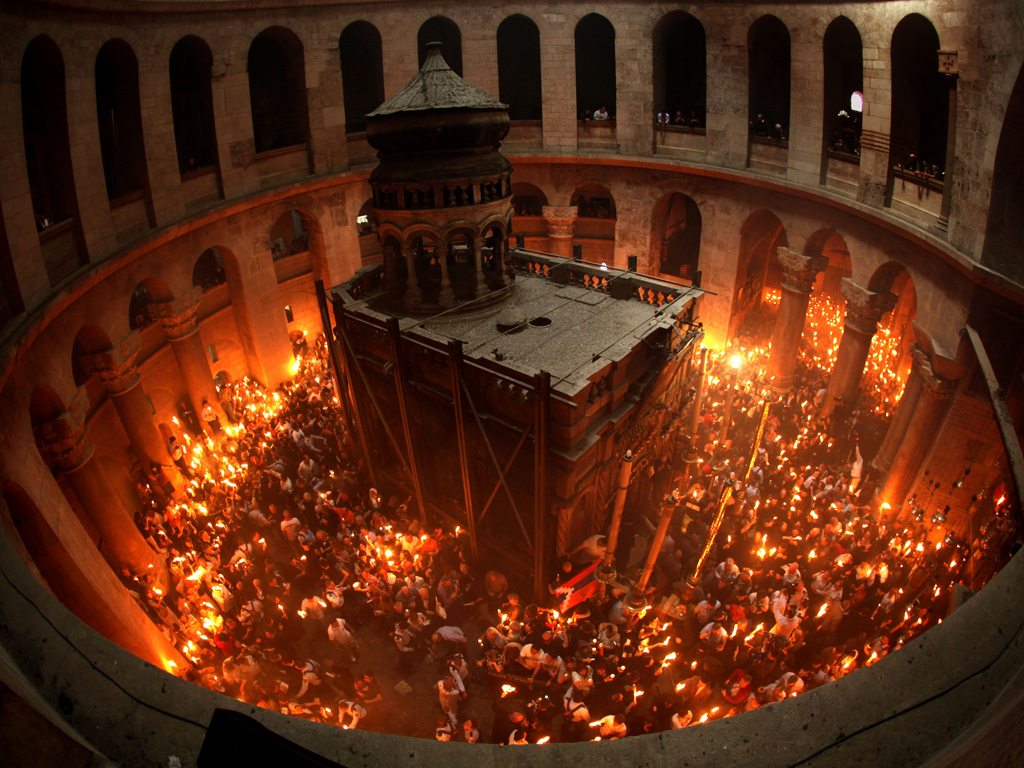
The Holy Fire (Greek ΄Αγιον Φώς) is a miracle that occurs every year at the Church of the Holy Sepulchre or Church of the Resurrection in Jerusalem on Holy and Great Saturday, the day preceding Holy Pascha. It is considered by many to be the longest-attested annual miracle in the Christian world, though the event has only been documented consecutively since 1106. In many Orthodox countries around the world, the miracle is televised live.
My beloved spiritual children in Christ Our Only True God and Our Only True Savior,
CHRIST IS IN OUR MIDST! HE WAS, IS, AND EVER SHALL BE.
+++
THE GREAT MIRACLE OF ORTHODOXY THROUGH THE CENTURIES: Holy Fire (Gk. ΄Αγιον Φώς)
The Holy Fire (Greek ΄Αγιον Φώς) is a miracle that occurs every year at the Church of the Holy Sepulchre or Church of the Resurrection in Jerusalem on Holy and Great Saturday, the day preceding Holy Pascha. It is considered by many to be the longest-attested annual miracle in the Christian world, though the event has only been documented consecutively since 1106. In many Orthodox countries around the world, the miracle is televised live.
The ceremony begins at noon when the Greek Orthodox Patriarch of Jerusalem recites a specific prayer. The faithful gathered will then chant "Lord, have mercy" (Kyrie eleison in Greek) until the Holy Fire descends on a lamp of olive oil held by the Patriarch while he is alone in the tomb chamber of Jesus Christ. The Patriarch will then emerge from the tomb chamber, offer additional prayers, and light either 33 or 12 candles to distribute to the faithful.
The Holy Fire is also spontaneously light other lamps and candles around the church. Orthodox Christian pilgrims say the Holy Fire is blue in color and will not burn hair, faces, etc., in the first 33 minutes after it appears. Before entering the Lord's Tomb, the Greek Orthodox Patriarch is inspected by Israeli authorities to prove that he does not carry the technical means to light the lamp. This investigation used to be carried out by Turkish soldiers. After the tomb of Christ is sealed the authorities affix the wax with their seals.
The ceremony of the Holy Fire or Light is as follows: a) The Litany, b) the entry of the Patriarch in the Holy Sepulchre and c) The prayers of the Patriarch in order for the Holy Light to appear.
Following the tradition, at noon of Holy Saturday the Greek Orthodox Patriarch with his escort - archpriests, priests and deacons and the Armenian Patriarch - enter the Holy Sepulchre, while the bells strike mournfully. Before the entry of the Patriarch, the keeper of the Sacristy of the Holy Temple carries the unsleeping oil lamp, (it is put out that day in order to turn on with the Holy Light). From the interior entry of the Church of the Apostle Jacob, the Patriarch enters in the sanctuary and seats on the Patriarchal throne. Then the representatives of the Armenians, the Arabs, the Copts, and others pass and kiss the hand of the Patriarch so that they will have the right to receive the Holy Light. Immediately afterward begins the Holy Litany that goes three times around the Holy Sepulchre and then it stops in front of the Holy Sepulchre where the officials stand. After the Litany, the Holy Sepulchre is unsealed and the Patriarch takes off his Hierarchical vestments and remains only with a white priest's tunic. Then the governor of Jerusalem and the police director examine the Patriarch in front of all.
Inside the Holy Sepulchre, the Patriarch prays kneeling and reading the special petitions requesting our Lord Jesus Christ to send His Holy Light as a gift of sanctification for the people. And in the absolute quietness at the hour when the Patriarch prays a wheeze is heard and almost simultaneously blue and white lightning of Holy Light penetrate from everywhere, as though millions of photographic flashes turn on embracing the walls and all the lamps light miraculously. In the Holy Sepulchre, the candles the Patriarch holds while he prays are lit also by the Holy Light. The faithful Orthodox Christians and others burst out in cheers while teardrops of joy and faith run from the eyes of the believers.
For a few minutes, the Holy Light doesn't have the attributes of fire. This happens the first minutes after the Patriarch comes out of the Holy Sepulchre and gives the Holy Light to the people. Anyone can touch the fire of the 33 candles and it does not burn. After 33 minutes the flame is normal.
The Holy Fire is first mentioned in the documents dating from the 4th century. A detailed description of the miracle is contained in the travelogue of the Russian Igumenos Daniel, who was present at the ceremony in 1106. Father Daniel mentions blue incandescence descending from the dome to the edicula where the Patriarch awaits the Holy Fire. Some claim to have witnessed this incandescence in modern times.
According to the tradition, in 1099, the failure of Crusaders to obtain the fire led to street riots in Jerusalem. It is also claimed that in 1579, the Armenian patriarch prayed day and night in order to obtain the Holy Fire, but the Fire miraculously struck a column near the entrance and lit a candle held by the Greek Orthodox patriarch standing nearby. Upon entering the church, many Orthodox Christians venerate this column, which bears marks and a large crack attributed to the bolt of lightning from the Holy Fire.
The Holy Light or Fire symbolizes and reminds us in a miraculous way the Resurrection of our Lord Jesus Christ. It is a Godsend miracle throughout the centuries to strengthen our faith in Christ Who is the True Light of the world.
KALI ANASTASI TO ALL! A BLESSED RESURRECTION TO ALL!
In Christ's service,
+Father George
On Eternity
Nothing so moves a sinner to repentance as eternity, and nothing is so useful to every Christian as remembrance and contemplation of eternity. Eternity restrains a man from sin, calms his passions, turns him from the world and all its vanity, makes his heart contrite, gives birth to tears of repentance, incites him to prayer, and works true sighing of the heart. Contemplation and remembrance of eternity can correct even the most depraved man.
My beloved spiritual children in Christ Our Only True God and Our Only True Savior,
CHRIST IS IN OUR MIDST! HE WAS, IS, AND EVER SHALL BE.
+++
ON ETERNITY
By Saint Tikhon of Zadonsk
Nothing so moves a sinner to repentance as eternity, and nothing is so useful to every Christian as remembrance and contemplation of eternity. Eternity restrains a man from sin, calms his passions, turns him from the world and all its vanity, makes his heart contrite, gives birth to tears of repentance, incites him to prayer, and works true sighing of the heart. Contemplation and remembrance of eternity can correct even the most depraved man.
Contemplation of eternity filled dwellers of the desert, caves, mountains, and clefts of the earth. By contemplating eternity the holy martyrs willed to endure the most grievous torments rather than submit to the will of ungodly kings and deny Christ.
From consideration of eternity brigands, murderers, robbers, fornicators, and prostitutes, and all manner of grievous sinners were made saints and the elect of God. Glory to God Who loves mankind, for He opens the doors to Himself unto all, even the most grievous sinners!
It is amazing that Christians of the present age while hearing n the Holy Scripture of eternity, are nevertheless so attached to the vanity of this world, and seek honors, glory, and riches in this world, and build, add onto, and adorn their houses and other edifices, as though there were no eternity. Forgetfulness of eternity works this in them, and the enticement of the vanity of the eyes darkened their hearts.
Beloved Christians! Let us inscribe eternity in our memory, and without fail, ceaselessly, in true repentance, contrition of heart, and prayer let us not be enticed by any vanity of this world and let us shun every sin as a venomous serpent. All that seems beautiful, pleasant and dear to the sons of this age are loathsome to us. Let us truly be content with a morsel of bread and a little shack and ragged clothing. Remembrance and consideration of eternity will work this contentment in us.
Do you know what eternity is? Eternity is beginning without end. That is, once it begins it never ends. Or, it is always and never. That is, it shall always be and never cease. This is eternity! All the ages from the foundation of the world to the end are as the smallest speck as compared to the whole world, or as a minute as compared to thousands of years.
There are two eternities, that most fortunate and that most unfortunate.
In fortunate eternity there shall be the Kingdom of God, God will be seen face to face, and there will be unspeakable joy and gladness. The soul and body will receive their perfect blessedness, and a man will be vouchsafed good things which "the eye hath not seen, nor ear heard, neither have entered into the heart of man" (1 Corinthians 2:9). "Then shall the righteous shine forth as the sun in the Kingdom of their Father" (St. Matthew 13:43).
In unfortunate eternity there shall be deprivation and separation from God, and every suffering and torment of body and soul. There are men will wish to die and death will flee from them, that is the second death and eternal death.
Sinners! We hear of eternity from the word of God, and we see that there are two eternities. Fortunate eternity is full of joy and everything good, and eternal life. Unfortunate eternity is full of torment, sorrow, disease, and everything evil, and is eternal death. Let us repent, then, wash away our sins with tears that we may avoid the unfortunate eternity and that we may enter into eternal life and the Kingdom of God.
After the Dread Judgment of Christ, all shall go to their eternity, for then Christ as Judge shall pronounce a fitting sentence on everyone. He will open the doors of His Kingdom to the righteous, and He shall say to them, "Come, ye blessed of My Father, inherit the Kingdom prepared for you from the foundation of the world" (St. Matthew 25:34).
To sinners He shall say, "Depart from Me, ye cursed, into everlasting fire, prepared for the devil and his angels...And these shall go away into everlasting punishment: but the righteous into life eternal" (St. Matthew 25:41,46).
Remember us, O Lord, when thou enterest into thy kingdom. (Source: Journey to heaven. Counsels on the particular duties of every Christian)
__________________________
"Glory Be To GOD For All Things!" -- Saint John Chrysostomos
+++
With sincere agape in His Holy Diakonia (Ministry),
The sinner and unworthy servant of God
+Father George
Remembrance of the Divine Passion
A real and powerful encouragement in the struggle against sin, and in the holy and Christian life, is the contemplation of the sufferings of Christ. Of this the Apostle says, "and if you call on the Father, Who without respect of persons judges according to every man's works, pass the time of your sojourning here in fear: for as much as you know that you were redeemed with corruptible things as silver and gold, from your vain conversation received by tradition from your fathers; but with the Precious Blood of Christ, as of a lamb without blemish or spot" (1 Peter 1:17-19).

My beloved spiritual children in Christ Our Only True God and Our Only True Savior,
CHRIST IS IN OUR MIDST! HE WAS, IS, AND EVER SHALL BE.
+++
REMEMBRANCE OF THE DIVINE PASSION
By Saint Tikhon of Zadonsk
Think on the suffering of Christ
A real and powerful encouragement in the struggle against sin, and in the holy and Christian life, is the contemplation of the sufferings of Christ. Of this the Apostle says, "and if you call on the Father, Who without respect of persons judges according to every man's works, pass the time of your sojourning here in fear: for as much as you know that you were redeemed with corruptible things as silver and gold, from your vain conversation received by tradition from your fathers; but with the Precious Blood of Christ, as of a lamb without blemish or spot" (1 Peter 1:17-19).
Look, O Christian, at that by which you were delivered from sin, the devil, hell, and eternal death. Not by any perishable substance, but by what? By Most Precious and Priceless Blood of Christ, the Son of God. Then, of your own will, do you will not wish to sin and to offend Christ your Great Benefactor with sin, and so cast yourself again into that very misfortune from which Christ delivered you by His most bitter suffering? This is as though someone who loved and pitied you delivered you from fire, or drowning, or captivity, or death, or prison, or some other such misfortune, and of your own will you gave yourself up again to that same misfortune.
That is what you do when you sin, and through sin, you give yourself over to the devil again and cast yourself into eternal destruction. Sin is sweet to man, but its fruits are bitter and heavy -- eternal death, "For the wages of sin is death" (Romans 6:23).
In the same way, the treasure of eternal salvation was bought for us by nothing else but by the very Blood of Jesus Christ, the Son of God. It is far more precious than the whole world, more than heaven and earth and the fullness thereof, because it is eternal and full of every good thing, eternal and incomprehensible, and it was purchased at an immeasurable price: Christ, the Lord of Glory and God, obtained it for us by His own blood. Then do you wish to lose so great and incomprehensible a treasure by your own will? Christ snatched you out of destruction as He is almighty and gave you eternal blessedness as a precious pearl. "For so an entrance shall be ministered unto you abundantly in the everlasting Kingdom of our Lord and Savior Jesus Christ" (2 Peter 1:11).
Keep the faith, then, and guard it against your enemy the devil, who desires and attempts to seize it away from you and make you his captive. Struggle against the enemy; consider, then, the suffering of Christ and it will teach you every virtue. (Source: Journey to Heaven. Counsels on the particular duties of every Christian)
________________
"Glory Be To GOD For All Things!" -- Saint John Chrysostomos
+++
With sincere agape in His Holy Diakonia,
The sinner and unworthy servant of God
+Father George