
Fourth Sunday of Holy and Great Lent: Saint John the Author of The Ladder of Divine Ascent
With the exception of the Holy Bible and the service books, there is no work in Eastern Christendom that has been studied, copied and translated more often than The Ladder of Divine Ascent by Saint John Climacus. Every Lent in Orthodox monasteries it is appointed to be read aloud in church or in the refectory, so that some monks will have listened to it as much as fifty or sixty times in the course of their life.

My beloved spiritual children in Christ Our Only True God and Our Only True Savior,
CHRIST IS IN OUR MIDST! HE WAS, IS, AND EVER SHALL BE.
+
FOURTH SUNDAY OF HOLY AND GREAT LENT: SAINT JOHN THE AUTHOR OF THE LADDER (CLIMACUS) OF DIVINE ASCENT
With the exception of the Holy Bible and the service books, there is no work in Eastern Christendom that has been studied, copied and translated more often than The Ladder of Divine Ascent by Saint John Climacus. Every Lent in Orthodox monasteries it is appointed to be read aloud in church or in the refectory, so that some monks will have listened to it as much as fifty or sixty times in the course of their life.
The author of The Ladder lived in the desert of Sinai, at the foot of Jebel Musas' Mount, that rises rocky and precipitous to a height of nearly 7,500 feet. The surroundings would often have called to his mind the scene in Exodus: the lighting and thunder, the mountain shrouded in thick cloud, and Moses climbing up alone into the darkness to speak with God face to face (Exodus 20:18-21). But Saint John Climacus was also reminded constantly of another mountain-top, belonging to the New Covenant--Tabor, "the high mountain apart" (St. Matthew 17:1), where our Lord was transfigured before the three Disciples. For, when he prayed in the church built for the monks of Sinai by the Emperor Justinian in 556-7, each time he looked up Saint John would have been in the apse at the east end the great mosaic that still survives to this day, depicting Christ's Transfiguration.
Visually and spiritually, then, St. John's imagination was dominated by these two mountains, Sinai and Tabor, and both alike are reflected in the book that he wrote. In its severity, its refusal of compromise and its demand for total dedication, The Ladder calls to mind and arid desert, and the rocks and darkness of Sinai. But those prepared to look deeper will discover that the book speaks not only of penitence but of joy, not only of self-denial but of man's entry into divine glory. Together with the gloom of Sinai, there is also the fire of the burning bush and the Light of Tabor.
Little is known, beyond the bare outlines, about the life of Saint John Climacus. In Greek, he is called Ioannis tis Klimakos, "John of the Ladder", after the book that he wrote. In Greek he is also named, "John the Scholastic" (scholastikos); while the term used here could mean a lawyer, it is often more broadly applied to someone well educated or widely read, and this seems to be the sense in St. John's case.
Saint John's dates have been much debated. According to the view most commonly accepted, he was born in or shortly before 579 A.D., and he died around 649 A.D., but some scholars put his birth as early as 525 A.D. and his death around 600 A.D. While certainly is not possible, it seems reasonable to regard Saint John as an author of the 7th rather than the 6th century, as a contemporary, that is to say, of Saint Maximus the Confessor (+ 580-662 A.D.). It is not known where he was born. His delight in metaphors drawn from the sea has led some to conclude that his early years were spent near the coast, but this is no more than speculation.
Saint John was 16 years old when he came to Sinai. Here he would have found a monastic center already well established, containing in close proximity all the three forms of the monastic life that he describes in Step 1 of The Ladder. First, inside the fortress walls built at the orders of Emperor Justinian, and occupying the buildings around the church with its mosaic of the Transfiguration, there was a fully organized Κoinobion (Κοινόβιον) or Cenobium, a monastic brotherhood pursuing the common life under the direction of an Abbot (Higoumenos). Second, scattered through the surrounding desert there were hermits (Ερημίτης) dedicated to the solitary life. And in the third place, there were monks following the middle way, intermediate between the cenobitic and the anachoretic forms, whereby small groups lived as close-knit families, each under the immediate guidance of a spiritual father. For this third way, "the life of stillness shared with one or two others," as he terms it, Saint John himself expresses a preference: it avoids the dangers of excessive isolation, while being at the same time less "structured" and more personal than life in a large-scale monastery, and providing more opportunities for silence.
In the course of his life, Saint John Climacus had experience of all these three forms. Initially, so it seems, he adopted the middle way, taking as his spiritual father a certain Abba (Father) Martyrius. After three years, when Saint John was 19 years old or twenty. Martyrius took him to the Chapel at the top of Moses' Mount and there, following the custom of the time, he tonsured Saint John as a monk. Coming down from the summit, the two met Anastasius, the Abbot (Hegoumenos) of the central monastery, who had not seen St. John before. "Where does this boy come from?" asked Anastasius, "and who professed him?" Martyrius replied that he had done so. "How strange!" Anastasius exclaimed. "Who would have thought that you had professed the Abbot (Hegoumenos) of Mount Sinai!" Martyrius and John Climacus continued on their way, and paid a visit to the celebrated solitary John the Sabbaite, who washed John Climacus' feet and kissed his hand but took no notice of Martyrius. John the Sabbaite's disciple was scandalized by this, but after the two visitors had left the old man assured him: "Believe me, I don't know who that boy is, but I received the Abbot of Sinai and washed his feet. Forty years later these prophecies were fulfilled."
After 40 years of hermit life at Tholas, against his will, John was elected Abbot (Hegoumenos) of the Central Monastery at Sinai. On the day of his installation as Abbot, a party of six hundred pilgrims chanced to arrive at the monastery. While they were all being given a meal, St. John saw "a man with short hair, dressed like a Jew in a white tunic, going around with an air of authority and giving orders to the cooks, cellarers, stewards and other servants." Once the meal had finished, the man was nowhere to be found. "It was our lord Moses," said St. John. "He has done nothing strange in serving here in the place that is his own." To the monks the sign was significant; for they were soon to feel that, in the person of their new Abbot John, they had indeed found another Moses.
How long St. John continued in office is unknown. It was during this last period of his life, while Abbot, that he composed The Ladder of Divine Ascent, at the request of another John, the superior of a nearby monastery at Raithu, "what like Moses of old you have seen in divine vision upon the mountain; write it down in a book and send it to us if it was the Tables of the Law, written by God." In his reply, Saint John Climacus protests that the task is beyond his strength: "I am still among the learners." But, he says, constrained by the virtue of obedience, he has complied with the request, composing "in my stammering way" what is no more than "an outline sketch."
Shortly before his death Saint John Climacus, longing to enjoy once more the stillness in which he had lived as a solitary, resigned his position to Abbot (Hegoumenos), appointing his brother George to replace him.
There is nothing to indicate that Saint John Climacus was ever ordained a priest. His appointment as Abbot is not in itself proof that he was in Holy Orders. (Source: John Climacus. The Ladder of Divine Ascent)
___________________________
"Glory Be To GOD For All Things!" - Saint John Chrysostomos
+++
With sincere agape in His Holy Diakonia (Ministry),
The sinner and unworthy servant of God
+Father George
Rationalism in Our Times
Geronda (Elder) what is the place of reason and logic in spiritual life?
- Which logic are you talking about? If you mean secular logic, then this kind of logic has no place at all in the spiritual life. [When the Elder refers to logic and reproaches it, he does not mean by this term the gift of reason with which God has honored human beings, but rather rationalism, or, as he calls it "afflicted reason", the logic that is void of faith in God, rejects Divine Providence and denies the possibility of miracles.]

My beloved spiritual children in Christ Our Only True God and Our Only True Savior,
CHRIST IS IN OUR MIDST! HE WAS, IS, AND EVER SHALL BE.
+++
RATIONALISM IN OUR TIMES
Logic and Spiritual Life
Geronda (Elder) what is the place of reason and logic in spiritual life?
- Which logic are you talking about? If you mean secular logic, then this kind of logic has no place at all in the spiritual life. [When the Elder refers to logic and reproaches it, he does not mean by this term the gift of reason with which God has honored human beings, but rather rationalism, or, as he calls it "afflicted reason", the logic that is void of faith in God, rejects Divine Providence and denies the possibility of miracles.] Angels and Saints, enter through our windows, we can see them, talk with them, and then they leave...There is no way that one can explain this logically. Today, increased knowledge and trust in logic has, unfortunately, shaken our faith to its foundations and filled our souls with question and marks and doubts. This is why we don't have miracles anymore because a miracle cannot be explained logically, it can only be experienced. But faith in God will bring down divine power and overturn all human expectations. It will perform miracles, resurrect the dead and astonish science. From the outside, all things pertaining to the spiritual life seem upside-down. Indeed, the mysteries of God will be impossible to know and will appear strange and contrary to nature as long as we don't overturn our secular mindset and see everything with spiritual eyes. Those who believe that they can come to know God's mysteries through mere scientific theory, without spiritual life, resemble a fool who thinks he can look through a telescope and see paradise.
Logic is very harmful when we use it to scrutinize the divine, the mysteries, and the miracles. Logic drove the Roman Catholics, as I have heard, to put the Holy Communion through chemical tests to determine it if is the actual Body and Blood of Christ! Now think of the Saints who had so much faith that they could often see flesh and blood on the Holy Communion spoon. Pretty soon, they will be putting the Saints through an X-ray machine to establish their sainthood! Thus, the Catholics got rid of the Holy Spirit, put logic in its place and now spend their time with "white magic". I said to a Catholic, a man with a good disposition, who came to see me and was in tears, "Among the most important differences that we have with you, is that you put the mind first, whereas we put faith. You have developed rationalism and, in general, you stress the human factor. This way you limit the power of God because you put Divine grace aside. You put a preservative in Holy Water to keep it from spoiling. We, on the other hand, pour Holy Water on spoiled things and they become fresh again. We believe in grace that sanctifies, and for this reason Holy Water remains unspoiled for two hundred years, five hundred years; it never spoils."
In other words, Geronda, what has happened is that logic and rationalism have taken precedence over God?
- Could it be that what we are talking about is not logic but pride? Because you see, this kind of logic is actually impaired rather than sound reason. Pride is the reason that is impaired, full of egoism, harboring demons. When this sort of logic is involved in our actions, we grant rights to the devil to intervene. (Source: With Pain and Love for Contemporary Man)
__________________
"Glory Be To GOD For All Things!" - Saint John Chrysostomos
+++
With sincere agape in His Holy Diakonia,
The sinner and unworthy servant of God
+Father George
Simplify Your Life to Avoid Anxiety
The more people distance themselves from natural, simple life and embrace luxury, the more they suffer from anxiety. And as they distance themselves from God, they naturally cannot find rest in anything they do. This is why they go around restless; they even spin around the moon -- like the belt of an engine spinning around the "crazy wheel" --since earth cannot contain all their restlessness.

My beloved spiritual children in Christ Our Only True God and Our Only True Savior,
CHRIST IS IN OUR MIDST! HE WAS, IS, AND EVER SHALL BE.
+++
SIMPLIFY YOUR LIFE TO AVOID ANXIETY
By Saint Paisios of Mount Athos
"Worldly Happiness Causes Worldly Anxiety"
The more people distance themselves from natural, simple life and embrace luxury, the more they suffer from anxiety. And as they distance themselves from God, they naturally cannot find rest in anything they do. This is why they go around restless; they even spin around the moon -- like the belt of an engine spinning around the "crazy wheel" --since earth cannot contain all their restlessness.
Worldly stress is the result of worldly happiness, of worldly pleasures and self-indulgence. Educate externally and being full of anxiety, hundreds of people (even young children) are driven to psychoanalysis and psychiatrists. New psychiatric hospitals are being built and young psychiatrists go on for post-graduate studies. Many of them do not believe in God or accept the existence of the soul. How can these people help the human soul, when they themselves are full of anxiety? How can one feel truly comforted, if he does not believe in God and in the true and eternal life after death? When man grasps the deeper meaning of this true life, stress goes away, divine consolation comes and he is healed. If someone went to a psychiatric hospital and read the Abba (Father) Isaac to the patients, those who believe in God would get well, because they would come to understand the deeper meaning of life.
People try to calm themselves with tranquilizers or with the theories of yoga, and they neglect altogether the true serenity that comes when the soul is humble and God fills it with divine consolation. And imagine how all those tourists must suffer who come from other countries to Greece and walk the streets in the hot summer sun, in the dusty and noisy streets! What great pressure they must feel inside, how stressed they must be if they need all this heat and noise to find comfort! It's like their own selves are driving them away, and all they can see in this trouble is rest!
When we see a person who has everything be stressed, anxious and sad, we must know that God is missing from his life. In the end, even wealth will make people suffer, because the material goods cannot satisfy them. Theirs is a double affliction. I know wealthy people who have everything and are miserable. They do not even have children but they are still miserable. They are too lazy to lie down or take a walk. "Fine," I told someone, "since you have some free time, do something spiritual; read one of the Hours of prayer, read a passage from the Gospel." "I cannot," he said. "Then," I told him, "try doing something good; go to a hospital to visit some sick person." "Why should I go all the way there," he says, "what will become of it?" "Go help some poor person in your neighborhood." "No," he says, "that does not please me either." Can you believe that this person is miserable despite the fact that he has everything: free time, numerous houses and so on? Do you know how many people like this are in society? And these people suffer to the point that they lose their mind. What a dreadful thing! And if they happen to be independently wealthy and do not work, then they are the most miserable of all. If they at least had a job they would feel somewhat better.
Rushing Back And Forth Makes Modern Life Hell
People are always in a hurry, rushing from one place to another. They have to be here, the next hour they must be there, and the hour after that they will have to be somewhere else. To remind themselves of their many obligations, they have to write them down. With all this running around, it is a good thing they still remember their names! They do not even recognize themselves! No wonder! It's so difficult to see yourself mirrored in murky waters. May God forgive me, but the world has become a huge madhouse! No one thinks of the next life anymore. All they want is more and more material goods. This is why they cannot find peace and run around constantly.
Fortunately, the other life exists. Considering what they have done to their lives, if people lived eternally in this life, there would be no greater hell. With the stress they have, if they lasted eight or nine hundred years like people did in Noah's time, their lives would be hell. In Noah's time they lived simple and long lives and that' s how Tradition was preserved. What is happening now is what we read in Psalm: "The years of our life are three-score and ten, or even by reason of strength fourscore; yet their span is but toil and trouble; they are soon gone, and we fly away. Seventy years is barely enough time for people to provide for their children. (Source: Elder Paisios of Mount Athos. Spiritual Counsels. With Pain and Love for Contemporary Man)
___________________
"Glory Be To GOD For All Things!" -- Saint John Chrysostomos
+++
With sincere agape in His Holy Diakonia (Ministry),
The sinner and unworthy servant of God
+Father George
The Holy Eucharist
The Holy Eucharist is the central event in the life of the Church. Through it, the faithful become partakers of the Body and Blood of Christ (Matthew 26:26-28; Mark 14:22-24; Luke 22:15-20; John 6:51-56; I Corinthians 11: 24-26).

My beloved spiritual children in Christ Our Only True God and Our Only True Savior,
CHRIST IS IN OUR MIDST! HE WAS, IS, AND EVER SHALL BE.
+++
THE HOLY EUCHARIST
By Father Anthony Alevizopoulos, PhD. of Theology, PhD. of Philosophy
The Holy Eucharist is the central event in the life of the Church. Through it, the faithful become partakers of the Body and Blood of Christ (Matthew 26:26-28; Mark 14:22-24; Luke 22:15-20; John 6:51-56; I Corinthians 11: 24-26).
How can Christ offer us His Body to eat and His Blood to drink? This was a question which the Jews raised, and even some who followed Christ and were His Disciples. Christ, however, insisted that they must do so, and explained that He was not referring to dead flesh but to His Body, which was united with the Holy Spirit, which vivifies (St. John 6:52; 60-63). In the Holy Eucharist, bread and wine are offered and God accepts this prosfora (oblation) of man. He changes these elements and in turn offers them to man as His Body and Blood, as participation in the sacrifice which Christ offered on Golgotha "once and for all" (Hebrews 7:27; 9:12, 28). Before His Sacrifice on the Cross, Christ celebrated this "Supper" and commanded His Disciples to do the same until the Second Coming, declaring that the "food" of His Body and the "drink" of His Blood were necessary for salvation (St. John 6:31-50; I Corinthians 11:23-29).
This "supper" as "food" and "drink" of the Body and Blood of Christ is not understood apart from, and independent of, the Sacrifice on Golgotha; it constitutes "participation" in this unique sacrifice. The fact that the Holy Eucharist was celebrated before Christ's Sacrifice demonstrates that its identity with the sacrifice celebrated "once and for all" cannot be comprehended by human logic (reason) it can be understood only "in mystery". The same holds true with the Holy Eucharist celebrated today within the Church.
Of course, the Holy Eucharist also constitutes a remembrance of Christ's Passion (St. Luke 22:19; I Corinthians 11:24-25), but it is not only a remembrance. Already in the Old Testament, it was prophesied concerning the messianic age, i.e. the Church, that "a pure sacrifice" would be celebrated (Malachi 1:11). Here is meant the sacrifice which according to the New Testament is offered on the Christian "altar" from which the Jews cannot eat (Hebrews 13:10).
Saint Paul proceeds to a comparison of the Christian altar (the "table of the Lord"), with that of Israel of the flesh, and that of the idolators. He underlies that participation in the Christian altar makes Christians partakers of the Body and Blood of the Lord. On the contrary, the participation in the altar of the idols makes the idolators "partakers of demons". The "Lord's table" then, is according to Saint Paul, the only true altar of the living God.
The Holy Eucharist constitutes the expression of God's great love for man. In the Person of Christ He Himself sought out apostate man. Now he feeds us with His own Body and Blood, just as a mother, full of tenderness and compassion, feeds her child, not with other food, but with her very own milk, which is her very blood. He condescends to our weakness and employs basic elements from our daily fare, bread, and wine, which He changes into His Body and Blood.
Through the Holy Eucharist the purpose of the Divine dispensation is realized in the Person of Christ, for it is the synaxis or gathering "into one" of God's scattered children (Saint John 11:52), into one Body (I Corinthians 10:17), and the constitution of His Church. It is for this reason that the gathering or synaxis for the celebration of the Holy Eucharist is called a gathering "in Church" (Η Εκκλησία) I Corinthians 11:18) and "Kingdom of God". This is why the Divine Liturgy begins with the phrase: "Blessed is the Kingdom of the Father, Son, and Holy Spirit". A beautiful prayer of one of the early Christian liturgies expresses precisely this: "Just as this particle from the bread was as sheaves of wheat scattered on the mountains and became one bread, thus let your church be gathered from the ends of the earth into Your Kingdom".
The Holy Eucharist is presided over by the Bishop or by a Presbyter (Priest). It is not he, however, who performs the Eucharist: Christ is He "Who offers and is offered"; the priests are Christ's ministers (diakonoi), stewards of His Mysteries (I Corinthians 4:1). The laity (lay Christians) also actively participate in what takes place; they are not passive witnesses. Liturgy means the "work or task of the people" (in Greek (λαού έργον), that of God's entire people, not only the clergy, for the latter are included within God's people and do not stand above them.
Each member has his ministry, in accordance with the gift he has received. The laity does not have as their own the special priesthood of the clergy, but neither do the clergy understand the lay element to be passive recipients of "that is being performed." Such a distinction between "performers" and "witnesses" in the Orthodox Liturgy is unacceptable.
The active participation of the faithful in the Holy Eucharist, the communicating of the Body and Blood of Christ is essential for salvation, for by it the faithful are kept alive spiritually. This is why the Orthodox Church offers Holy Communion to infants as well, in obedience to Christ's Commandment (St. Matthew 18:2-5; 19:13-15). The Orthodox Christian does not consider Holy Communion to be common food. He thus properly prepares for its reception through prayer and fasting. He follows the injunction of Saint Paul who assures us that Holy Communion is indeed the true communion of Christ's body and blood, and declares: "Let each man examine himself, and thus eat of this Bread and drink from this cup" (I Corinthians 10:16-21; 11:26-28).
But how can a believer realize that a specific Eucharistic gathering belongs in truth to the Orthodox Church? How can he discern whether or not a Divine Liturgy is in all its aspects orthodox? In this, it is not enough that there be certain external similarities, or even that the orthodox text of the Divine Liturgy is followed.
Saint Ignatius of Antioch gives us the answer to this question: Orthodox is that liturgy which is performed by the Bishop, or by a Presbyter (Pries) in communion with the Bishop and has the necessary authorization. The Bishop is the guarantor of Christ's presence, because he has his Priesthood from Christ Himself, through Apostolic succession, which is a continuous and unbroken chain of unity preceding back to the Holy Apostles.
It is thus necessary that the Priest Who performs the Holy Eucharist possess a valid ordination and be in union with the bishop of the local Church. The Bishop's presence at every Orthodox Divine Liturgy is manifested in that the divine liturgy is performed upon an antimension which bears the bishop's signature, and that the during the Divine Liturgy the bishop's name is commemorated. Indicative is the fact that the Priest who performs the Liturgy does not commemorate the name of the bishop who ordained him but the bishop in whose Metropolis the liturgy is being performed.
For a Divine Liturgy to be Orthodox, the bishop whose name is commemorated during it must be in union with the Orthodox Church in that country. But even this is not sufficient. The Synod of bishops of that country must be recognized by, and in communion with, the other Orthodox Churches throughout the world. If these presuppositions exist, then the Divine Liturgy is Orthodox and every Orthodox faithful can feely participate in the Holy Eucharist. (Source: The Orthodox Church Its Faith, Worship, and Life)
____________________
"Glory Be To GOD For All Things!"--Saint John Chrysostomos
+++
With sincere agape in His Holy Diakonia (Ministry),
The sinner and unworthy servant of God
+Father George
Do Not Judge
"My dear, let it be the code and rule of our lives the saying of the Lord: 'Do not judge'."
Apparently a light commandment. Light, because if we examine it with some attention, we shall see that it is easy to avoid judging, to protect our soul and mouth from it. Besides judging is not something priorly rooted from birth and kneaded with our soul. It is something external, especially when judging is not born out of animosity or hatred but from superficiality and negligence and from the usual tendency to always talk about the others.

My beloved spiritual children in Christ Our Only True God and Our Only True Savior,
CHRIST IS IN OUR MIDST! HE WAS, IS, AND EVER SHALL BE.
+++
DO NOT JUDGE
"My dear, let it be the code and rule of our lives the saying of the Lord: 'Do not judge'."
Apparently a light commandment. Light, because if we examine it with some attention, we shall see that it is easy to avoid judging, to protect our soul and mouth from it. Besides judging is not something priorly rooted from birth and kneaded with our soul. It is something external, especially when judging is not born out of animosity or hatred but from superficiality and negligence and from the usual tendency to always talk about the others.
In fact, judging is not only a light but also a heavy sin, unfortunately extensively spread. We meet it everywhere. It consists of a much-polluted atmosphere which we continually breathe. It is a common phenomenon that one can say it has become the norm for man. "Nothing is more pleasant to man than to judge the actions of others," says Saint Gregory the Theologian. Exactly because of this extensive spread of judging, makes this sin hard to fight and makes the Divine Commandment "do not judge" heavy.
No one can dispute this sad condition but also no right-thinking person can seriously claim that he is justified in judging, since others judge. Woe to us if we used as criterion and rule of our ethical life the disorderly life of others. Our conscience herself, no matter how much she has been overshadowed by the prevailing confused and disordered condition of our society, will protest and condemn the judging. She will scream that the rule of our life must be not the voice and habits of the world but her voice, which in the final analysis is the voice of God. That is why every person finds the Commandment of God "do not judge", correct and just, even if he is swept away in "judging".
"Do not judge!" Truly, why should we judge another? Why should we become involved with what others say or do? Who made us examiners, inspectors, and judges of the behavior of others? No one! Besides, don't we sin? On the contrary, the word of God many times and emphatically forbids this judging, this censuring of others. "Do not judge" commands the Lord, for only He has the right of judgment. He is the lawmaker and the judge. In His presence we are all accountable, all the people whether judging or judged. Therefore, the tendency and habit to judge and condemn the others are usurping and removing the authority and rights of the Lord. It is impiety against the just Judge Himself.
That is why the brother of the Lord Saint James (Iakovos) writes on the one who judges: "Do not speak evil against one another, my brothers. He who says evil against his brother or makes himself his brother's judge, says evil against the law and is judging the law; and in judging the law you become not a doer of the law but a judge. There is one judge and law-giver, even He Who is able to save or to destroy; but who are you to be your neighbor's judge?" (Saint James 4:11-12). And for you, yourself, God has enacted to respect and to love your neighbor. However, when you judge your brother, you trample and ignore the Law of God, you condemn with your action and make void the Law of God. You are no more the defender but the abolisher of the Law and you present yourself, you a sinful person, with impudent pretence to judge others and usurp rights of others. This way with your judging you perpetrate a sin, perhaps graver than that which your brother committed.
And the Holy Apostle Paul adds: "You are therefore without excuse, oh man, whoever you are that judges, for when you are judging another you are judging yourself, for you who judges do the same things" (Romans 2:1). We are all responsible in front of the Lord. To Him, we will have to give account of our actions. Whenever you judge and condemn the other, what argument would you bring in front of the Lord and how would you dare ask for mercy and leniency? And just because you know how God angers against the sinners-and judging is sin- for this you will be found unforgiven at that great day of the Second Coming. Also consider that the person you judge, could repent, or has repented and could find mercy in front of God, be saved and glorified, while you could remain with the heavy guilt of condemnation. So while you condemn the other, you condemn yourself.
Heavy they appear these God-inspired predications of the Holy Bible. Serious is the condemnations against judging. And just think they are not few. In many other instances, the Holy Bible condemns with just strictness the judging because it considers it an impiety against God and lack of love for one's neighbor. That is what Saint John Chrysostomos had in mind when he said: "Brothers, let us not be bitter judges and accusers of others that we may not be found seriously responsible against God. Let us, therefore, be lenient towards the others no matter how badly they have sinned, that we may be assured of the mercy and leniency of God."(Source: Pantokratoras)
___________________________
"Glory Be To GOD For All Things!" -- Saint John Chrysostomos
+++
With sincere agape in His Holy Diakonia (Ministry),
The sinner and unworthy servant of God
+Father George
The Power of Repentance
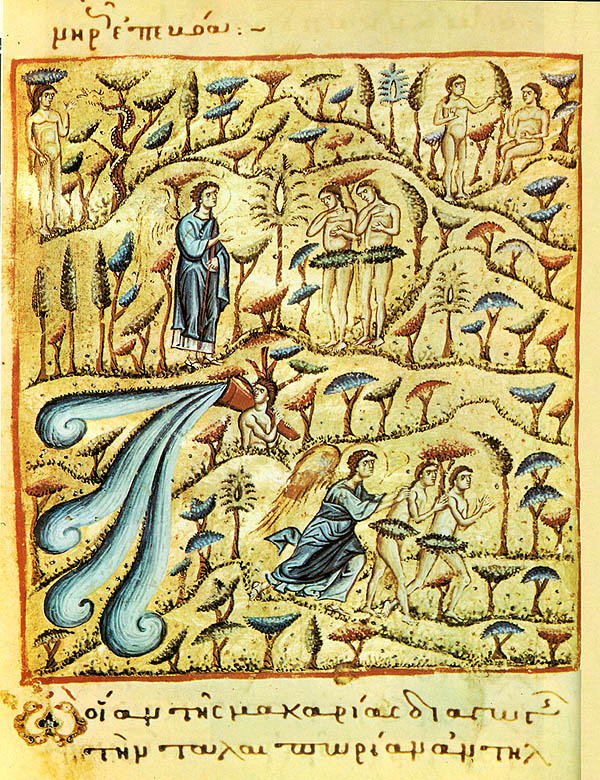
Saint Paul the humble, whose memory our church honoring, once stayed in front of the church gate of a monastery and was watching the state of the monks' souls, since he had a discerning gift from God. The monks who entered the church had a very nice and pleasant look, and each of them was accompanied by his happy-looking Angel. The Holy Father glorified God for what he had seen. But at a certain time, he saw a monk with a dark look, accompanied by many demons and his Angel at a distance looking gloomy and anxious. When Paul saw this, he started crying and did not want to leave his position so as not to miss watching that monk again during his exit from the church. After the Divine Liturgy, while the monks were leaving the church, he watched that monk again, but this time his face was shining and was all white, gleaming like light and close to him his Angel was following happily whereas the gloomy looking demons were in distance.
My beloved spiritual children in Christ Our Only True God and Our Only True Savior,
CHRIST IS IN OUR MIDST! HE WAS, IS, AND EVER SHALL BE.
+++
THE POWER OF REPENTANCE
Saint Paul the humble, whose memory our church honoring, once stayed in front of the church gate of a monastery and was watching the state of the monks' souls, since he had a discerning gift from God. The monks who entered the church had a very nice and pleasant look, and each of them was accompanied by his happy-looking Angel. The Holy Father glorified God for what he had seen. But at a certain time, he saw a monk with a dark look, accompanied by many demons and his Angel at a distance looking gloomy and anxious. When Paul saw this, he started crying and did not want to leave his position so as not to miss watching that monk again during his exit from the church. After the Divine Liturgy, while the monks were leaving the church, he watched that monk again, but this time his face was shining and was all white, gleaming like light and close to him his Angel was following happily whereas the gloomy looking demons were in distance.
When Paul saw this, rose up from his position and glorified God. He stood at a higher place and narrated the miraculous things he had seen. Everybody kept asking the monk what had happened to him. He said out of extreme humility; "I am a sinful man but sin has not left me yet. When I entered the church, I listened to the words of Prophet Isaiah, which are God's words; "Wash and make yourselves clean. Take your evil deeds out of my sight! Stop doing wrong, learn to do right! Seek justice, encourage the oppressed. Defend the cause of the fatherless, plead the case of the widow. Come now, let us reason together", says the Lord. Though your sins are like scarlet, they will be as white as snow. If you are willing and obedient, you will eat the best from the land."
"When I heard this, I came to, I felt pain in my heart, I cried and sighed; "My Lord God, Who came to this world to save the sinners, please bestow on me, who is a sinner and an unworthy man, all the things you promised through your Prophet. I promise you that from this very moment I give up every lawlessness and sin which I have committed until now and from now on I will never sin again with Your help". When I finished my prayer I went out and decided to do all the things I had promised to the Lord". When the fathers heard these words, they glorified God for His great philanthropy and extreme condensation, since the power and the consequences of the sinner's repentance was obvious. (From the book of Evergetinos). Orthodox Kypseli Publication
_____________________
"Glory Be To GOD For All Things!" -- Saint John Chrysostomos
+++
With sincere agape in His Holy Diakonia (Ministry),
The sinner and unworthy servant of God
+Father George