
Clean Thursday: Holy and Great Lent
Canticle Eight
Let us abstain from every pleasure; through fasting let us enrich our powers of perception, and gladly let us drink the cup of compunction, as we sing: O ye works of the Lord, bless ye the Lord.
Cleansed by the Fast, let us go up into the chariot of the divine virtues, and let us make our mind ascend on wings to the height of heaven, as we sing: O ye works of the Lord, bless ye the Lord.
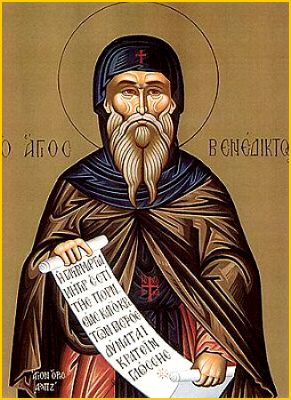
Venerable Benedict of Nursia
My beloved spiritual children in Christ Our Only True God and Our Only True Savior,
CHRIST IS IN OUR MIDST! HE WAS, IS, AND EVER SHALL BE.
+++
CLEAN THURSDAY: HOLY AND GREAT LENT
Thursday in the First Week of Lent
Canticle Eight
Let us abstain from every pleasure; through fasting let us enrich our powers of perception, and gladly let us drink the cup of compunction, as we sing: O ye works of the Lord, bless ye the Lord.
Cleansed by the Fast, let us go up into the chariot of the divine virtues, and let us make our mind ascend on wings to the height of heaven, as we sing: O ye works of the Lord, bless ye the Lord.
______________________
ON STILLNESS (Step 27)
By Saint John Climacus
We are like purchased, like servants under contract to the unholy passions. And because this is so, we know a little of their deceits, ways, impositions, and wiles. We know of their evil disposition in our wretched souls. But there are others who fully understand the tricks of these spirits, and they do so because of the working of the Holy Spirit and because of the freedom they themselves have managed to achieve. We in our sickness can only imagine the sort of relief that would come with good health; but they, being healthy, can understand and talk about the weakness that goes hand in hand with sickness.
Stillness of the body is the accurate knowledge and management of one's feelings and perceptions. Stillness of soul is the accurate knowledge of one's thoughts and is an unassailable mind.
Brave and determined thinking is a friend of stillness. It is always on the watch at the doors of the heart, killing or driving off invading notions. What I mean by this will be well understood by the man who practices stillness in the deep places of the heart, while the novice will have no experience or knowledge of it.
A shrewd Hesychast requires no words. He is enlightened by deeds rather than by words.
The start of stillness is the rejection of all noisiness as something that will trouble the depths of the soul. The final point is when one has no longer a fear of noisy disturbance when one is immune to it. He who when he goes out does not go out in his intellect is gentle and wholly a house of love rarely moved to speech and never to anger. The opposite to all this is manifest. (Source: The Ladder of Divine Ascent)
_____________________
NOT BY BREAD ALONE: FASTING TODAY IN THE ORTHODOX CHRISTIAN WAY
By Father Peter A. Chamberas
The venerable and sacred discipline of fasting began in the Old Testament (OT), continued into the New Testament (NT), was developed by the early Church into a highly refined spiritual art and remains to this day an integral element in the spiritual life of Orthodox Christians. Although Western Christianity (Roman Catholicism and Protestantism) has over the centuries downgraded the ascetic spirit of the early Church, even to the point of rejecting fasting altogether, the Orthodox Church continues to uphold this Sacred Tradition with great reverence, even when many of her members do not practice this discipline today. The present neglect and misunderstanding over fasting should not be a surprise to anyone, simply because this sacred discipline was always a challenge from the very beginning, requiring constant clarification and reaffirmation throughout its long history, in order to be properly understood and practiced as an essential and important element in a godly way of life. Fasting is, of course about food and what we choose to put into our mouth by way of nourishment for our physical health and well-being, but it is not only about food; it is also about practicing discipline and self-control. Fasting can never be only about physical and natural food; it must always be about that other food of God, the "spiritual" food that sustains our spiritual nature. Fasting then is inseparable from prayer and repentance, obedience to and communion with God. In times past, believers took fasting for granted and generally knew when, how and why they were fasting. Today, as with other aspects of the Sacred (Holy) Tradition of the Orthodox Christian Church, fasting requires some clarification and reaffirmation. By drawing from the Sacred Tradition of the Orthodox Church, this article will attempt to highlight the true nature of fasting and show how it can be practiced today in the Orthodox Christian way unto the glory of God and our spiritual edification.
(To be continued)
______________________
"Glory Be To GOD For All Things!" -- Saint John Chrysostomos
+++
With sincere agape in His Holy Diakonia (Ministry),
The sinner and unworthy servant of God
+Father George
Clean Wednesday: Great Compline
Kontakion Hymn
My soul, O my soul, rise up! Why art thou sleeping? The end draws near, and soon thou shalt be troubled. Watch, then, that Christ Our God may spare thee, for He is everywhere present and fills all things.

My beloved spiritual children in Christ Our Only True God and Our Only True Savior,
CHRIST IS IN OUR MIDST! HE WAS, IS, AND EVER SHALL BE.
+++
CLEAN WEDNESDAY: GREAT COMPLINE
Kontakion Hymn
My soul, O my soul, rise up! Why art thou sleeping? The end draws near, and soon thou shalt be troubled. Watch, then, that Christ Our God may spare thee, for He is everywhere present and fills all things.
Cantile Nine
Healing sickness, Christ the Logos/Word preached the good tidings to the poor. He cured the crippled, ate with publicans, and conversed with sinners. With the touch of His hand, He brought back the departed soul of Jairus' daughter.
The Publican was saved and the Harlot turned to chastity, but the Pharisee with his boasting was condemned. For the first cried 'Be merciful', and the second, 'Have mercy on me'; but the third said, boasting, 'I thank Thee, O God', and other words of madness.
_______________________
ON ALERTNESS (Step 20)
By Saint John Climacus
Some stand weaponless and without armor before the kings of the earth, while others hold insignia of office, shields, and swords. The former are vastly superior to the latter since they are regularly the personal relations of the king and members of the royal household.
Let us see now what happens when we stand in prayer during the evening or throughout the day and night before God our King. Some keep nightlong vigil, their hands raised in prayer like spirits free of every burden. Others sing the psalms or read, while some, out of weakness, bravely fight sleep by working with their hands. Others think constantly of death and try in this way to obtain a contrite heart. Of all these types, the first and the last persevere in nightlong vigil out of love for God, the second do what is appropriate for a monk, and the third travel the lowliest road. Still, God accepts and judges the offerings of each type in accordance with their intentions and their abilities.
Alertness keeps the mind clean. Somnolence binds the soul. The alert monk battle with fornication, but the sleepy one goes to live with it. Alertness is a quenching of lust, deliverance from fantasies in dreams, a tearful eye, a heart made soft and gentle, thoughts restrained, food digested, passions tamed, spirits subdued, tongue controlled, idle imaginings banished.
The vigilant monk is a fisher of thoughts, and in the quiet of the night he can easily observe and catch them. (Source: The Ladder of Divine Ascent)
_______________________
"Glory Be To GOD For All Things!" - Saint John Chrysostomos
+++
With sincere agape in His Holy Diakonia (Ministry),
The sinner and unworthy servant of God
+Father George
Liturgy of the PreSanctified Gifts and the Reception of Holy Communion on Wednesdays and Fridays
Holy and Great Lent is a season of repentance, fasting, and intensified prayer, and therefore the Orthodox Christian Church encourages its believers to receive Holy Communion more frequently. However, the Divine Liturgy has a joyful character not keeping with the season. Therefore, the Presanctified Liturgy is celebrated instead; the Divine Liturgy is only performed on Saturdays and Sundays. Although it is possible to celebrate this divine service on any weekday of Great Lent, the service is prescribed to be celebrated only on Wednesdays and Fridays of Holy Lent.

My beloved spiritual children in Christ Our Only True God and Our Only True Savior,
CHRIST IS IN OUR MIDST! HE WAS, IS, AND EVER SHALL BE.
+
LITURGY OF THE PRESANCTIFIED GIFTS AND THE RECEPTION OF HOLY COMMUNION ON WEDNESDAY AND FRIDAY OF GREAT LENT
Holy and Great Lent is a season of repentance, fasting, and intensified prayer, and therefore the Orthodox Christian Church encourages its believers to receive Holy Communion more frequently. However, the Divine Liturgy has a joyful character not keeping with the season. Therefore, the Presanctified Liturgy is celebrated instead; the Divine Liturgy is only performed on Saturdays and Sundays. Although it is possible to celebrate this divine service on any weekday of Great Lent, the service is prescribed to be celebrated only on Wednesdays and Fridays of Holy Lent.
The service is an ancient one in the Orthodox Church. We officially hear about it in the Holy Canons of the 7th century, which obviously indicates its development at a much earlier date.
"On all days of the Holy Fast of Lent, except on the Sabbath, the Lord's Day, and the holy day of the Annunciation, the Liturgy of the Presanctified is to be served" (Canon 52, Quinisext, 692).
How should an Orthodox Christian believer prepare to receive Holy Communion on Wednesdays and Fridays of Great Lent?
The Liturgy of the Presanctified Gifts is offered on Wednesday and Friday evenings. It comes in the evening after a day of spiritual preparation and abstinence. The proper preparation and proper fast is total fasting on those two evenings. However, Orthodox Christians who are unable to make the effort of total fasting due to the demands of their work during the day, they normally eat a light Lenten meal in the early morning. Many Orthodox Christians fast sometimes from midnight and sometimes the entire workday, not eating anything after the morning meal until they break the fast with Holy Communion at this evening divine service.
The life of an Orthodox Christian goes on from Holy Eucharist to Holy Eucharist. The special feature of the Liturgy of the Presanctified Gifts is that it is celebrated in the evening in connection with Vespers (Esperinos). The early Christians preparing to receive Holy Communion at the Liturgy of the Presanctified fasted the whole day from morning till evening. "The evening reception of Holy Communion at the Liturgy of the Presanctified Gifts is fulfilled after a day of prayer and fasting, with the total abstinence from food and drink at least from the early morning hours of the day. Some consider the taking of even light, Lenten food on the morning of the Presanctified Liturgy as a "lessening" of discipline. Those who have fasted a whole working day in preparation for the evening participation in the Holy Sacrament, however, know the great difficulty of the effort, as well as the very special fruits which it brings from God." Today complete fasting is prescribed starting from noon so that after twelve o'clock we have nothing to eat or drink until after the evening Liturgy. Another current practice is to abstain from food and drink at least six hours prior to receiving Communion. These evening liturgies renew the early Christian practice of receiving Holy Communion in the evening which is indicated by the name "Lord's Supper."
Part of the purpose of having days and seasons of fasting is to exercise the Spiritual fruit and virtue of moderation and temperance, and so to avoid the sins of drunkenness and gluttony. Moderate consumption of alcohol is allowed on many days throughout the year, but more than that is drunkenness which is wrong and unhealthy both spiritually and physically, and worse yet if this is not a one-time occurrence but becomes frequent. Likewise, eating or drinking (non-alcoholic beverages such as soda, caffeine, etc.) to fullness on non-fasting days is one thing, but to overeat or over drink, especially if repeatedly, is gluttony.
No one today suffers because of his/her fasting because very few follow the fasting discipline of the Church. How many people do you know that fast strictly throughout Great Lent? How many Orthodox Christians abstain from foods and drink even during Holy and Great Week? The unfortunate fact is that the practice of fasting has been diluted or water-down by most of our fellow Orthodox believers. If you truly desire to keep our holy Orthodox tradition you must be willing to make a personal decision and to do it with understanding and the right spirit otherwise it has no value at all.
Please remember the Divine words of our Lord and Savior Jesus Christ, "However, this kind does not go out except by prayer and fasting" (St. Matthew 17:21). Jesus fasted for 40 days and nights and so did Moses. All the righteous and holy men and women of God lived an ascetic life and always concentrated on prayer and fasting.
_____________________
With sincere agape in Christ God,
+Father George
Clean Tuesday: Holy and Great Canon of Saint Andrew of Crete
Most blessed is the grace of the Holy Fast. For through fasting Moses was glorified, and he received the Law written upon tablets; and through fasting, then, let us quench the burning passions of the flesh, and let us cry to Christ the Savior: Grant conversion to us all and deliver us from Gehenna.

My beloved spiritual children in Christ Our Only True God and Our Only True Savior,
CHRIST IS IN OUR MIDST! HE WAS, IS, AND EVER SHALL BE.
+++
CLEAN TUESDAY: GREAT AND HOLY LENT GREAT CANON OF SAINT ANDREW OF CRETE
Orthros (Matins)
Sessional hymns: Tone Two
Most blessed is the grace of the Holy Fast. For through fasting Moses was glorified, and he received the Law written upon tablets; and through fasting, then, let us quench the burning passions of the flesh, and let us cry to Christ the Savior: Grant conversion to us all and deliver us from Gehenna.
+
The season of repentance is at hand: O my soul, show fruits of abstinence. Consider those who repented in the past, and cry aloud to Christ: I have sinned, O save me, Loving Master, as Thou has saved the Publican who sighed with sorrow from his heart, for Thou alone art rich in mercy.
Theotokion
Fervent Advocate of Christians, ever entreat thy Son, O Theotokos, to deliver us from all the malice and cunning of the enemy, and to grant us in His tender mercy the forgiveness of our sins, at thine intercessions, O Mother and Virgin.
Tone Five
As we begin the second day of saving abstinence, we cry to Thee, O Lord: Pierce the hearts of us Thy servants with compunction and accept the prayers we offer Thee in fear. Grant us without stumbling to complete the course of the Fast, and bestow upon us cleansing and great mercy.
____________________
Step 18
On Sensitivity
By Saint John Climacus
Insensitivity is deadened feeling in body and spirit and comes from long sickness and carelessness. Lack of awareness is negligence that has become a habit. It is thought gone numb, an offspring of pre-disposition, a trap for zeal, a noose for courage, an ignorance of compunction, the gateway to despair, the mother of forgetfulness giving birth to loss of fear of God and, in turn, to a deadened spirit, like a daughter bearing her own mother.
The insensitive man is a foolish philosopher, an exegete condemned by his own words, a scholar who contradicts himself, a blind man teaching sight to others. He talks about healing a wound and does not stop making it worse. He complains about what has happened and does not stop eating what is harmful. He prays against it but carries on as before, doing it and being angry with himself. And the wretched man is in no way shamed by his own words. "I'm doing wrong," he cries, and zealously continues to do so. His lips pray against it and his body struggles for it. He talks profoundly about death and acts as if he will never die. He groans over the separation of soul and body, and yet lives in a state of somnolence as if he were eternal. He reads about the judgment and begins to smile, about vainglory and is vainglorious while he is reading. He recites what he has learned about keeping vigil, and at once drops off in sleep. Prayer he extols and runs from it as if from a plague. Blessings he showers on obedience and is the first to disobey. Detachment he praises, and he shamelessly fights over a rag...He looks people in the eye with passion and talks about chastity. Out in the world, he is full of praise for the solitary life and cannot see how much he is disgracing himself. He glorifies almsgivers and despises the poor. In everything, he shows himself up for what he is and does not come to his senses, though I would not say he was incapable of doing so. (Source: The Ladder of Divine Ascent)
_____________________
"Glory Be To GOD For All Things!" -- Saint John Chrysostomos
+++
With sincere agape in His Holy Diakonia (Ministry),
The sinner and unworthy servant of God
+Father George
First Week of Holy and Great Lent: The Great Canon of Saint Andrew of Crete
Born in Damascus of Christian parents, he was dumb until the age of seven. When his parents took him to church for Holy Communion and upon receiving the Mysterion (Sacrament) of Holy Communion he was able to speak. Such is the Divine power of Holy Communion.

My beloved spiritual children in Christ Our Only True God and Our Only True Savior,
CHRIST IS IN OUR MIDST! HE WAS, IS, AND EVER SHALL BE.
+++
FIRST WEEK OF HOLY AND GREAT LENT: The Great Canon of Saint Andrew of Crete
SAINT ANDREW, ARCHBISHOP OF CRETE (Commemorated on July 4th)
Born in Damascus of Christian parents, he was dumb until the age of seven. When his parents took him to church for Holy Communion and upon receiving the Mysterion (Sacrament) of Holy Communion he was able to speak. Such is the Divine power of Holy Communion.
He went to the holy city of Jerusalem at the age of 14 and was tonsured in the Monastery of Saint Sava the Sanctified. In his understanding he surpassed many of the older monks and was an example to all. The Patriarch took him as his secretary.
When the Monothelite heresy, which taught that the Lord had no human will but only a Divine one, began to rage, the Sixth Ecumenical Council met in Constantinople in 681 A.D., in the reign of Constantine Iv. Theodore, Patriarch of Jerusalem, was not able to be present at the Council and sent Andrew, then a Deacon, as his representative. At the Council, Andrew showed his great gifts: his articulateness, his zeal for Christ and Church, his rare prudence. Being instrumental in confirming the Orthodox Christian faith, Andrew returned to his work in Jerusalem.
He was later chosen as Archibishop of the Greek island of Crete. As Archbishop, he was greatly beloved by the people. His zeal for Orthodoxy and strongly withstood all heresy. He worked miracles through his prayers, driving the Saracens from the island by his prayers. He wrote many learned books, poems and canons, of which the best-known is the Great Canon of Repentance said in full on the Thursday of the Fifth Week of the Great Fast.
Such was his outward appearance that, 'looking at his face and listening to the words that flowed like honey from his lips." Returning from Constantinople on one occasion, he foretold of his death before reaching Crete. And so it happened as the boat approached the island of Mitylene, this light of the Church finished his earthly course and his soul went to the Kingdom of Christ in the year 740.
____________
THE GREAT CANON
The Great Canon of Saint Andrew, bishop of Crete, is the longest Canon in all of our divine services, and is associated with Great Lent and it is appointed to be read in church are the first four nights of Great Lent [Clean Monday through Clean Thursday, and at Orthros (Matins) for Thursday of the Fifth Week of Great Lent, when it is read in its entirety (in this latter the life of Saint Mary of Egypt is also read)].
The First Week of Great Lent has been known since times of old as the "dawn of abstinence," or "clean week." During that week, the Church persuades her children to come out of that sinful state into which all of mankind fell because our Forefathers did not abstain, because they lost the blessings of heaven, the state of sin which each of us increases by his personal sins. It coaxes them into coming forth by way of faith, prayer, humility and fasting, things, which are pleasing to God. This is the time for repentance, says the Church "Behold the days of salvation, the entrance to the fast. O my soul, be watchful, close all the doors through which the passions enter, and look up towards the Lord." (From the first canticle of the Triodion Canon at Orthros (Matins) on Monday of the First Week of Great Lent).
The Old Testament Church, which held especially sacred the first and the last days of several great feasts. Likewise, according to the ustav, Orthodox Christians, prepared and inspired by the maternal instructions offered by their Church from antiquity, observe the first and last weeks of Great Lent especially strictly and assiduously.
The services of the First Week are especially lengthy, and the askesis of physical abstinence during that week is considerably more rigorous than in the subsequent days of Great Lent. Over the course of the first four days of Great Lent, Great Compline (Mega Apotheipnon) is served, with the reading of the Great Penitential Canon of Saint Andrew of Crete, which as it were sets the tone which is to resound throughout Great Lent. During the first week of Great Lent, the Canon is divided into four separate parts, one chanted at each Compline. On Thursday (actually Wednesday evening of the Fifth Week of Great Lent, our attention is again directed to Saint Andrew's marvelous composition, this time in its entirety, so that with the conclusion of Great Lent is sight, we might not become lackadaisical, careless, and negligent, so that we might not forget ourselves and stop strictly watching over ourselves in everything.
The refrain "have mercy upon me O Lord, have mercy upon me" accompanies each verse of the Great Canon. Several troparia (hymns) in honor of Saint Andrew, composer of the Canon, and to Saint Mary of Egypt are also included. The Church of Jerusalem implemented this practice during Saint Andrew's lifetime.
The Great Canon is more astonishing than any other liturgical text encountered during Great Lent. It is a marvel of liturgical hymnography, with texts of amazing power and poetic beauty. The Church decided to call it the Great Canon not so much for its length (250 Troparia, or verses), as for the quality and power of its content. Saint Andrew, Archbishop of Crete, who composed the Canon in the 7th Century, also composed many other canons used by the Church over the course of the liturgical year.
_________________________
"Glory Be To GOD For All Things!"--Saint John Chrysostomos
+++
With sincere agape in His Holy Diakonia,
The sinner and unworthy servant of God
+Father George
40 Holy Martyrs of Sevaste-March 9
In the year 313 A.D. Saint Constantine the Great issued an edict granting Christians religious freedom, and officially recognizing Christianity as equal with paganism under the law. But his co-ruler Licinius was a pagan, and he decided to stamp out Christianity in his part of the Empire. As Licinius prepared his army to fight Constantine, he decided to remove Christians from his army, fearing mutiny.

My beloved spiritual children in our Only True God and Our Only True Savior,
CHRIST IS IN OUR MIDST! HE WAS, IS, AND EVER SHALL BE.
+++
ON MARCH 9th OUR HOLY ORTHODOX CHRISTIAN CHURCH COMMEMORATES THE FEAST OF 40 HOLY MARTYRS OF SEVASTE
In the year 313 A.D. Saint Constantine the Great issued an edict granting Christians religious freedom, and officially recognizing Christianity as equal with paganism under the law. But his co-ruler Licinius was a pagan, and he decided to stamp out Christianity in his part of the Empire. As Licinius prepared his army to fight Constantine, he decided to remove Christians from his army, fearing mutiny.
One of the military commanders of that time in the Armenian city of Sevaste was Agricola, a zealous champion of idolatry. Under his command was a company of forty Cappadocians, brave soldiers who had distinguished themselves in many battles. When these Christian soldiers refused to offer sacrifice to the pagan gods, Agricola locked them up in prison. The soldiers occupied themselves with prayer and the psalmody, and during the night they heard a voice saying, "Persevere until the end, then you shall be saved."
On the following morning, the soldiers were again taken to Agricola. This time the pagan tried flattery. He began to praise their valor, their youth and strength, and once more he urged them to renounce Christ and thereby win themselves the respect and favor of their emperor.
Seven days later, the renowned judge Licius arrived at Sevaste and put the soldiers on trial. The Saints steadfastly answered, "Take not only our military insignia, but also our lives, since nothing is more precious to us than Christ God." Licius then ordered his servants to stone the holy Martyrs. But the stones missed the Saints and returned to strike those who had thrown them. One stone thrown by Licius hit Agricola in the face, smashing his teeth. The torturers realized that the Saints were guarded by some invisible power. In prison, the soldiers spent the night in prayer and again they heard the voice of the Lord comforting them: "He who believes in Me, though he die, yet shall he live" (St. John 11:25). Be brave and fear not, for you shall obtain imperishable crowns."
On the following day the judge repeated the interrogation in front of the torturer, but the soldiers remained unyielding.
It was winter, and there was a severe frost. They lined up the holy soldiers, threw them into a lake near the city, and set a guard to prevent them from coming out of the water. In order to break the will of the Martyrs, a warm bath-house was set up on the shore. During the first hour of the night, when the cold had become unbearable, one of the soldiers made a dash for the bath-house, but no sooner had he stepped over the threshold, than he fell down dead.
During the third hour of the night, the Lord sent consolation to the Martyrs. Suddenly there was light, the ice melted away, and the water in the lake became warm. All the guards were asleep, except for Aggias, who was keeping watch. Looking at the lake he saw that a radiant crown had appeared over the head of each Martyr. Aggias counted thirty-nine crowns and realized that the soldier who fled had lost his crown.
Aggias then woke up the other guards, took off his uniform and said to them, "I too am a Christian," and he joined the Martyrs. Standing in the water he prayed, "Lord God, I believe in You, in Whom these soldiers believe. Add me to their number, and make me worthy to suffer with Your servants." Then a fortieth crown appeared over his head.
In the morning, the torturers saw with surprise that the Martyrs were still alive, and their guard Aggias was glorifying Christ together with them. They led the soldiers out of the water and broke their legs. During this horrible execution the mother of the youngest of the soldiers, Meliton, pleaded with her son to persevere until death.
They put the bodies of the Martyrs on a cart and committed them to fire. Young Meliton was still breathing, and they left him on the ground. His mother then picked up her son, and on her own shoulders she carried him behind the cart. When Meliton drew his last breath, his mother put him on the cart with the bodies of his fellow sufferers. The bodies of the Saints were tossed in the fire, and their charred bones were thrown into the water, so that Christians would not gather me up.
Three days later the holy Martyrs appeared in a dream to Saint Peter, Bishop of Sevaste, and commanded him to bury their remains. The bishops together with several priests gathered up the holy relics of the glorious Martyrs by night and buried them with honor. (Source: Orthodox Church in America)
___________________________
"Glory Be To GOD For All Things!" -- Saint John Chrysostomos
+++
With sincere agape in His Holy Diakonia (Ministry),
The sinner and unworthy servant of God
+Father George