
The Entry into Holy and Great Lent
The Monday that follows Cheese-fare Sunday is the first day of Great Lent itself. We have now begun on this succession of forty days which prepare us for the time of the Passion and for the time of Pascha. But before going into the details of these weeks of Holy Lent, let us give a little time to the consideration of some of its general characteristics.

My beloved spiritual children in Christ Our Only True God and Our Only True Savior,
CHRIST IS IN OUR MIDST! HE WAS, IS, AND EVER SHALL BE.
+++
THE ENTRY INTO HOLY AND GREAT LENT
The Monday that follows Cheese-fare Sunday is the first day of Great Lent itself. We have now begun on this succession of forty days which prepare us for the time of the Passion and for the time of Pascha. But before going into the details of these weeks of Holy Lent, let us give a little time to the consideration of some of its general characteristics.
The first of these characteristics is, of course, the fast. One cannot ignore or treat the question of fasting from food lightly, and we have devoted a special note to this. The Holy Fathers of the Church and the collective conscience of the faithful have discerned clearly the spiritual value -- a value which is both penitential and purifying -- of abstention from certain foods. It would, however, be a serious mistake to think that this abstention constituted the only observance necessary to Holy Lent. Bodily fasting must be accompanied by another fast. In the first centuries, the discipline of the Church prescribed conjugal abstinence during Holy Lent; it forbade participation in feasts and attendance at public festivals. This discipline has perhaps become weakened and is not presented to believe quite as forcefully as in the times of the Holy Fathers. All the same, it remains as a precious indication of the spirit, the intention of the Church. But most surely, this intention is that during Holy Lent we exercise much stricter control over our thoughts, our words, and actions, and concentrate our attention on the Person of the Savior and what He requires of us. Almsgiving (charity) is also one of the forms of Lenten observance that the Holy Fathers recommended most highly. A fast that is pleasing to God is, therefore, a 'whole' which cannot be separated into inner and outward aspects; of the two the former is certainly the most important.
The second feature of Holy and Great Lent lies in certain characteristics of ritual, and we will now say a few words about these.
First of all, there is there the reciting of 'Great Compline' (Megan Apotheipnon). We know that the Office of Compline (that which comes after supper), is the last, of the daily offices. Ordinary Compline, or 'Little Compline', is a fairly short office. But on Mondays, Tuesdays, Wednesdays, and Thursdays of Holy and Great Lent, it is replaced by 'Great Compline', with a fairly long reading of psalms and troparia, amongst which will be noticed a long Biblical prayer: Manasseh, king of Judah's, the prayer of penitence.
Furthermore, the Divine Liturgy which is celebrated on Sundays during Holy and Great Lent is not the usual Divine Liturgy attributed to Saint John Chrysostom. It is the Divine Liturgy attributed to Saint Basil the Great, Archbishop of Caesarea, in the 4th century. This Divine Liturgy is longer than that of Saint John Chrysostom and the text is sometimes slightly different. In certain passages, it has an archaic and moving quality, for example when prayers are offered for those of our brothers who are in the house of Caesar and for those who are condemned to hard labor in the mines (here we can think of the concentration camps).
On Wednesday and Friday during Holy and Great Lent, the liturgy called the 'Presanctified' is celebrated, that is to say, the liturgy for which the Holy Gifts have been consecrated in advance. It is not a Eucharistic liturgy in the full sense, as there is no consecration. It is a Communion service in which the priest and congregation take Holy Communion with the elements which were consecrated during the previous Divine Liturgy of Saint Basil the Great or Saint John Chrysostom, and which have been reserved since then. The Liturgy of the Presanctified is added on to Vespers. That is why, in principle, it should be celebrated in the evening. It includes certain psalms, certain special Biblical readings, and certain prayers borrowed from the Divine Liturgy of Saint John Chrysostom. The latter is celebrated every Saturday morning.
On Friday evening during Holy and Great Lent the hymn called the 'Akathist' (Not sitting) is chanted. It is a long poem of praise to the Most Holy Virgin and Mother of God. It comprises twenty-four stanzas set out in alphabetical order and broken up into four portions. These portions are read one after another -- one each Friday -- during the First Four Fridays of Holy Lent. On the Fifth Friday, the Akathistos is read in its entirety.
The 'Great Canon' of Saint Andrew of Crete is read in its entirety during the evenings of the first week of Holy and Great Lent. It is an enormous composition of two hundred and fifty stanzas. These are divided up into nine series of Odes that express the longings of a guilty and penitent soul; they contrast human frailty with the goodness and mercy of God.
Finally -- and perhaps above all -- the admirable prayer attributed to Saint Ephraim the Syrian must be mentioned. In this, neither poetry nor rhetoric (which are not lacking in the compositions we have just spoken of) plays any part. We are here faced with a pure upsurge of the soul -- short, sober and full of ardor. This prayer, accompanied by prostrations (metanoias), is said for the first time on the evening of the Sunday which immediately precedes Lent (the evening service being counted as already belonging to Monday, the first day of Holy Lent). It is repeated during most of the Lenten services, especially in the Liturgy of the Presanctified. The Prayer of Saint Ephraim is widely known by Orthodox Christian believers; this is its text:
'O Lord and Master of my life, give me not a spirit of sloth, vain curiosity, lust for power, and idle talk. But give to me, Thy servant, a spirit of chastity, humility, patience, and love. O Lord and King, grant me to see my own faults and not to judge my brother (and sister); for blessed art Thou unto the ages of ages. Amen.'
This prayer sums up all that is essential in spiritual life. A Christian who used it constantly, who nourished himself from it during Holy and Great Lent, would be at the simplest and best school. Even someone who restricted himself to repeating and meditating on these words, "Lord and Master of my life", would enter deeply into the reality of the relationship between God and the soul, the soul, and its God. (Source: The Year of Grace of the Lord by a Monk of the Eastern Orthodox Church)
______________________
"Glory Be To GOD For All Things!"-- Saint John Chrysostomos
+++
With sincere agape in His Holy Diakonia,
The sinner and unworthy servant of God
+Father George
The 40 Days of Holy and Great Lent
The two preceding Sundays, of the Last Judgment and of Forgiveness, together constitute -- albeit in reverse order -- a recapitulation of the whole range of Sacred History, from its beginning-point, Adam in Paradise, to its end-point, the Second Coming of Christ, when all time and history are taken up into eternity. During the Forty Days that now follow, although this wider perspective is never forgotten, there is an increasing concentration upon the central moment in Sacred History, upon the saving event of Christ's Passion and Resurrection, which makes possible man's return to Paradise and inaugurates the End. Holy Lent is, from this point of view, a journey with a precise direction; it is the journey to Pascha.

My beloved spiritual children in Christ Our Only True God and Our Only True Savior,
CHRIST IS IN OUR MIDST! HE WAS, IS, AND EVER SHALL BE.
+++
THE 40 DAYS OF HOLY AND GREAT LENT
The two preceding Sundays, of the Last Judgment and of Forgiveness, together constitute -- albeit in reverse order -- a recapitulation of the whole range of Sacred History, from its beginning-point, Adam in Paradise, to its end-point, the Second Coming of Christ, when all time and history are taken up into eternity. During the Forty Days that now follow, although this wider perspective is never forgotten, there is an increasing concentration upon the central moment in Sacred History, upon the saving event of Christ's Passion and Resurrection, which makes possible man's return to Paradise and inaugurates the End. Holy Lent is, from this point of view, a journey with a precise direction; it is the journey to Pascha. The goal of our journey is concisely expressed in the closing prayer at the Liturgy of the Presanctified: '...may we come uncondemned to worship at the Holy Resurrection'. Throughout the Forty Days we are reminded that we are on the move, travelling on a path that leads straight to Golgotha and the Empty Tomb. So we say at the start of the first week:
'Let us set out with joy...Having sailed across the great sea of the Fast, May we reach the third-day Resurrection of Our Lord. Let us hasten to the Holy Resurrection on the third day...While our journey proceeds, as travelers we regularly call to mind how far we have progressed: As we begin the second day...Let us now set out with joy upon the second week of the Fast...As we start upon the third week of the Fast, O ye faithful, Let us glorify the Holy Trinity, And joyfully pass through the time that still remains...Weaving garlands for the queen of days -- the day, that is, of the Lord's Resurrection. So we continue; Now that we have passed beyond the middle point in the time of the Fast, Let us hasten eagerly towards our journey's end...So may we be counted worthy to venerate the Divine Passion of Christ Our God, And to attain His dread and Holy Resurrection.'
During each week of Holy Lent, Our faces set towards the objective of our journeying: the Savior's suffering and triumphant Passover.
The Forty days' journey of Holy Lent recalls in particular the forty years in which the Chosen People journeyed through the wilderness. For us, as for the children of Israel, Holy Lent is a time of pilgrimage. It is a time of liberation from the bondage of Egypt, from the domination by sinful passions; a time for progress by faith through a barren and waterless desert; a time for unexpected reassurance, when in our hunger we are fed with manna from heaven; a time when God speaks to us out of the darkness of Sinai; a time in which we draw near to the Promised Land, to our true home in Paradise whose door the crucified and Risen Christ has reopened for us. (Source: The Lenten Triodion)
(To be continued)
__________________________
"Glory Be To GOD For All Things!" - Saint John Chrysostomos
+++
With sincere agape in His Holy Diakonia (Ministry),
The sinner and unworthy servant of God
+Father George
Forgiveness (Cheesefare) Sunday
This Sunday is the Fourth of the Sundays which prepare us for Holy Lent. It ends, and is the last day of the period of preparation. From the following day, Monday, we shall be in Holy Lent itself. This Sunday itself is called 'Cheese-Fare Sunday' because, beginning with the next day, the Tradition of the Church is that we should abstain from eggs, milk, butter and cheese.

My beloved spiritual children in Christ Our Only True God and Our Only True Savior,
CHRIST IS IN OUR MIDST! HE WAS, IS, AND EVER SHALL BE.
+++
FORGIVENESS (CHEESE-FARE) SUNDAY
This Sunday is the Fourth of the Sundays which prepare us for Holy Lent. It ends, and is the last day of the period of preparation. From the following day, Monday, we shall be in Holy Lent itself. This Sunday itself is called 'Cheese-Fare Sunday' because, beginning with the next day, the Tradition of the Church is that we should abstain from eggs, milk, butter and cheese.
The Saturday preceding this Sunday is dedicated to the memory of those Saints, men and women, who have given themselves to the ascetic life. At the threshold of Holy Lent, we honor them as inspirers and intercessors in this difficult way of penitence.
The Epistle reading of Saint Paul to the Romans (13:11-14, 4), read at the Sunday Divine Liturgy, exhorts us to cast off the works of darkness and to put on the armor of light, to walk honestly as in the day, fleeing drunkenness, debauchery and the lusts of the flesh. Saint Paul links this theme of the flesh to the theme of fasting. One person believes that he may eat all things; another eats only herbs. Let not him that eats despise him who does not, and let not him who does not eat judge him who does. Who are you to judge another? Both you and he are dependent on the same Master.
The Gospel for the Divine Liturgy, taken from Saint Matthew (6:14-21), opens with the precept of forgiveness: "if you forgive men their trespasses, your Heavenly Father will also forgive you: but if you forgive not men their trespasses, neither will your Father forgive your trespasses." The fact that the Church has chosen this saying to introduce the gospel for this day shows that she intends to make forgiveness the dominant theme for this Sunday. It is true that the rest of the gospel for this day speaks of fasting; but the Greek particle which joins the verses about fasting to the verses about forgiveness seem to assign to the former a position of dependence on the latter. The Lord Jesus advises those who fast not to look gloomy like the hypocrites who want to be noticed when they fast. "Thou, when thou fastest, anoint thy head, and wash thy face." The Father, who sees in secret, shall reward thee openly. Let thy treasure and thy heart be not on earth, but in heaven.
____________________
"Glory Be To GOD For All Things!"-Saint John Chrysostomos
+++
With sincere agape in His Holy Diakonia,
The sinner and unworthy servant of God
+Father George
Spiritual Freedom or Spiritual Slavery?
"Everything is superficial. Beneath the outward appearance that is elegant and smooth is concealed an entirely different spirit, which, if it were to be brought to light, would be found to be neither elegant nor even tolerable. So, it turns out that when we gather together, we are a collection of hypocritical actors and actresses. What a comedy! Furthermore, what I find most astonishing is the coldness coming from everyone. How could this be?...Indeed, everyone seems to be everyone else's friend, ready to give them the shirt off their back, but there is an underlying coldness."
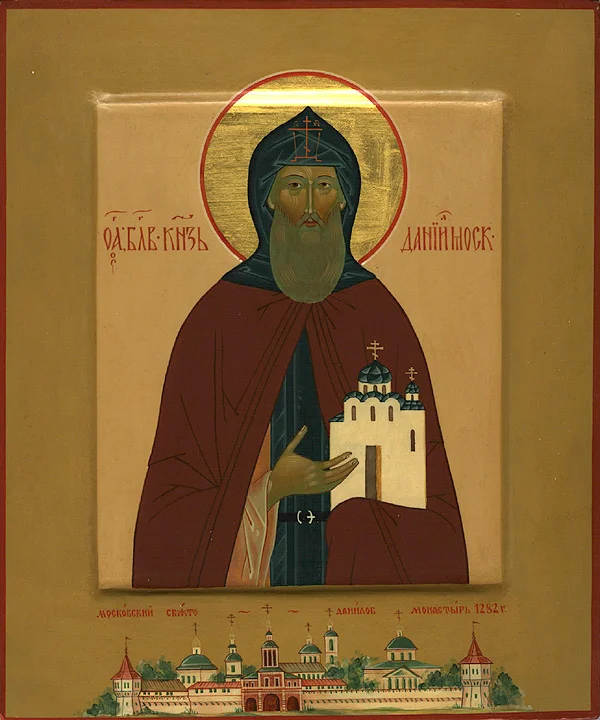
Right-believing Prince Daniel of Moscow
My beloved spiritual children in Christ Our Only True God and Our Only True Savior,
CHRIST IS IN OUR MIDST! HE WAS, IS, AND EVER SHALL BE.
+++
SPIRITUAL FREEDOM OR SPIRITUAL SLAVERY?
By Saint Theophan the Recluse, from The Spiritual Life and How to Be Attuned to It (Letter no. 4)
"Everything is superficial. Beneath the outward appearance that is elegant and smooth is concealed an entirely different spirit, which, if it were to be brought to light, would be found to be neither elegant nor even tolerable. So, it turns out that when we gather together, we are a collection of hypocritical actors and actresses. What a comedy! Furthermore, what I find most astonishing is the coldness coming from everyone. How could this be?...Indeed, everyone seems to be everyone else's friend, ready to give them the shirt off their back, but there is an underlying coldness."
You are quite right. There is nothing more to add to your description. All this has long since been observed and mentioned to forewarn us.
Long ago, Saint Makarios the Great described this bustle of life with its futile pursuit, a little of which you have experienced: "The children of this age have become like wheat poured into the sieve of this earth, and then scattered among the inconstant dreams of this world, in the presence of the unending turmoil of earthly cares, desires and maze of material concepts. Satan shakes the souls, and with the sieve, that is, the earthly cares, scatters the entire sinful human race. From the time of the Fall, when Adam transgressed the law and came under the prince of darkness who gained power over him, with the unending seductive and turbulent thoughts of all the sons of this age, he has led them to conflict in this sieve of the earth. The more the wheat in the sieve is shaken about, turned over and cast up, the more the prince of darkness takes over all people with their earthly cares: he shakes them, agitates them and alarms the, forcing them to flee to vain thoughts, unclean desires, earthly and worldly bonds, and constantly enticing the sinful race of Adam.
The Lord foretold to the Apostles the future coming of temptation over them: 'Satan hath desired to have you, that he might sift you like wheat: but I have prayed to My Father that thy faith fail not' (St. Luke 33:31-32). The pronouncement and decision spoken by the Creator to Cain is clear: 'Thou shalt be groaning and trembling on the earth' (Genesis 4:12).
This sentence serves as a secret image and likeness to all sinners, because Adam's race, having transgressed the commandment and fallen into sin, secretly took upon itself these likenesses. People are led into uncertainty by inconstant thoughts of fear, terror, every kind of confusion, desire, and all kinds of pleasures. The prince of this world disturbs every soul which is not born from God, and he disturbs human ideas, which are like wheat constantly being shaken in the sieve, leading everyone into uncertainty, and ensnaring them with worldly seductions, pleasures of the flesh, terrors and confusion." (Homily 5:1-2).
"...refuse as much as possible to enter into this circle of worldly life. When it does pull you against your will, act as if you were not there; look, but do not see; listen, but do not hear. Let what you see pass by your eyes, and what you hear pass by your ears. Outwardly behave like everyone else, be straightforward and sincere; but guard your heart from sympathies and attractions.
As for the other aspects of worldly life which you noted, I would just say that it cannot be any other way. For such as life is the life of the fallen man, whose primary characteristic is pride and egoism, which presents itself as the primary goal, while everyone and everything else are the means. Thus, everyone's goal is to impose his desires on someone else, or to bind him by them; you have quite accurately called this "tyranny." No matter how well someone conceals his desires, behind them stands egoism, which desires to twist you to its needs, or to use you as it means. So the goal is one of deception; essentially, it uses the strained contrivance of concealing one's faults without correcting them. Otherwise, one's influence on others and manipulation of them would be stopped. That is the reason that everyone exudes such coldness: everyone shuts himself u in his own shell and is unable to produce any warmth...
The main thing is to guard the heart, then you will be there in body only, but not in soul, faithfully carrying out the commandment of the Apostle: "Be as...they that use this world, (but) don't abuse it" (I Corinthians 7:31). "World" here refers to worldly life. You will be using the world, that is, you will have a need to come into contact with worldly life; but when you keep your heart at a distance, then you will not be abusing that life; that is, you will not be participating in it out of sympathy and desire, but out of being obliged by your present circumstances.
I have worn you out by my long letter, but you compelled me to do it. I ask that you carefully peruse what I have written, especially the last lines." (Source: Orthodox Heritage)
_______________________
"Glory Be To GOD For All Things!" -- Saint John Chrysostomos
+++
With sincere agape in His Holy Diakonia,
The sinner and unworthy servant of God
+Father George
"When the Son of Man Shall Come in His Glory..." (Meatfare Sunday)
This Sunday is called 'Meat-fare Sunday' because it is the last day on which the consumption of meat is authorized. From the next day, Monday, one should, if one can, abstain from meat until Pascha. On the other hand, the use of milk, butter, and cheese are allowed during all the days of this week, including Wednesday and Friday.
My beloved brothers and sisters in Christ Our Only True God and Our Only True Savior,
CHRIST IS IN OUR MIDST! HE WAS, IS, AND EVER SHALL BE.
+++
"WHEN THE SON OF MAN SHALL COME IN HIS GLORY." (Meat-fare Sunday)
This Sunday is called 'Meat-fare Sunday' because it is the last day on which the consumption of meat is authorized. From the next day, Monday, one should, if one can, abstain from meat until Pascha. On the other hand, the use of milk, butter, and cheese are allowed during all the days of this week, including Wednesday and Friday. During the liturgy a portion of the First Epistle of Saint Paul to the Corinthians (8:8-13 and 9:1-2) is read in which the holy Apostle, in substance, says the following: "Eating or not eating meat in itself is not a matter of importance, but his liberty which we have must not scandalize or be a stumbling-block to the weak. A man who believes in the only God and does not believe in the reality of idols may, with a clear conscience, eat the flesh of beasts sacrificed to idols; but, if one of his brothers is less enlightened and thinks that this means some sort of association with the worship of idols, then he should abstain from doing this, and respect the conscience of those brothers for whom too, Christ died." And so, if we are inspired by Saint Paul's idea, someone who feels he has valid reasons for not fasting, or for modified fasting during Lent, will, all the same, be careful to avoid anything that might scandalize or offend the conscience of those who are less strong.
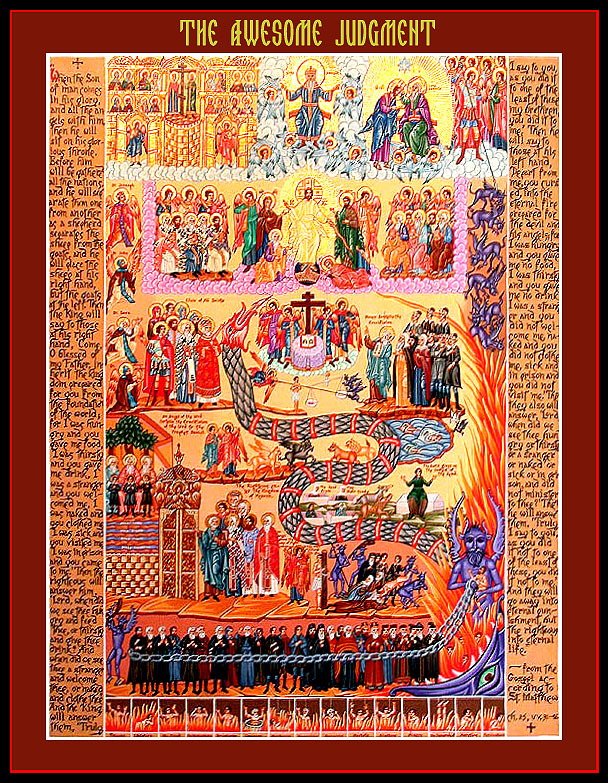
The Gospel for the Divine Liturgy (St. Matthew 25:31-46) describes the Last Judgment. "When the Son of Man Shall Come in His Glory"…with all the holy Angels, all the nations will be gathered before His Throne. He will separate the sheep from the goats, setting the righteous on His right and the sinners on His left. He will invite those who have fed, clothed and visited him in his human guise of the poor, the prisoners and the sick, to enter the Kingdom of the Father. He will exclude from the Kingdom those who have acted otherwise. This description of the judgment obviously is partly symbolic. We pass judgment on ourselves when, voluntarily, we adhere to God or reject Him. It is our love or our lack of love which will place us amongst the 'blessed' or amongst those who are dismissed (or perhaps deferred). Even if we do not have to interpret the details or the judgment literally, exactly as the Evangelist describes them, we must listen very carefully to what the Savior says about His presence in those who suffer, for it is in them alone that we are in way able to help the Lord Jesus.
The prayers at Vespers (Esperinos) this Saturday evening and at Orthros (Matins) for the Sunday give a general impression of terror in the face of God's judgment. There is mention of open books, of fearful Angels, of rivers of fire and of trembling before the altar. All this is very sound, and many sayings in the Gospels urge us to be converted (to change our ways) before it is too late. But his shadowed side, the darkness into which a stubborn sinner can choose to throw himself, must not make us forget the side of Light and Hope. Here is a phrase from one of the chants at Vespers in which these two aspects find themselves well united:
"O my soul, the time is near at hand; make haste before it is too late, and cry aloud in faith; I have sinned, O Lord, I have sinned against Thee; but I know Thy love for man and Thy compassion, O, Good Shepherd..."
+
"Repentance signifies the renewal of Holy Baptism. Repentance is a new agreement with the Lord for a New Life. Repentance is the daughter of hope and the renunciation of despair. It is reconciliation with God by deeds (works) of virtue (mercy) in opposition to our sins. Repentance means a purification of our conscience" Saint John Climacus. [Ladder of Divine Ascent, Homily 5,2].
__________________________
"Glory Be To GOD For All Things!"- Saint John Chrysostomos
+++
With sincere agape in His Holy Diakonia (Ministry),
The sinner and unworthy servant of God
+Father George
The Sunday of the Last Judgment
The two past Sundays spoke to us of God's patience and limitless compassion, of His readiness to accept every sinner who returns to Him. On this third Sunday, we are powerfully reminded of a complementary truth: no one is so patient and so merciful as God, but even He does not forgive those who do not repent. The God of agape (love) is also a God of righteousness, and when Christ comes again in glory, He will come as our judge. 'Behold the goodness and severity of God' (Romans 11:22). Such is the message of holy Lent to each of us: turn back while there is still time, repent before the end comes. In the words of the Great Canon:
My beloved spiritual children in Christ Our Only True God and Our Only True Savior,
CHRIST IS IN OUR MIDST! HE WAS, IS, AND EVER SHALL BE.
+++
THE SUNDAY OF THE LAST JUDGMENT (Gospel reading: St. Matthew 25:31-46)
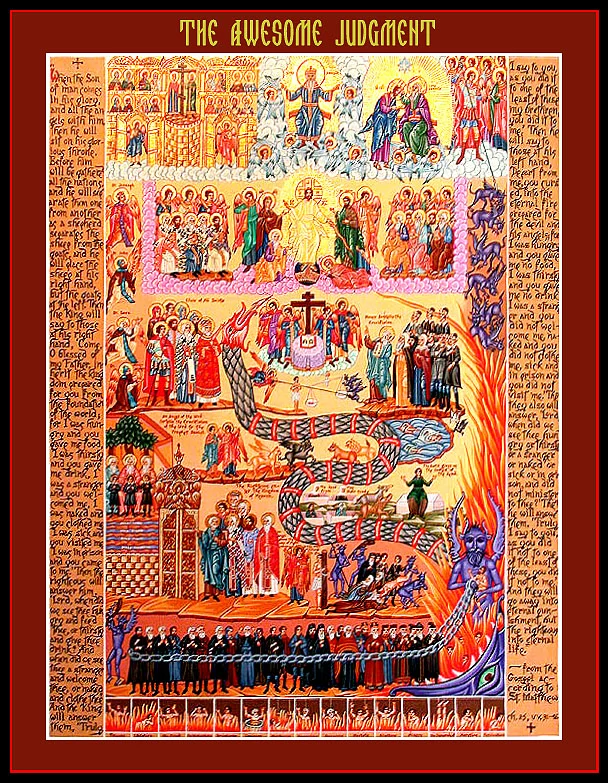
The two past Sundays spoke to us of God's patience and limitless compassion, of His readiness to accept every sinner who returns to Him. On this third Sunday, we are powerfully reminded of a complementary truth: no one is so patient and so merciful as God, but even He does not forgive those who do not repent. The God of agape (love) is also a God of righteousness, and when Christ comes again in glory, He will come as our judge. 'Behold the goodness and severity of God' (Romans 11:22). Such is the message of holy Lent to each of us: turn back while there is still time, repent before the end comes. In the words of the Great Canon:
"The end draws near, my soul, the end draws near; Yet thou dost not care or make ready. The time grows short, rise up: the Judge is at the door. The days of our life pass swiftly, as a dream, as a flower."
This Sunday sets before us the 'eschatological' dimension of holy Lent: the Great Fast is a preparation for the Second Coming of the Savior, for the Eternal Passover (Pascha) in the Age to Come. (This is a theme that will be taken up in the first three days of Holy and Great Week.) Nor is the judgment merely in the future. Here and now, each day and each hour, in hardening our hearts towards others and in failing to respond to the opportunities we are given of helping them, we are already passing judgment on ourselves. (Source: The Lenten Triodion)
________________________
SAINT JOHN CLIMACUS ON OBEDIENCE
"Obedience is a total renunciation of our own life, and it shows up clearly in the way we act. Or, again, obedience is the mortification of the members while the mind remains alive. Obedience is unquestioned movement, death freely accepted, a simple life, danger faced without worry, an unprepared defense before God, fearlessness before death, a safe voyage, a sleeper's journey. Obedience is the burial place of the will and the resurrection of lowliness. A corpse does not contradict or debate the good or whatever seems bad, and the spiritual father who has devoutly put the disciple's soul to death will answer for everything. Indeed, to obey is, with all deliberateness, to put aside the capacity to make one's own judgment.
The beginning of the mortification both of the soul's will and also of the body's members is hard. The halfway stage is sometimes difficult, sometimes not. But the end is liberation from the senses and freedom from pain…He who is submissive is passing sentence on himself. If his obedience for the Lord's sake is perfect, even when it does not appear to be so, he will escape judgment. But if in some things he follows his own will, then even though he thinks of himself as obedient, he takes the burden onto his own self. If the superior continues to rebuke him, then that is good; but if he gives up, I do not know what to say.
Those who submit to the Lord with a simple heart will run the good race. If they keep their minds on a leash they will not draw the wickedness of demons onto themselves."
+
ON PENITENCE
"Repentance is the renewal of baptism and is a contract with God for a fresh start in life. Repentance goes shopping for humility and is ever distrustful of bodily comfort. Repentance is critical awareness and a sure watch over oneself. Repentance is the daughter of hope and the refusal to despair. The penitent stands guilty--but undisgraced. Repentance is reconciliation with the Lord by the performance of good deeds which are the opposites of the sins. It is the purification of the conscience and the voluntary endurance of affliction. The penitent deals out his own punishment, for repentance, is the fierce persecution of the stomach and the flogging of the soul into intense awareness."
+
ON TALKATIVENESS AND SILENCE
"The time has come now to indicate the cause of this vice and to give an adequate account of the door by which it enters--or, more accurately, by which it goes out.
Talkativeness is the throne of vainglory on which it loves to preen itself and show off. Talkativeness is a sign of ignorance, a doorway to slander, a leader of jesting, a servant of lies, the ruins of compunction, a summoner of despondency, a messenger of sleep, a dissipation of recollection, the end of vigilance, the cooling of zeal, the darkening of prayer.
Intelligent silence is the mother of prayer, freedom form bondage, custodian of zeal, a guard on our thoughts, a watch on our enemies, a prison of mourning, a friend of tears, a sure recollection of death...
The lover of silence draws close to God. He talks to Him in secret and God enlightens him. Jesus, by His silence, shamed Pilate; and a man, by his stillness, conquers vainglory. Peter wept bitterly for what he had said. He had forgotten the one who declared: "I said: I will guard my ways so that I may not sin with my tongue" (Psalm 18:1). He had forgotten too, the saying, "Better to fall from a height to the ground than to slip with the tongue" (Ecclus 20:18). [Source: John Climacus. The Ladder of Divine Ascent]
_________________________
"Glory Be To GOD For All Things!" -- Saint John Chrysostomos
+++
With sincere agape in His Holy Diakonia,
The sinner and unworthy servant of God
+Father George