
The Mystery (Sacrament) of Marriage
The family, as is well known, comprises the fundamental cell of the organism of society, being the nucleus and foundation of society. Thus also in the Militant (the Church on earth) of Christ, it is a basic unity of the Church body. Therefore the Christian family in itself is called in the writings of the holy Apostles a "church": "Greet Priscilla and Aquila, my helpers in Christ Jesus... and the church that is in their house" (Romans 16:3, 5); Salute...Nymphas and the church which is in his house" (Col. 4:15). From this, it is understandable what great attention should be given to the family from the point of view of the Church so that the family might fulfill its purpose of being a small "church."

My beloved spiritual children in Christ Our Only True God and Our Only True Savior,
CHRIST IS IN OUR MIDST! HE WAS, IS, AND EVER SHALL BE.
+++
THE MYSTERION (MYSTERY OR SACRAMENT) OF MARRIAGE
The family, as is well known, comprises the fundamental cell of the organism of society, being the nucleus and foundation of society. Thus also in the Militant (the Church on earth) of Christ, it is a basic unity of the Church body. Therefore the Christian family in itself is called in the writings of the holy Apostles a "church": "Greet Priscilla and Aquila, my helpers in Christ Jesus... and the church that is in their house" (Romans 16:3, 5); Salute...Nymphas and the church which is in his house" (Col. 4:15). From this, it is understandable what great attention should be given to the family from the point of view of the Church so that the family might fulfill its purpose of being a small "church."
The Significance of the Mystery (Sacrament)
In the Mystery (Sacrament) of Marriage, the Church invokes the help of God on those being married, that they might understand, fulfill, and attain the aims set before them; namely, to be a "house church," to establish within the family truly Christian relationships, to raise children in faith and life according to the Gospel, to be an example of piety for those around one, and to bear with patience and humility the unavoidable sorrows, and, often, sufferings which visit family life.
The Indissolubility of Marriage
The Church only in exceptional circumstances agrees to the dissolving of a marriage, chiefly when it has been defiled by adultery, or when it has been destroyed by conditions of life (for example, long absence of one spouse, without word). The entrance into a second marriage after the death of a husband or wife, or in general the loss of one spouse by the other, is allowed by the Church, although in the prayers for those being married the second time, forgiveness is asked for the sin of a second marriage. A third marriage is tolerated only as a lesser evil to avoid a greater evil--immoral life (as Saint Basil the Great explains). (Source: Orthodox Dogmatic Theology)
Petition for Ecclesiastical Divorce
"To petition for Ecclesiastical Divorce and attend the Spiritual Court should be considered an extension of the Sacrament of Holy Confession. The petitioning and the members of the Spiritual Court are reminded of the sensitive and confidential nature of this process; its purpose is neither to justify nor to condemn anyone, but rather to facilitate the process of healing and reconciliation to the Body of Christ. In preparing a petition for Ecclesiastical Divorce, the priest is asked to convey to the petitioner that this is a Pastoral and Healing Ministry, rather than a legalistic formality."
"When the priest submits a Petition for Divorce, it is understood that he has made a conscientious effort to contact the spouse in order to find out if there is any possibility of a reconciliation and to better understand why the marriage deteriorated, even if the civil divorce was in place before the priest came to the parish..."
"In accordance with prevailing practice of the Church, as directed by the very words of our Lord and Savior Jesus Christ, "Whosoever shall put away his wife, saving for the cause of fornication, causeth her to commit adultery: and whosoever shall marry her that is divorced committeth adultery" (St. Matthew 5:32). An Ecclesiastical Divorce is granted first of all because of adultery. In such cases, the divorce is given only to the wronged party, not to the party that betrayed the marital trust or brought dishonor to the marriage. Saint Paul the holy Apostle says, "If a woman should separate from her husband for reason of adultery, let her remain single" (Corinthians 7:11). The same thing holds true, of course, for the husband who is guilty of adultery."
"It is true that our Church has decided, through compassion and for reasons of "oikonomia", that a second marriage is permitted in certain cases, but only after an ecclesiastical divorce is rendered to dissolve the first one. But the Church also remembers that there are certain instances when a second marriage is never permitted. This is especially true for a marriage that will lead to derision and complete defilement of the sanctity of this sacrament."
Please adhere to the policy and teachings of our Church and do not make any decisions regarding your marriage or divorce without first consulting your parish priest.
With sincere agape,
+Father George
Orthodox Byzantine Music (Part II)
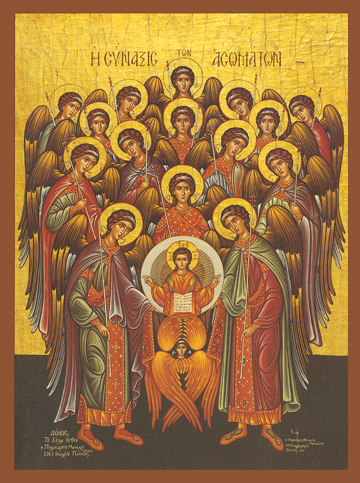
The effect that this concept had on Church music was threefold: first, it bred a highly conservative attitude to musical composition; secondly, it stabilized the melodic tradition of certain hymns; and thirdly, it continued, for a time, the anonymity of the composer. For if a chant is of heavenly origin then the acknowledgment received by man in transmitting it to posterity ought to be minimal. This is especially true when he deals with hymns which were known to have been first sung by angelic choirs - such as the Amen, Alleluia, Trisagion, Sanctus and Doxology. Consequently, until Palaeologan times, was inconceivable for a composer to place his name beside a noted text in the manuscripts.
My beloved spiritual children in Christ Our Only True God and Our Only True Savior,
CHRIST IS IN OUR MIDST! HE WAS, IS, AND EVER SHALL BE.
+++
ORTHODOX BYZANTINE MUSIC (Part II)
By Dimitri Conomos, Ph.D.
Medieval Period
The effect that this concept had on Church music was threefold: first, it bred a highly conservative attitude to musical composition; secondly, it stabilized the melodic tradition of certain hymns; and thirdly, it continued, for a time, the anonymity of the composer. For if a chant is of heavenly origin then the acknowledgment received by man in transmitting it to posterity ought to be minimal. This is especially true when he deals with hymns which were known to have been first sung by angelic choirs - such as the Amen, Alleluia, Trisagion, Sanctus and Doxology. Consequently, until Palaeologan times, was inconceivable for a composer to place his name beside a noted text in the manuscripts.
Saint Ignatius wrote to the Church of Ephesus in the following way:
"You must every man of you join in a choir so that bring harmonious and in concord and taking the keynote of God in unison, you may sing with one voice through Jesus Christ to the Father, so that He may hear you and through your good deeds recognize that you are parts of His Son."
A marked feature of liturgical ceremony was the active part taken by the people in its performance, particularly in the recitation or chanting of hymns, responses and psalms. The terms choros, koinonia and ekklesia were used synonymously in the early Byzantine Church. In Psalms 149 and 150, the Septuagint (Authentic translation from Hebrew to Greek of the Old Testament by 72 Hebrew Scholars) translated the Hebrew word machol (dance) by the Greek word choros. As a result, the early Church borrowed this word from classical antiquity as a designation for the congregation, at worship and in song in heaven and on earth both. Before long, however, a clericalizing tendency soon began to manifest itself in linguistic usage, particularly after the Council of Laodicea, whose 15th Canon permitted only the canonical psaltais, "chanters," to sing at the services. The word choros came to refer to the special priestly function in the liturgy - just as, architecturally speaking, the choir became a reserved area near the sanctuary - and choros eventually became the equivalent of the word kleros.
The development of large scale hymnographic forms begins in the 5th century with the rise of the kontakion, a long and elaborate metrical sermon, reputedly of Syriac origin, which finds its acme in the work of Saint Romanos the Melodos (6th century). This dramatic homily, which usually paraphrases a Biblical narrative, comprises some 20 to 30 stanzas and was sung during the Morning Office (Orthros or Matins) in a simple and direct syllabic style (one note per syllable). The earliest musical versions, however, are "melismatic" (that is, many notes per syllable of text), and belong to the time of the 9th century and later when kontakia were reduced to the ptooimion (introductory verse) and first oikos (stanza). In the second half of the 7th century, the kontakion was supplanted by a new type of hymn, the kanon, initiated by Saint Andrew of Crete (ca. 660-ca 740) and developed by Saint John of Damascus and Kosmas of Jerusalem (both 8th century). Essentially, the kanon is an hymnodic complex comprised of 9 Odes which were originally attached to the 9 Biblical canticles and to which they were related by means of corresponding poetic allusion or textual quotation.
The nine canticles are:
(1)-(2) The two songs of Moses (Exodus 15:1-19 and Deuteronomy 32:1-43
(3)-(7) The prayers of Hannah, Habbakuk, Isaiah, Jonah and the Three Children (1 Kings [1 Samuel] 2:1-10; Habakkuk 3:1-19; Isaiah 26:9-20; Jonah 2:3-10; Apoc. Daniel 3:26-56;
(8) The song of the Three Children (Apoc. Daniel 3:57-88);
(9) The Magnificat and the Benedictus (Luke 1:46-55 and 68-79).
Each ode consists of an initial troparion, the heirmos followed by three, four or more troparia which are the exact metrical reproductions of the heirmos, thereby allowing the same music to fit all troparia equally well.
The nine heirmoi, however, are metrically dissimilar; consequently, an entire kanon comprises nine independent melodies (eight, when the second ode is omitted, which are united musically by the same mode and textually by references to the general theme of the liturgical occasion, and sometimes by an acrostic. Heirmoi in syllabic style are gathered in the Heirmologion, a bulky volume which first appeared in the middle of the 10th century and contains a 1,000 model troparia arranged into an oktoechos (the eight-mode musical system).
(To be continued)
_____________________
"Glory Be To GOD For All Things!" -- Saint John Chrysostomos
+++
With sincere agape in His Holy Diakonia (Ministry),
The sinner and unworthy servant of God
+Father George
The Parish Priest is More Than...
In the Church, which is both a Divine and human institution, there is but one leader, our Lord, and Savior Jesus Christ. Through His Holy Apostles the validity of the Holy Orders, known as "Apostolic Succession," has flowed down over the centuries to our bishops, and through them to all Clergy.

Dear friends in Christ God,
Christ is in our midst!
In the Church, which is both a Divine and human institution, there is but one leader, our Lord, and Savior Jesus Christ. Through His Holy Apostles the validity of the Holy Orders, known as "Apostolic Succession," has flowed down over the centuries to our bishops, and through them to all Clergy.
By virtue of his many years of education, training, experience and the grace bestowed upon him at the time of his ordination, the priest is prepared to assume his parish duties. The Priest is the leader of the parish and responsible for the souls under his care. His chief role is to provide leadership in all facets of parish life. Activities such as educating the young, serving the sick, conducting worship services, performing marriages and baptisms, counseling the troubled and aiding the needy are all part of the Christian Mission.
A word should be added about the misconception that evolved in the early years of our Archdiocese whereby it was believed that a parish should be administered by a 'division of duties." That is, the priest should take care of all "religious matters," and the parish council "should handle everything else." This division of parish life into "spiritual" and "secular" spheres is not valid in Orthodoxy, and whether the subject is fundraising, publicity or administration, spiritual values must underlie all decisions and policies for which a parish is ultimately responsible.
It is most important to note that the church is a 'hospital,' a place of healing. Remember that our Lord, God, and Savior Jesus Christ is "the Physician of our souls and bodies." We attend and participate in the divine services and Mysteries (Sacraments) of the Church so as to be healed and sanctified by the grace of the Holy Spirit. The Church is where we are renewed, strengthened spiritually and comforted by God Himself. It is the church that we run to when we are filled with grief, sorrow, despair, confusion, and when one feels lost and afraid. It does not matter what kind of personal, marital, or family crisis we are going through. The Church provides security, wisdom, safety, and peace. It is a harbor where one is protected from the stormy seas of life.
Your priest is always there for you. The title or name 'Father' doesn't apply only when he is conducting a sacrament but the priest is your spiritual father willing to serve your every spiritual need and come to your aid. When one is ill the Orthodox Christian turns to his/her priest to be offered prayers and to be anointed with holy unction. When one is troubled because of something serious that he or she has done, he offers the Sacrament of Repentance and Confession. When one is preparing to be married in the Church he meets with the priest to discuss not only the marriage ceremony but also to receive counseling. If there are serious marital issues before we run immediately to the attorneys to apply for a civil divorce we meet with our parish priest with the hope that with his help there can be reconciliation between husband and wife and save the marriage. The priest is there at times of the death of a loved one to give the family support and comfort. The priest is there to counsel the young people of the parish who may have issues i.e., school, health, drugs, alcohol, moral, spiritual, other, etc.
Your priest is not there to be judgmental, to be critical or to condemn anyone. Your priest is there to be a loving and caring father. To encourage and to guide you to make the right decision for yourself. It is not, however, appropriate to exclude him altogether from your life. Your priest must not be the last one to find out through the grapevine that there is something seriously wrong with you or a family member. It is also necessary to trust him and to respect his advice to you.
May God bless all of you always.
With agape in our Merciful Lord,
+Father George
Suffering as an Unavoidable Aspect of the Life in Christ (Part II)
Suffering and the spiritual struggle that come with it must be viewed in a positive light since they offer such a wide variety of virtues and rewards. Biblical and Patristic reference to the benefits of suffering is numerous. Let it suffice to cite just a few isolated examples. The Apostle Paul teaches, "...we also glory in tribulations, knowing that tribulation produces perseverance; and perseverance, character; and character, hope. Now hope does not disappoint..." (Romans 5:3-5).

My beloved spiritual children in Christ Our Only True God and Our Only True Savior,
CHRIST IS IN OUR MIDST! HE WAS, IS, AND EVER SHALL BE.
+++
SUFFERING AS UNAVOIDABLE ASPECT OF THE LIFE IN CHRIST (Part II)
According to Saint Silouan the Athonite
The Fruits OF Suffering
Suffering and the spiritual struggle that come with it must be viewed in a positive light since they offer such a wide variety of virtues and rewards. Biblical and Patristic reference to the benefits of suffering is numerous. Let it suffice to cite just a few isolated examples. The Apostle Paul teaches, "...we also glory in tribulations, knowing that tribulation produces perseverance; and perseverance, character; and character, hope. Now hope does not disappoint..." (Romans 5:3-5).
Saint John Chrysostom, in his homily devoted to this same verse, distinguishes between the future rewards of suffering from those benefits enjoyed in the present. Among those benefits-oriented more to the present, he mentions 'the increase of faith', which in itself leads to many other benefits. Saint Mark the Ascetic writes that pain and suffering lead to the fear of God and to repentance and that voluntary suffering is "by nature the enemy of sensual pleasure." Such views are shared by Saint Maximos the Confessor who sees suffering as 'blunting' sensual pleasure, while Saint Isaac the Syrian refers to it as 'killing the sweetness of passions", as well as 'purifying the heart'. Saint Symeon the New Theologian writes that such trials benefit the believer because they lead to greater recognition of the compassion and mercy of God and that they also turn one's love toward Him. Another interesting observation is made by Saint Thalassios. He notes that one practical benefit of such trials is that they reveal who your true friends are.
There are also those blessings of suffering that await the believer in the life to come. Among these eternal and everlasting blessings are joy and glory. It is interesting that Elder Sophrony considers these future rewards of suffering an "inalienable possession" referring also to the fact that the fruit of such labors "stay engraved in us for eternity". Thus, suffering provides the believer with this opportunity for spiritual progress and the acquisition of a wide variety of benefits and virtues.
The Importance OF Courage
One of the well known, although perhaps extreme, examples showing how suffering can lead to deeper prayer and spiritual progress is described by Saint Athanasius in The Life of Anthony. Saint Silouan refers to the example of Saint Antony (Saint Anthony the Great) when he discusses the importance of courage in the spiritual struggle. Saint Athanasius records how Saint Anthony, having devoted himself totally to Christ, went to live in an enclosed tomb in pursuit of pure prayer. His progress was a great provocation to the enemy (Satan). One night a multitude of demons attacked him and began to beat him so viciously that he could not speak or get up off of the ground on account of the intensity of his pain. But even this could not deter Saint Anthony's desire for prayer. Having been taken to the village by a friend in order to recover, he then went back and enclosed himself again in the tomb. Still unable to stand because of the severity of his injuries, he prayed while lying on the ground. Such perseverance provoked the enemy to even more violent rage. As if crashing through the walls of the tomb, according to the narrative of Saint Athanasius, the demons now assumed the forms of various wild animals: "... the sounds of all the creatures that appeared were terrible, and their raging was fierce. Struck and wounded by them, Antony's body was subject to yet more pain...and he groaned because of the pain felt in his body."
Of course, such suffering in the spiritual life is rare. The point is that one wonders why God would allow such severe testing and torments. The answer is that God allows such suffering as an opportunity for man to acquire the virtue of courage, which is vital for spiritual progress...
Christ Himself calls the believer to courage, "in the world you will have trouble; but have courage! I have overcome the world." As the Lord teaches, to have courage is to have hope in His victory. Without such courage, there is no hope of overcoming the inevitable onslaught of spiritual warfare. Saint Silouan makes the analogy: "The spiritual struggle has much in common with ordinary warfare; and in this battle, we must likewise be brave...the courageous soul thereby vanquishes her enemies; whereas the cowardly soul is disconcerted, despairs and so perishes..."
The virtue of courage is so vital in the face of the endless sufferings encountered in spiritual warfare that it is pointless to enter the battle without it. So significant is the virtue of courage that Saint Silouan sees it as inciting the Lord's love toward the believer, "Do not be cast down over the struggle--the Lord loves a brave warrior" and elsewhere he writes, "The Lord loves the soul that is valiant." Courage could thus be considered as one of the greatest gifts--not only to have but also to give to others. For without it, even that which has already been attained may be lost. Courage is not something to be taken for granted. Rather, it must be acquired and preserved. (Source: Orthodox Spiritual Life According to Saint Silouan the Athonite by Harry Boosalis)
__________________________
"Glory Be To GOD For All Things!" - Saint John Chrysostomos
+++
With sincere agape in His Holy Diakonia (Ministry),
The sinner and unworthy servant of God
+Father George
Suffering as an Unavoidable Aspect of the Life in Christ
Suffering is seen as a sign of God's love for man. Saint Silouan also considered suffering as a sort of 'measuring stick' of man's love for God. In his characteristic simplicity, he sums up this particular point using the example of Panayia. Referring to her limitless love for her Son and her inconceivable grief as she stood at the foot of the Cross, Saint Silouan states succinctly, "The greater the love, the greater the suffering".

My beloved spiritual children in Christ Our Only True God and Our Only True Savior,
CHRIST IS IN OUR MIDST! HE WAS, IS, AND EVER SHALL BE.
+++
SUFFERING AS AN UNAVOIDABLE ASPECT OF THE LIFE IN CHRIST
By Saint Silouan the Athonite
Suffering is seen as a sign of God's love for man. Saint Silouan also considered suffering as a sort of 'measuring stick' of man's love for God. In his characteristic simplicity, he sums up this particular point using the example of Panayia. Referring to her limitless love for her Son and her inconceivable grief as she stood at the foot of the Cross, Saint Silouan states succinctly, "The greater the love, the greater the suffering".
Suffering is thus seen as an unavoidable outcome of the believer's fervent desire for the life in Christ. It is the condition without which there can be no participation in His life and hence no entry into His Kingdom of love. The New Testament teaches this quite clearly, "we must through many tribulations enter the Kingdom of God" (Acts 14:22). This is not a question of whether the believer 'may' suffer, the operative word here is "must". It is inevitable. Anyone actively pursuing the life in Christ will suffer. In fact, there is no spiritual progress without suffering, sorrow, pain, and persecution.
However, Saint Silouan teaches that man often makes his sufferings out to be more unbearable than they really are. This is a source of great anxiety and it is due to a lack of faith. It shows that the believer has not yet humbled himself, nor given himself over completely to the will of God. The believer must realize that it is ultimately the Lord who is in complete control of every facet of his life. By allowing such sufferings, the Lord actually directs and disciplines the believer, thereby making him His own 'legitimate' son or daughter. One must bear in mind that it is the Lord who allows these afflictions for the spiritual benefit of the believer, and it is also the Lord who delivers him from them. According to Saint Silouan, "...the Lord Himself guides with His grace them that are given over to God's will, and they bear all things with fortitude for the sake of God Whom they have so loved and with Whom they are glorified forever..." The believer is thus 'tested' as to the extent of his complete commitment to the will of God, as well as to the measure of his unconditional love for Him."
The life of man is a time of testing. This is clearly seen in every aspect of human life and especially within human relationships. This is not confined to the testing of a teacher towards his student or an employer toward his workers. Friendships too are often tested, thereby revealing a true friend. Marriage is constantly tested, thus allowing the sacramental union of love to grow continually. Parents test their children in the lessons of life, yet children too test their parents to see how much they can get away with, i.e.., as to the extent of the parents' permissiveness or strictness.
It seems as if love itself is meant to be tested, for only in this way is it proven to be 'true'. In fact, it could be said that love is 'true' when it is tested and when the person loved fails yet is still loved in spite of this failure. Such is the unconditional love of God toward man. It is interesting to note that in Monastic life the Greek word for the person who is actively seeking tonsure is 'dokimos' (δόκιμος), which means literally, "he who is being tried or tested.' The testing of one's commitment and love is a formative experience. It is not a question of whether one is tried or proven in a juridical sense. Rather, the point is that through 'testing' one is offered the opportunity to advance in the acquisition of spiritual virtues and to grow in the grace of the Holy Spirit.
Suffering as a Christ-Centered Experience
As he undergoes these various trials and tribulations, some of which will be quite intense, the believer must always have before him the example of Christ Himself. Obviously, it is Christ, Who as the Suffering Servant or 'Man of sufferings,' provides the pristine example which is to be followed by those who have chosen to take up their own cross and follow Him. The Apostle Peter teaches, "For to this you have been called, because Christ also suffered for you, leaving you an example, so that you should follow in His steps" (see 1 Peter 2:21). To live in Christ is to follow Him. This entails following His personal example of self-emptying, self-sacrifice and 'much suffering.'
By partaking in such sufferings--in whatever way God may allow--the believer thereby partakes in the victory of Christ's Resurrection over death. This is not just some kind of ethical or juridical 'trade-off'. It is the existential participation in His victory over death and corruption. His victory then becomes the believer's victory. One's own personal participation in such sufferings thus opens the way to even further participation in the life in Christ. One's own experience is to be dealt with in full consciousness of Christ's sufferings and sorrows. The sufferings encountered in the spiritual life are thus to be seen as opportunities for sharing in those of Christ. Yet sharing in His sufferings implies sharing in His glory: "...we suffer with Him so that we may also be glorified with Him" (Romans 8:17). Saint Maximos the Confessor also mentions this point when he refers to the "shared suffering" between God and man. "If God suffers in the flesh when He is made man, should we not rejoice when we suffer, for we have God to share our sufferings?
True Christ-like suffering, however, is rarely grasped by man. Such suffering is obviously beyond compare. Yet when man somehow shares in the sufferings and sorrows of Christ--to whatever degree--he is then led to a variety of virtues and benefits, and ultimately toward his deification (theosis). (Source: Orthodox Spiritual Life according to Saint Silouan the Athonite by Harry Boosalis)
(To be continued)
__________________
Please note: I am bringing to you the divine words of Saint Silouan the Athonite on suffering because there are many of you that do not understand the purpose, value or meaning of suffering. We all suffer in this earthly life of ours and we all experience sorrow and pain. However, as Christian believers, we must view suffering in a positive light since there are numerous spiritual benefits that are derived from our sufferings.
We must not see our sufferings as a punishment from our Loving God but as sharing in the suffering of our Lord and Savior Jesus Christ. The Godman Who suffered to save us and Who died, resurrected, so that we may have life eternal in His Kingdom. We do not suffer ever alone but we have God Who always shares our sufferings.
Don't be angry or disappointed with God because of your sufferings. Instead, be thankful that He loves you so much that He is willing to strengthen your love and commitment for Him. Please know that our God, the God of unconditional love for mankind, does not inflict us with pain and suffering but simply allows it to happen so that our souls be cleansed and saved.
_____________________
"Glory Be To GOD FOR ALL THINGS!" (including suffering)
+++
With sincere agape in His Holy Diakonia,
The sinner and unworthy servant of God
+Father George
Orthodox Byzantine Music
Strictly speaking, Byzantine music is the medieval sacred chant of Christian Churches following the Orthodox rite. This tradition, encompassing the Greek-speaking world, developed in Byzantium from the establishment of its capital, Constantinople, in 330 A.D. until its fall in 1453. It is undeniably of composite origin, drawing on the artistic and technical productions of the classical age, on Jewish music, and inspired by the monophonic vocal music that evolved in the early Christian cities of Alexandria, Antioch and Ephesus.

My beloved spiritual children in Christ Our Only True God and Our Only True Savior,
CHRIST IS IN OUR MIDST! HE WAS, IS, AND EVER SHALL BE.
+++
ORTHODOX BYZANTINE MUSIC
By Dimitri Conomos, Ph.D.
Strictly speaking, Byzantine music is the medieval sacred chant of Christian Churches following the Orthodox rite. This tradition, encompassing the Greek-speaking world, developed in Byzantium from the establishment of its capital, Constantinople, in 330 A.D. until its fall in 1453. It is undeniably of composite origin, drawing on the artistic and technical productions of the classical age, on Jewish music, and inspired by the monophonic vocal music that evolved in the early Christian cities of Alexandria, Antioch and Ephesus.
Early Christian Period
Byzantine chant manuscripts date from the 9th century, while lectionaries of biblical readings in Ekphonetic Notation (a primitive graphic system designed to indicate the manner of reciting lessons from Scripture) begin about a century earlier and continue in use until the 12th century or 13th century. Our knowledge of the older period is derived from Church service books Typika, Patristic writings and medieval histories. Scattered examples of hymn texts from the early centuries of Greek Christianity still exist. Some of these employ the metrical schemes of classical Greek poetry; but the change of pronunciation had rendered those meters largely meaningless, and, except when classical forms were imitated. Byzantine hymns of the following centuries are prose-poetry, unrhymed verses of irregular length and accentual patterns. The common term for a short hymn of one stanza, or one of a series of stanzas, is troparion (this may carry the further connotation of a hymn interpolated between psalm and verses). A famous example, whose existence is attested as early as the 4th century, is the Vesper hymn, Phos Hilaron, "Gladsome Light"; another, O Monogenes Yios, "Only Begotten Son," ascribed to Justinian I (527-565 A.D.), figures in the introductory portion of the Divine Liturgy. Perhaps the earliest set of troparia of known authorship are those of the monk Auxentios (first half of the 5th century), attested in his biography but not preserved in any later Byzantine order of service.
Medieval Period
Two concepts must be understood if we are to appreciate fully the function of music in Byzantine worship. The first, which retained currency in Greek theological and mystical speculation until the dissolution of the Empire, was the belief in the Angelic transmission of sacred chant: the assumption that the early Church united men in the prayer of the Angelic choirs. This notion is certainly older than the Apocalypse account (Revelation 4:8-11), for the musical function of Angels as conceived in the Old Testament is brought out dearly by Prophet Isaiah (6:1-4) and Prophet Ezekiel (3:12). Most significant in the fact, outlined in Exodus 25, that the pattern for the earthly worship of Israel was derived from heaven. The allusion is perpetuated in the writings of the early Holy Fathers, such as Saint Clement of Rome, Saint Justin, Saint Ignatius of Antioch, Saint Athenagoras of Athens, and Pseudo-Dionysios the Areopagite. It receives acknowledgment later in the Liturgical treatises of St. Nicolas Kavasilas and Saint Symeon of Thessaloniki (Patrologia Graeca, Cl. 368-492 and CLV, 536-699, respectively).
(To be continued)
_________________________
"Glory Be To GOD For All Things! - Saint John Chrysostomos
+++
With sincere agape in His Holy Diakonia (Ministry),
The sinner and unworthy servant of God
+Father George