
The Domestic or Home Church
Everyone is cognizant of the ever-changing world and society that we live in and everyone knows that the changes that have become part of our daily lives are not always positive ones and profitable. Nowhere is this more obvious than in the average home. The home was once viewed as a safe haven for families (oikoggenies). It was a sacred place, 'the little church', a place of guidance, of prayer, of teaching the Christian faith, values, precepts, morality, respect for others, of compassion for others, of love. For Orthodox Christian families, the home was thought to be an extension of the Church, a place to practice what was taught on Sundays.

My beloved spiritual children in Christ Our Only True God and Our Only True Savior,
CHRIST IS IN OUR MIDST! HE WAS, IS, AND EVER SHALL BE.
+++
E KAT' OIKON EKKLESIA OR THE DOMESTIC OR HOME CHURCH
Everyone is cognizant of the ever-changing world and society that we live in and everyone knows that the changes that have become part of our daily lives are not always positive ones and profitable. Nowhere is this more obvious than in the average home. The home was once viewed as a safe haven for families (oikoggenies). It was a sacred place, 'the little church', a place of guidance, of prayer, of teaching the Christian faith, values, precepts, morality, respect for others, of compassion for others, of love. For Orthodox Christian families, the home was thought to be an extension of the Church, a place to practice what was taught on Sundays. The sanctity of the home for every husband and wife was placed into motion on the day of their Christian marriage when, through the crowning ceremony (stepsis), they were reminded that they were now royalty (king and queen) of a new "spiritual kingdom"--their household which was Christ-centered.
Tragically, most of today's home is not governed according to the holy teachings and principles taught by our Christian faith. Blame is cast in many directions: with two working parents, it is difficult to find time to devote to our family's spiritual needs. Children have so many "outside interests" that have taken them away from the home. We can go on and on with "reasons" for the decline of the Orthodox Christian home or the "Kat' oikon ekklesia". The truth of the matter, however, is that there should be no reason to have our home lose its Christian character.
It matters not if the parents are of a different Christian tradition. Theological differences may and do, exist between Christians of various traditions, however, the basic Christian principles regarding how to live as Christians, our faithfulness to our Lord and Savior Jesus Christ and his commandments, the importance of the Holy Scripture, the necessity of daily prayer, of worship, of chastity, of living a virtuous life are the same. I believe all Christians believe that salvation can be attained only through Christ our Lord. It is absolutely necessary that the Christian family does not lose its Christian identity and become a secular institution.
Has it ever been easy to raise God-fearing children who are totally committed to Christ and His Holy Church? Orthodox Christian parents have historically labored under the yoke of pagan Rome, barbarian invasions, famine, the enslavement by Islam, communist oppression and atheism. Under the Ottoman Turkish occupation of Orthodox Christian countries, Christians found ways of teaching their children their Christian faith and culture in what we refer to as "crypha scholia" or "secret schools" in mountain caves. Under the communists, the Orthodox Christians had "the underground church". This was done knowing if caught by the authorities they would be either imprisoned or even executed.
The intrusion or invasion of the secular society in our home is very real and poses an immense threat to our family. It presents itself as 'entertainment'. The instruments that are used to corrupt and destroy the traditional and Christian family are television, the internet, computers, radio, movies, popular music through its lyrics which promote immoral messages. The secular society promotes and attempts to indoctrinate young people to condone all kinds of styles of life which are contrary to our Christian faith and the commandments of God. Christian parents must not surrender their children to this evil influence.
The supplications of the church are particularly good for verbalizing exactly what it is we need. We, as parents, should pray to the Mother of God. Through our Church's divine service the Akathist to the Mother of God called "Nurturer of Children."
"Raise my children to be wise as serpents and innocent as doves. Raise my children to have knowledge of good but not of sin. Raise my children to be wise against the snares of the devil. Raise my children to order their lives wisely, following the example of the Saints...Raise my children, O Lady, to be made worthy of the Kingdom of Heaven, and make them heirs of eternal blessings." (Ikos Two)
Keep your children close to the Church. Teach them our Christian faith and set for them a good example. Set aside time for prayer together each day. "The family that prays together stays together." Children should be taught to pray each morning and evening, as well as at meals, and parents should join them. Read the Holy Scripture each day, even if it is just a few verses and discuss it with them. Everyone is given a Church Calendar and follow it daily. Our Orthodox Christian faith is not just a "Sunday religion." It is a "tapestry" of holy feasts and fasts, with the commemoration of the Saints interwoven among them. Orthodox families should celebrate the holy feasts, honor and adhere to the fasts and imitate the lives of the Saints of our Holy Church. Prepare to receive Holy Communion by participating in the sacrament of Holy Confession first.
Saint Paul teaches us to "stand fast and hold the traditions which you were taught, whether by word or our epistle" (2 Thessalonians 2:15). It is most important that Orthodox Christians practice the holy traditions of the Church. Prepare the 'bread of oblation" or "prosphoron" for the Divine Liturgy or boiled wheat" (kolyva) for the Saturday of Souls and make sure you bring the names of your dead relatives and friends. Invite your priest to bless your home and business following the feast of Theophany or during the year. Take fruit (grapes to church to be blessed on the Feast of the Holy Transfiguration. On Sunday mornings before you leave for church offer incense and go around to every room of your house as a blessing, have an icon corner at home where you keep your holy water, blessed flowers and your vigil light, there should be a holy icon or a cross in every room of your home except the bathroom of course.
Do not fail Christ or your family! Make God real in your home.
With sincere agape in Christ,
+Father George
The Feast of the Hypapante (Meeting of Christ) or the Presentation of Christ in the Temple (Part III)
The feast of the Meeting of Christ is not simply a feast referring only to Christ the Lord and pointing to one of the stages of the Divine Economy, but it is also a feast of the person who lives by Christ.
My beloved spiritual children in Christ Our Only True God and Our Only True Savior,
CHRIST IS IN OUR MIDST! HE WAS, IS, AND EVER SHALL BE.
+++
THE HOLY FEAST OF HYPAPANTE (THE MEETING OF CHRIST) Part III
ON FEBRUARY 2nd OUR HOLY ORTHODOX CHRISTIAN CHURCH COMMEMORATES THE HOLY FEAST OF HYPAPANTE (THE MEETING OF CHRIST)
By His Eminence Metropolitan of Nafpaktos HIEROTHEOS
The feast of the Meeting of Christ is not simply a feast referring only to Christ the Lord and pointing to one of the stages of the Divine Economy, but it is also a feast of the person who lives by Christ.
The Church made the feast of Christ's fortieth day also a ceremony, a service for the fortieth day after everyone's birth. On the fortieth day after birth, the infant is offered to the Temple by its mother. This offering has a double meaning. First, the mother is blessed for the end of her purification after the bleeding of her confinement. Just as the Church prays for every illness, so also it prays for the woman who has given birth and naturally feels tired and physically weak. It prays for her purification and because, as we know today, the manner of our birth came after the fall. Secondly, it is a celebration of thanksgiving for the birth of a child. Since the conception and birth of a human being is not a work of nature alone, but of God's energy, we feel that it belongs to God. So we offer it to God and He, through our priest gives it over to us again to bring up. But in reality, it belongs to God. (What does this say about those who practice and believe in the abortion of a child?)
However, according to Saint Gregory of Nyssa, we must offer to God, to the Altar above, in place of a pair of turtle-doves, the purity of soul and body, and in place of the two young pigeons we must offer much prayer not only before the face of God but also before the face of mankind. And just as Christ did all that the law required and returned to His fatherland, filled and advancing in wisdom, so we too are to return to our true fatherland, which is the heavenly Jerusalem, because we are to live spiritually according to divine law and advance in wisdom and joy and reach the measure of the stature of the fullness of Christ, perfected in the inner man and having become dwellings of the Holy Spirit.
According to Saint Athanasius the Great, it is our task to liken ourselves to Righteous Symeon and the Prophetess Anna. We too must meet Christ with wisdom, purity, guilelessness, forgiveness and in general with love for God and mankind. No one can meet Christ, the true life, in any other way.
The Meeting of Christ shows that Christ is the life and light of men and that man should aim to attain this personal light and personal life. The Church sings, by way of exhortation: "Illuminate my soul and the light of my senses, that I may see the in purity, and I will proclaim that thou art God". In order for anyone to proclaim God, he must see him clearly. Only those who see God or at least accept the experience of those who see can become teachers. But in order to see God one must previously be illuminated, shine in soul and bodily senses. Then the feast of the Meeting of Christ also becomes a feast of the meeting of every believer. (Source: The Feasts of the Lord. An Introduction to the Twelve Feasts and Orthodox Christology)
____________________________
"Glory Be To GOD For All Things!" - Saint John Chrysostomos
+++
With sincere agape in His Holy Diakonia (Ministry),
The sinner and unworthy servant of God
+Father George
What is Family Ministry? (Part II)
Love
Giving of ourselves sacrificially through genuine mutuality.
As family ministry leaders, read 1 Corinthians Chapters 12 and 13 together. Which aspects of the body of Christ or the essence of love stand out for you? How can these aspects assist us in our ministry to families?

My beloved spiritual children in Christ Our Only True God and Our Only True Savior,
CHRIST IS IN OUR MIDST! HE WAS, IS, AND EVER SHALL BE.
+++
WHAT IS FAMILY MINISTRY? (Part II)
By Rev. Father Alexander Goussetis
Love
Giving of ourselves sacrificially through genuine mutuality.
As family ministry leaders, read 1 Corinthians Chapters 12 and 13 together. Which aspects of the body of Christ or the essence of love stand out for you? How can these aspects assist us in our ministry to families?
Can you recall recent examples of self-denial and sacrifice that parish family members have shown to one another?
Which examples of Jesus's Ministry and interactions with other help you to better comprehend the virtue of love?
What are practical ways of expressing sacrificial love and mutuality to our neighbors, our community, our parish, our school, our place of work?
Trust
Assuring others of our mutual respect, dependability, collaboration, faith, and shared vulnerability.
The Greek word for faith implies not only faith but also trust. To have faith in Jesus is not only to believe in Him but also to put one's trust in Him. In our relationship with others, we might express the difference between believing a person (what he/she says is reliable and true) and believe in a person (entrusting yourself to that person). Can you see the difference? On a personal level, consider the following:
Who are the people in your life that you trust? What did they do to earn that trust from you?
When did another person betray your trust? What lesson was learned and applied in the future?
Do you consider yourself to be a dependable person, with a reputation of being trusted by others?
How and when should be vulnerable with others? What are the dynamics necessary to share your thoughts, feelings, and history in a safe setting?
How can we work to build trust among our parish family members?
Learning
Growing in and sharing the knowledge of the Orthodox Christian Faith and our particular fields of expertise.
The Orthodox Church practices infant baptism. Some criticize this tradition, suggesting that only an adult can make such a faith decision. Our response is that baptism represents only the first step in our relationship with Christ and His Church. We are invited to grow in our knowledge of the faith, to use God's blessings to serve others with our gifts and to share the message of the Gospel with others. The Orthodox Christian faith demands an active response to the love of God, growing in grace and wisdom.
In what ways do we help parish family members expand their knowledge of the teachings and practices of the Orthodox Faith?
What parish study groups do we offer to promote this growth? What resources do we share for further enrichment with our parish family members (podcasts, webinars, books, websites, etc.)?
Is our parish a welcoming environment that invites people to want to know more about our faith?
Does our parish support and highlight missionary activities in the Orthodox Church, both locally and internationally?
+
There is much to consider in responding to the question, "What is family ministry?" For parish ministry leaders, this question needs to begin with self-reflection on the role these core values have in our lives. We cannot lead people to grow in Christ unless we are working to grow closer to Him ourselves.
[Rev. Father Alexander Goussetis is the Director of the Center for Family Care of the Greek Orthodox Archdiocese of America.]
_________________________________
"Glory Be To GOD For All Things!" -- Saint John Chrysostomos
+++
With sincere agape in His Holy Diakonia,
The sinner and unworthy servant of God
+Father George
What is Family Ministry?
"The family is a microcosm of the entire Church, a most sacred place where relationships with one another are cultivated in the love of Jesus Christ." - Archbishop Demetrios, Geron of America

My beloved spiritual children in Christ Our Only True God and Our Only True Savior,
CHRIST IS IN OUR MIDST! HE WAS, IS, AND EVER SHALL BE.
+++
WHAT IS FAMILY MINISTRY?
By Rev. Father Alexander Goussetis
"The family is a microcosm of the entire Church, a most sacred place where relationships with one another are cultivated in the love of Jesus Christ." - Archbishop Demetrios, Geron of America
More and more in our Archdiocese, we are seeing the development of family ministry as parishes begin to host family nights, parent retreats, mom mornings and a variety of other activities that fall under this umbrella. Ministry to family, however, is so much more than just hosting programs and retreats. It connects the Church with the home. It focuses on equipping the faithful to apply the teachings and practices of the Orthodox Faith in every dimension of their lives. It can benefit every member of our parish family!
But who is part of this family? In the traditional sense, the family is composed of the parents and children in a household all brought together by Divine grace-the "domestic church." Additionally, it must be understood that the Church--the body of Christ--constitutes a broader dimension of the family through the very real spiritual relationship established through the Baptism and Chrismation that unites all of its members. We are all one family in Christ!
When we see our parish as a family, we extend family ministry beyond the demographic of parents and children and look at the entire cycle of life. Recently, a parish was hosting a family night for parents and children. On the day of the event, a woman in her eighties who had no children or grandchildren asked if she could come--the parish, of course, welcomed her. Instead of sitting home alone, she joined the family night. She watched the children playing, helped with crafts, listened to the adult's program and broke bread with her fellow parishioners. She left with feelings of joy and a sense that she belonged to the Church family. Not only did she benefit from attending, but the children and their parents also benefited from interacting with her throughout the evening. This is what Family Ministry does--it brings all the children of God together.
On a practical level, how do we develop this type of family ministry? How do we attempt to connect Church and home? As a parish, consider the following core values when developing a family ministry.
Christ-Centered Living
Engaging in an active, authentic relationship with Christ manifested through personal prayer, community worship and sacramental life.
Through what lens do we view the world? Are our daily decisions dictated primarily by political perspectives, scientific insights or cultural observations? As valuable as those worldly disciplines may be, the goal of the Christian life is to develop and cultivate a relationship with Jesus Christ. The liturgical and sacramental services inform us and shape us, revealing the pathway to salvation. Personal prayer allows for an intimate union with God, sharing our daily joys and struggles with our beloved Creator. As a parish family, we encourage our members to engage in an active, authentic relationship with Christ. As we minister to families we can ask ourselves the following:
How do we encourage parish family members to develop a rule of prayer that guides their daily connection with God?
How do we inspire parish family members to become active participants in the worship cycle of our Church?
How do we impress parish family members to pray for one another in their homes and throughout the day?
How do we motivate parish family members to fully participate in all the sacraments the Church has to offer?
Orthodox Authenticity
Providing balance and structure in our innovative and creative endeavors through the Holy Tradition of our faith.
The social norms of society often change over time, sometimes from permissive to restrictive and back again. Families may struggle with how to live an authentic Orthodox Christian life, especially when the standards and ethos of society shift or conflict with the Orthodox Christian Faith. Fortunately, the teachings, practices, and values of our Church have remained balanced and consistent for 2,000 years, allowing families to rely on a firm foundation while adapting to the needs of the family at any given time.
How do we teach our parish family members about the role of Holy Tradition in their daily lives?
How do we guide our parish family members toward developing a relationship with a spiritual father--preferably their parish priest--to help them maintain an Orthodox perspective while navigating through societal shifts? How do we educate them as to what this relationship should be?
How do we help our parish family members integrate the rhythm of the Church year into their daily lives to promote balance and structure?
How do we as a parish use innovation and creativity to aid our parish family's spiritual journey?
Love
Giving of ourselves sacrificially through genuine mutuality.
Jesus is the ultimate model of self-sacrifice, inviting us to a deep and intimate relationship of love both in this life and the world to come. In 1 Corinthians 12, Saint Paul offers the image of the body of Christ, emphasizing that every part of the body has innate value and works together for the greater good. The family is the ideal setting for modeling mutuality and support for one another, joyfully surrendering our own ego while expressing a selfless love for each member. (Source: Greek Orthodox Archdiocese of America)
(To be continued)
_______________________
"Glory Be To GOD For All Things!" -- Saint John Chrysostomos
+++
With sincere agape in His Holy Diakonia,
The sinner and unworthy servant of God
+Father George
The Feast of the Hypapante (the Meeting of Christ) or the Presentation of Christ in the Temple (Part II)
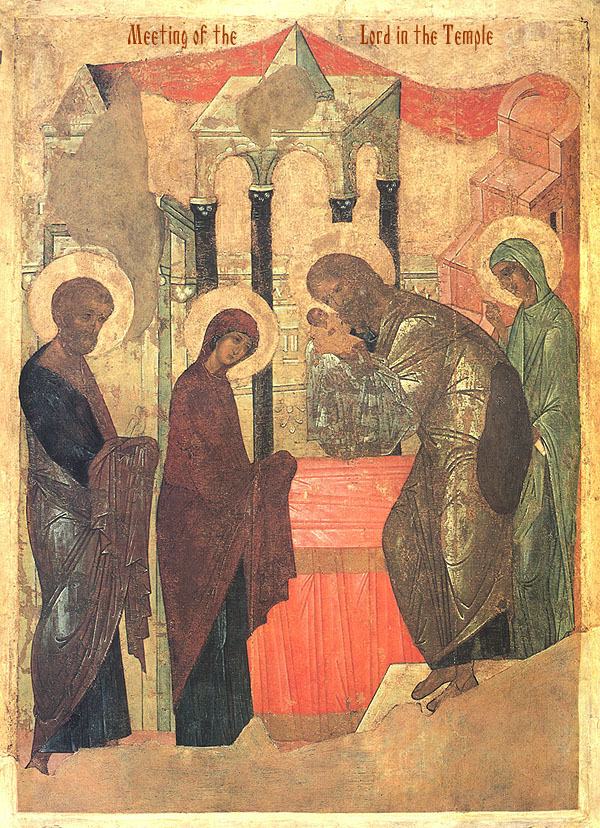
Christ is called first-born in three ways. First, because He was born of the Father before all ages. The holy Apostle Paul says: "He is the image of the invisible God, the first-born over all creation" (Col. 1:15). The "first-born" is identified with the "Only-Begotten". Secondly, He is called first-born in His human birth, and regardless of whether another was born of the Panagia. "And she brought forth her first-born son" (St. Luke 2:7). And thirdly, He is called first-born from the dead because He was the first to rise from the dead, thus making it possible for everyone to be raised at the appropriate time.
My beloved spiritual children in Christ Our Only True God and Our Only True Savior,
CHRIST IS IN OUR MIDST! HE WAS, IS, AND EVER SHALL BE.
+++
THE HOLY FEAST OF HYPAPANTE (THE MEETING OF CHRIST) Part II
By Metropolitan of Nafpaktos HIEROTHEOS
Christ is called first-born in three ways. First, because He was born of the Father before all ages. The holy Apostle Paul says: "He is the image of the invisible God, the first-born over all creation" (Col. 1:15). The "first-born" is identified with the "Only-Begotten". Secondly, He is called first-born in His human birth, and regardless of whether another was born of the Panagia. "And she brought forth her first-born son" (St. Luke 2:7). And thirdly, He is called first-born from the dead because He was the first to rise from the dead, thus making it possible for everyone to be raised at the appropriate time. The Resurrection is also characterized as a "birth", because resurrection is regarded as a birth. The holy Apostle Paul says: "He is the beginning and the first-born from among the dead" (Col. 1:18). The first meaning of the first-born is connected with the birth according to nature of the Son of God, that is to say, the term refers to theology, and the other two are connected with the incarnation of the Logos/Word and refer to the economy.
According to Saint Gregory of Nyssa, Christ became first-born in three ways in order to give life to our own human nature. Of course, He is not referring to His birth from the Father before all ages. Just as our own human nature is given life by three births, that from our mother, that from baptism, and that from the dead, which we hope will happen in the future, so too Christ became the first-born for in three ways, so that our own human nature would be given life and deified (theosis). For the birth of the body still has to be followed by the spiritual birth.
It is a moving scene when Christ as an Infant, as a baby, is offered to the Temple. The Pre-Eternal God Who, as the Logos/Word of God, has always been united with His Father and the Holy Spirit and simultaneously has directed the world, the entire universe is presented to the Temple as an Infant in the arms of His mother.
Although Christ was an infant, at the same time He was "God before the ages", and therefore He was wiser than anyone else. We know that human nature in the womb of the Theotokos was deified by the union of Divine and human nature in the Person of the Logos/Word, and therefore Christ's soul was enriched with the fullness of wisdom and knowledge. Yet this wisdom was expressed in accordance with His age because if it had been otherwise, He would have appeared to be a freak (St. John of Damaskos). Anyway, although Christ was an infant, nevertheless He was God, having all the fullness of divinity and all the human wisdom and knowledge by virtue of the hypostatic union of His Divine and human natures.
God has appointed that the offering of the first-born male should be accompanied by the offering of an unblemished lamb or a pair of turtle-doves or two young pigeons. In Leviticus, it says: "she shall bring to the priest a lamb of the first year as a burnt offering, and a young pigeon o a turtle-dove as a sin offering, to the door of the tabernacle of meeting" (Lev. 12:6). Saint Luke the Evangelist says that Christ's parents brought Him to the Temple "to offer a sacrifice according to what is said in the law of the Lord, 'a pair of turtle-doves or two young pigeons" (St. Luke 2:24).
Christ's parents did not offer a lamb as the law provided because they were poor. The wealthy classes offered a year-old lamb, while the poorer classes offered a pair of turtledoves or two young pigeons (Procopius). Christ really was born into a poor family and grew up as a poor man. In the end, Christ's poverty consisted not so much in the fact that He was born and lived in poverty, but rather that He became Incarnate and assumed human nature. As Saint Gregory the Theologian says, while He was rich, He became poor so that we might become rich with His Divinity.
The law provided that a pair of turtledoves or two young pigeons be offered, because the turtledoves, signify the wisdom of the parents who were joined together according to the law of marriage, while the two young-pigeons referred to the Panagia and Christ, because Christ was born of the Virgin and remained Virgin Himself to the end. Thus, while the former signified the honorable and blessed marriage, the latter symbolized the virginity of the Panagia and of Christ (Saint Gregory Palamas).
The offering of the Lord which the law provided was a figure of Christ. As Saint Cyril of Alexandria points out, "the turtle-dove is very loquacious among sparrows of the field, but the dove is gentle and meek." This symbolizes Christ, for Christ babbled like a pigeon to all the world and filled His own vineyard, that is, us who believes in Him, with His sweet voice, and like a dove, He was meek to the utmost degree. Clearly then, this offering referred to the Incarnation of the merciful God. (Source: The Feasts of the Lord. An Introduction to the Twelve Feasts and Orthodox Christology)
(To be continued)
___________________________
"Glory Be To GOD For All Things!" -- Saint John Chrysostomos
+++
With sincere agape in His Holy Diakonia (Ministry),
The sinner and unworthy servant of God
+Father George
The Feast of the Hypapante (the Meeting of Christ) or the Presentation of Christ in the Temple (Part I)
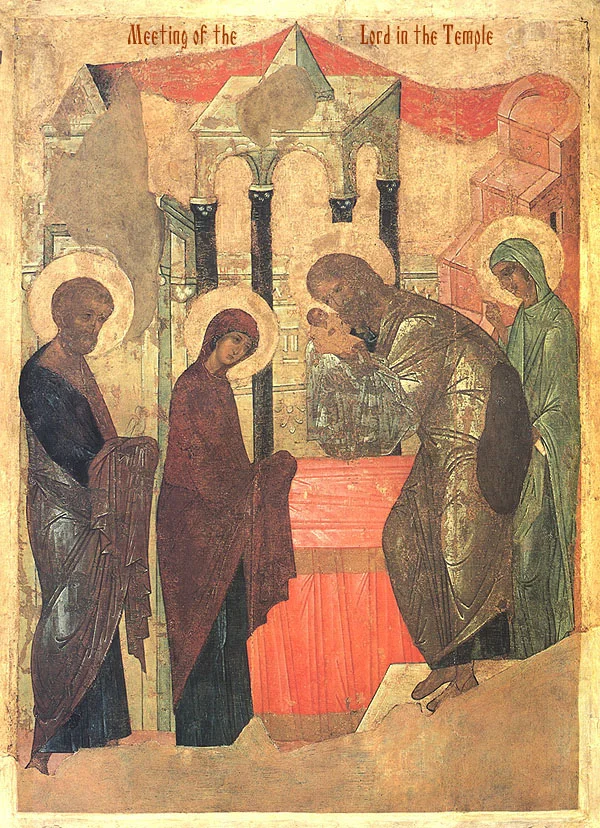
"Then took [Symeon Jesus] up into his arms, and blessed God, and said, 'Lord, now lettest though thy servant depart in peace, according to your word: for mine eyes have seen thy salvation, which thou hast prepared before the face of all people; to be a light to lighten the Gentiles and the glory of thy people Israel.' And Joseph and his mother marveled at those things which were spoken of him. And Symeon blessed them, and said unto Mary his mother, 'Behold, this child is set for the fall and rising again of many in Israel; and for a sign which shall be spoken against; (yea, a sword shall pierce through thy own soul also), that the thoughts of many hearts may be revealed."
My beloved spiritual children in Christ Our Only True God and Our Only True Savior,
CHRIST IS IN OUR MIDST! HE WAS, IS, AND EVER SHALL BE.
+++
ON FEBRUARY 2ND OUR HOLY ORTHODOX CHRISTIAN CHURCH COMMEMORATES THE HOLY FEAST OF HYPAPANTE (THE MEETING OF CHRIST) OR PRESENTATION OF CHRIST IN THE TEMPLE
The Holy Gospel According to Saint Luke 2:28-35
"Then took [Symeon Jesus] up into his arms, and blessed God, and said, 'Lord, now lettest though thy servant depart in peace, according to your word: for mine eyes have seen thy salvation, which thou hast prepared before the face of all people; to be a light to lighten the Gentiles and the glory of thy people Israel.' And Joseph and his mother marveled at those things which were spoken of him. And Symeon blessed them, and said unto Mary his mother, 'Behold, this child is set for the fall and rising again of many in Israel; and for a sign which shall be spoken against; (yea, a sword shall pierce through thy own soul also), that the thoughts of many hearts may be revealed."
Synaxarion of the Monastery of the Theotokos Evergetis: 2 January
"Hail, favored one, virgin Theotokos, for from you Christ our God rose, enlightening those in darkness. You too, righteous old man, be glad, having received in your arms the one who sets our souls free and grants us resurrection."
Saint Gregory of Corinth: Epigrams on the Twelve Feasts
"The aged priest Symeon, rejoicing holds now the babe. For the fire takes him from the Virgin's grasp and he is unburnt, and Symeon, shining with light, says: 'Behold, the redemption of the world comes; behold, the light shines upon those who are in shadow. This babe is the King of kings, and he will crush the gates of death, and draw out those who are in the bindings of Hades."
Commentary
The second of February celebrates three related events. The first is the Purification of the Virgin; Jewish law (Leviticus 12:2-8) mandated a period of forty (40) days for ritual purification following the birth of a male child. It was for this reason that it was included as one of the five Marian Great Feasts. Purified, the Virgin is now able to bring her son to the Temple, according to custom (see also Presentation of the Virgin); thus the second event: the Presentation of Christ in the Temple. Finally, at the Presentation occurred the meeting (Hypapante) between the Infant Christ and the old man, Symeon.
The Church appointed this great feast of the Lord and the Mother of God to be celebrated on the 2nd of February because it is the fortieth day after the 25th of December when the Nativity of Christ in the flesh is celebrated. In this way, the year is divided by the turning points in the Divine economy and blesses them. At the same time, it makes it possible for man to be initiated into the great mystery of the Incarnation of the Son and Logos/Word of God.
God Himself, that is to say, the Unincarnate Logos/Word of God, gave the Commandment of purification on the fortieth day to Moses and it has been established for the Israelites. This Commandment was given to Moses even before the exodus of the Israelites from Egypt before they crossed the Red Sea.
According to Saint Gregory Palamas, Christ had no need of purification, but since ritual purification was legislated in the Old Testament for both the parents and the children, He did it in order to obey the law which He Himself had given. Christ had no need of ritual purification because He was conceived without seed and given birth without loss of virginity. "There was certainly no need for purification, but it was an act of obedience." This obedience had the meaning of obedience to the law of God, but also of obedience of the New Adam, in contrast to the disobedience of the old Adam. And if the disobedience of the first Adam resulted in the fall and corruption, the obedience of the New Adam, Christ, brought disobedient human nature back to God and cured man of responsibility for the disobedience.
The bringing of the children in the Temple (church) on the fortieth (40) day was a feast of purification. The mother and child were to be cleansed of the results of the birth.
Certainly, the birth of children is a blessing of God, but it must be realized that the manner in which man gives birth is a fruit and result of the fall; it is the so-called coats of skin, which Adam wore after the fall and the loss of God's grace. It is in this light that we should see the words: 'Behold, I was brought forth in iniquity, and in sin my mother conceived me" (Psalm 50 [51], 5). Eventually, by dispensation God blessed this way in which man is born, but nevertheless, it is a fruit of the fall. Parents, as well as children, should be interpreted in this theological framework.
When we reflect on these theological truths, we can see that neither Christ nor the Panagia had need of purification. Conception without seed and birth without loss of virginity do not constitute impurity.
The Commandment which God gave to Moses said: "If a woman has conceived and borne a male child, then she shall be unclean seven days" (Lev. 12, 2). This passage shows the purity of the Panagia at once because the woman is unclean who is to give birth when she has been fertilized by a man. The Panagia, however, conceived by the Holy Spirit and not germinally, and therefore she was not unclean. This means that it did not apply in her case, but she went to the Temple in order to keep the law. (Source: The Feasts of the Lord. An Introduction to the Twelve Feasts and Orthodox Christology by Metropolitan of Nafpaktos HIEROTHEOS)
(To be continued)
____________________________
"Glory Be To GOD For All Things!" -- Saint John Chrysostomos
+++
With sincere agape in His Holy Diakonia (Ministry),
The sinner and unworthy servant of God
+Father George