
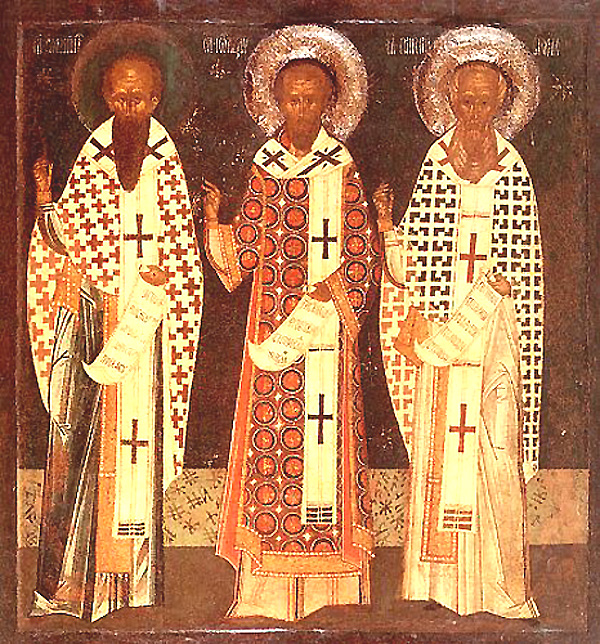
Three Hierarchs--St. Basil the Great, St. Gregory the Theologian and St. John Chrysostom
During the reign of the right-believing and Christ-Loving Emperor Alexius Comnenus, successor to Nicephorus Botaneiates, a dispute arose in Constantinople among the wisest and most eloquent teachers of rhetoric regarding these three hierarchs. Some had the highest respect for the great Basil, calling him the supreme orator, surpassing all in deed and word. They considered him almost equal to the Angels because he was steadfast, cautious in forgiving sins, and a stranger to everything earthly.
My beloved spiritual children in Christ Our Only True God and Our Only True Savior,
CHRIST IS IN OUR MIDST! HE WAS, IS, AND EVER SHALL BE.
+++
ON JANUARY 30TH OUR HOLY ORTHODOX CHRISTIAN CHURCH COMMEMORATES THE FEAST OF THE THREE GREAT UNIVERSAL TEACHERS AND HIERARCHS, BASIL THE GREAT, GREGORY THE THEOLOGIAN, AND JOHN CHRYSOSTOM.
[Based on the account written by John, Bishop of Euchaita]
During the reign of the right-believing and Christ-Loving Emperor Alexius Comnenus, successor to Nicephorus Botaneiates, a dispute arose in Constantinople among the wisest and most eloquent teachers of rhetoric regarding these three hierarchs. Some had the highest respect for the great Basil, calling him the supreme orator, surpassing all in deed and word. They considered him almost equal to the Angels because he was steadfast, cautious in forgiving sins, and a stranger to everything earthly. For the divine Chrysostom, they had less esteem since he was inclined to have mercy on sinners and quickly accepted their repentance. Others extolled the godly Chrysostom more highly than Basil the Great or Gregory the Theologian, as he was loving and condescended to human weaknesses, and by his sweet discourses guided all to remorse for sin. Still other preferred Gregory the Theologian, claiming that his writings were unsurpassed in clarity and expressiveness. Many became involved in the dispute and some scholars began calling themselves Johnites, some Basilians, and some Gregorians.
While matters were in this state, the Three Great Saints appeared in a vision, first individually, then together, to the holy John, Bishop of Euchaita, whose profound knowledge of Greek rhetoric and philosophy is evident from his writings. They told him, "We are equal before God and in complete concord with one another. Inspired by the Divine Spirit, each of us wrote to serve men's salvation. What we were taught mystically, we transmitted openly. There is no first or second among us. Cite one of us, and you will find that the other two are in agreement with him. Command the disputants to put aside their differences, for just as when we were alive, so even now our concern is to bring peace and oneness of mind to the ends of the earth. commemorate us together on a single day, compose a festive service to us, and inform everyone that we share a common rank before the Lord. Trusting that we enjoy God's favor, we promise to further the salvation of those who honor our memory." So saying, they ascended to heaven, surrounded by ineffable light and calling out each other's names.
The holy Bishop John quickly reconciled the factions, for he was esteemed by all because of his virtuous life and wide learning. In obedience to the Saints, he established the feast of the Three Hierarchs and persuaded all the churches to observe it solemnly. His wisdom is evident in the date he chose for the Synaxis of the Saints. Saint Basil the Great is commemorated individually on January 1st, the divine Gregory the Theologian on January 25th, and Saint John Chrysostom on January 27th. Ordaining that their common feast is held on January 30th, he fittingly crowned the celebration with canons, troparia (hymns), and praises.
In conclusion, we should add the following. Saint Basil the Great stood above all the teachers of his own time and antiquity, having mastered the art of oratory and the science of philosophy. He led a most ascetical life, acquired every virtue (especially chastity and voluntary poverty), and was granted the vision of God. He was 40 years old when he became a bishop and died nine years later. Saint Gregory's life was so lofty and holy that it could be portrayed symbolically as a statue of a man atop a pillar constructed of good deeds. Saint Gregory attained the summit of theology, vanquished every adversary by his wise arguments and expositions of the dogmas of faith, and was justly awarded the title "the Theologian." He was a bishop in Constantinople for twelve years, during which time he confirmed the capital in Orthodoxy. According to his Life, he was Patriarch only for a short time and stepped down from his throne because of illness. He was about 59 years old when he departed to heaven. Regarding Saint John Chrysostom, it is fair to say that he surpassed all the sages of ancient Greece in wisdom, clarity of expression, and eloquence. His homilies on the Divine Scripture are superlative. In virtue and the vision of God, Saint John far outshone his rivals. He was a wellspring of mercy and love and had great zeal for preaching. He lived to the age of 60, having served as Archpastor of Christ's Church for 6 years. By the prayers of these Three Great and Holy Hierarchs, may Christ God, Who is forever blessed, quell the uprising of heretics, preserve us in peace and unity, and deem us worthy of His Kingdom. Amen. (Source: The Collection of the Lives of the Saints)
________________________
"Glory Be To GOD For All Things!" -- Saint John Chrysostomos
+++
With sincere agape in His Holy Diakonia (Ministry),
The sinner and unworthy servant of God
+Father George
On Love
Since we have written about many and diverse things, my child, moved by your ardent faith and piety, I considered it good also to write a few things about love (agape) that I have learned from the Holy Fathers who lived before me and from reading the Holy Scripture. However, fearing the height of this supernatural grace, I am overcome by awe, lest I am unable to bring the discourse to an end. All the same, warmed by the hope of your holy prayers, I shall begin the discourse. For how can I, my child, with my own strength write about such a great charisma (gift) which exceeds my strength? And with what tongue can I tell of this heavenly delight and sustenance of the Holy Angels, Prophets, Apostles, Righteous, Martyrs, Monks, and every category of those listed in the heavens?

My beloved spiritual children in Christ Our Only True God and Our Only True Savior,
CHRIST IS IN OUR MIDST! HE WAS, IS, AND EVER SHALL BE.
+++
ON LOVE (AGAPE)
By Geronda (Elder) Joseph the Hesychast, from Monastic Wisdom: The Letters of Geronda (Elder) Joseph the Hesychast. An Epistle to a Hesychast Hermit, Chapter XII, pp. 384-389.
Since we have written about many and diverse things, my child, moved by your ardent faith and piety, I considered it good also to write a few things about love (agape) that I have learned from the Holy Fathers who lived before me and from reading the Holy Scripture. However, fearing the height of this supernatural grace, I am overcome by awe, lest I am unable to bring the discourse to an end. All the same, warmed by the hope of your holy prayers, I shall begin the discourse. For how can I, my child, with my own strength write about such a great charisma (gift) which exceeds my strength? And with what tongue can I tell of this heavenly delight and sustenance of the Holy Angels, Prophets, Apostles, Righteous, Martyrs, Monks, and every category of those listed in the heavens?
Truly, my child, even if I had all the tongues of men since Adam to help me, it still seems impossible to me that I would be able to extol love worthily. What am I saying, "worthily"? A mortal tongue is entirely incapable of even remotely expressing something concerning love, unless God, Who is Truth and Love itself, gives us the power of speech, wisdom, and knowledge. And through the human tongue, this God Himself, our sweet Jesus Christ is both called and praised as God. For love is nothing but the Father and the Savior Himself, our sweet Jesus, together with the Divine Spirit.
Of course, all the other divine gifts of the loving God, such as humility, meekness, abstinence, and so on, have divine sensation when they act upon us through Divine grace. For without the action of Divine grace all these, in general, are simply virtues that we keep to heal our passions because of the Commandment of the Lord.
Before we receive grace, we undergo changes all the time: towards humility and towards pride; towards love and towards hatred; towards abstinence and towards gluttony; towards meekness and towards anger; towards forbearance and towards indignation, etc. However, once we are acted upon by Divine grace, these continuous changes and alterations of the soul cease. Although the body continues to have its elemental and natural changes (namely: cold, heat, weight, fatigue, hunger, thirst, illness, and so on), the soul, fed the action of Divine grace, remains unchangeable in the natural, divine gifts it has been given.
What I mean by unchangeable is this: due to the grace abiding in us, the soul does not change in the divine gifts it has been given by God. Not that it does not change when grace withdraws, but it changes with difficulty due to the soul's firm resolution--it is not completely unchangeable, though.
For we have written also elsewhere in this epistle that as long as we carry about this earthen garment, no one should believe that there is an advanced spiritual state free from danger, except in the presence of Divine grace. Then one senses well every Divine gift and unerringly comprehends them. However, when he reaches the sensation of Divine Agape (Love)--which is God Himself, according to him who said, "God is agape (Love); and he that dwelleth in love, dwelleth in God, and God in him" (1 John 4:16)--how can a tongue, which is mortal and has no divine action, suffices to converse about God and His Holy Gifts?
Today, many virtuous people who live good lives, who please God with their deeds and words, and who benefit their neighbor, think they have (and are thought of having) attained love through their insignificant work of mercy and compassion they show towards their neighbor. But this is not the truth. They are only fulfilling the Commandment of love for the Lord. Who said, "Who said, love one another" (St. John 13:34). He who keeps this Commandment is worthy of praise as a keeper of the Divine Commandments--but this is not an action of Divine Love. It is a road towards the fountain, but not the fountain. It is a royal garment, but not the King. It is a Commandment of God, but not God.
Therefore, he who wishes to speak about love must have revelation of the mystery of love. Only then, if the Fountain of Love, our sweet Jesus, permit, should he impart to others some of the fruit he received; then he shall surely benefit his neighbor. For there is a danger for us to speak erroneously, to think turbidly, and to believe we know things that we do not.
So then, my beloved child, know this for certain fulfilling the Commandments of love through works done for mutual brotherly love is one thing, and the action of Divine Love is another. All men are able to fulfill the Commandment of brotherly love if they want to and if they force themselves. Divine Love, though, neither results from our works, nor does it depend on our will--if we want, and how we want, when we want, and how we want. But it depends on the fountain of agape (love), our sweetest Jesus, Who gives us if He wants, how He wants, and whenever He wants.
When we walk in simplicity, keep the Commandments, and patiently and persistently seek Divine Love with tears and pain, guarding Jethro's sheep like Moses (vid. Exodus 3:1)--that is, guarding the good and spiritual movements and meditations of the nous during the heat of the day and the frost of the night of continuous battles and temptation, which we crush with our struggle and humility--then we are counted worthy of seeing God and the Bush in our hearts, burning with Divine fire of love, burning but not consumed. And having approached it through noetic prayer, we hear the Divine voice in a mystery of spiritual knowledge saying, "Put off thy sandals from thy feet!" (Exodus 3:5). That is, put off from yourself every self-will and worry for this age as well as all childish thoughts, and be subject to the Holy Spirit and His Divine Will, "For the place whereon thou standest is holy ground" (Exodus 3:5).
"...So my child, blessed is the hour in which--if we are worthy--we present our soul clean to the Lord and rejoice together with all of those we mentioned, where for all, in all, and over all reigns Jesus Christ, the sweet Savior; God the Father; the Beloved, Holy, Good, Peaceful, Life-Giving, Life-creating Spirit--the Holy, Indivisible Trinity, now and ever, and unto the infinite ages of endless ages. Amen. (Source: Orthodox Heritage)
_______________________
"Glory Be To GOD For All Things!" -- Saint John Chrysostomos
+++
With sincere agape in His Holy Diakonia,
The sinner and unworthy servant of God
+Father George
The Holy Fathers on the Gift of Foresight
As we analyze this major subject, we ought to look at the teaching of the holy Fathers on this important charisma (gift) which is associated with the gift of the discernment of spirits.

My beloved spiritual children in Christ Our Only True God and Our Only True Savior,
CHRIST IS IN OUR MIDST! HE WAS, IS, AND EVER SHALL BE.
+++
THE HOLY FATHERS ON THE GIFT OF FORESIGHT
By His Eminence Metropolitan of Nafpaktos HIEROTHEOS
As we analyze this major subject, we ought to look at the teaching of the holy Fathers on this important charisma (gift) which is associated with the gift of the discernment of spirits.
This gift is not a human ability, but an energy of God in the one who has been purified and has become the house of God, someone in whom God dwells. It is the gift of grace to the spiritual man, who has the Holy Spirit within him. Saint Macarius the Egyptian says that the spiritual man "knows from what viewpoint each one speaks, and where he stands and what levels of perfection he has already experienced." He says this with reference to the passage from Saint Paul: "he who is spiritual judges all things, yet he himself is rightly judged by no one" (1 Corinthians 2:15). Saint Gregory of Nyssa says that the power to oversee things is a characteristic property of the divinity. If someone has within him the One for Whom he longs, "he too gains the ability to watch over and examine the nature of created things." Consequently, man becomes capable of overseeing and knowing the real nature of things through God's energy.
This energy of God that enables man to oversee things and the gift of clear sight is given to those who have been purified of the passions, in proportion to their purification. Saint Anthony the Great teaches that "When the soul is purified in every way", and is in its natural state, at its natural limits, "it is clear-sighted and sees better and further than the demons because it has the Lord Who reveals things to it." The man of God is clear-sighted on account of the presence of Christ within his heart. He knows things that even the devil does not know. The devil only knows what is happening now, he never knows what will happen in the future. Saint Isaac the Syrian also speaks about the purity of the soul that makes someone clear-sighted. He writes that, if people cleanse themselves and return to their "original created state", then they are able to see "the order below them, the one above, and each other". In other words, they see the Angels and the demons. And he writes that they see them in their existing state, without them having been previously changed into bodily form. Saint Isaac the Syrian asks why it is necessary to be purified first. He answers that it is essential because, although those who are impure can occasionally see Angels and demons, they can only see them with their bodily eyes. The Saints, who have been purified, see spiritually with the eye of their soul. He writes that, in contrast with those who are impure, "the purified soul sees in a spiritual manner with a natural eye, that is, the clairvoyant eye of insight." It is essential for someone to be purified in order to receive this great gift of grace. (Source: The Seer. The Life of the Prophet Samuel and its Relevance Today by Metropolitan of Nafpaktos Hierotheos)
___________________
"Glory Be To GOD For All Things!" -- Saint John Chrysostomos
+++
With sincere agape in His Holy Diakonia (Ministry)
The sinful and unworthy servant of God
+Father George
Natural Death and the Work of Perfection (Part II)
In some Western Christian groups, radiant health and youthful vigor are seen as proof of the vitality and validity of one's faith (this is undoubtedly the most recent incarnation of the Puritan doctrine of predestination and a sign that one is among the "elect".) According to this view, illness is to be banished at all cost and death must be pushed away as far and as long as possible.

My beloved spiritual children in Christ Our Only True God and Our Only True Savior,
CHRIST IS IN OUR MIDST! HE WAS, IS, AND EVER SHALL BE.
+++
NATURAL DEATH AND THE WORK OF PERFECTION (Part II)
By Father Alexey Young from "Christian Bioethics"
In some Western Christian groups, radiant health and youthful vigor are seen as proof of the vitality and validity of one's faith (this is undoubtedly the most recent incarnation of the Puritan doctrine of predestination and a sign that one is among the "elect".) According to this view, illness is to be banished at all cost and death must be pushed away as far and as long as possible. In its most extreme form, this theology is expressed by Christian Scientists (who say that pain and death have no reality) or other faith-healing denominations. This idea, however, is of relatively recent origin in the West and may actually have contributed to our culture's obsession with avoiding suffering and illness, particularly in connection with the dying process. Without its Calvinistic underpinnings, however, this view easily lends itself to the desirability of suicide or physician-assisted suicide, for if one cannot completely avoid pain and suffering (these being among the very highest values of contemporary Western man), death should then be hastened in order to avoid that which is seen as "negative," "bad," o without any redeeming value. Death becomes "good" and causing death may even be a "virtue."
Orthodox Christians, on the other hand, have always believed, and still, do, that the highest way to serve God is not out of expectation of any kind of reward but simply out of love. The act of loving God is thus seen as a reward and a goal in itself. This does not mean that one cannot ask God for bodily (as well as mental and spiritual health--Orthodox Christians, for instance, constantly pray for "health, salvation, and welfare" in our Divine services--but such well-being is not seen as an end itself, nor is a lack of health seen as "bad" or a sign of spiritual weakness (unless, of course, one has ruined one's own health through poor stewardship of the body).
This reflects still another ancient Christian idea, preserved today primarily by Orthodox Christians: that suffering and sorrows, when carried in the shadow of the Cross, have value:
"Church Tradition relates that Saint John the Merciful, after completing a Divine service, once noticed that a woman was crying bitterly in a corner of the church. He told his deacon: "Go and bring that woman, so that we can find out why she is so grieved: whether her husband has died, or her children are sick, or God has sent her some other misfortune."
The deacon brought the woman to the Saint. When Saint John asked her why she was crying so inconsolably, she said: "How can I not cry, holy father! Three years have passed, and no sorrow has come to us. It seems that God has forgotten us completely. There is no sickness in the home, no ox has been lost, nor has a sheep died, and my family has begun to live carelessly. I am afraid that we will perish because of our easy life, and that is why I am crying." The bishop-Saint marveled at that answer and praised God.
In such a way the Christians of the past have considered suffering to be sent from God and have grieved when they did not have sorrows...
Similarly, Saint Ignatius Brianchaninove explains:
"A sorrowless earthly life is a true sign that the Lord has turned His face from a man, and that he is displeasing to God, even though outwardly he may seem reverent and virtuous."
The Saints Show Us How to Die
Orthodox Christianity not only possesses a body of abstract theology and doctrine but also contains what could be called living theology or "theology in action"--which is the Lives of the Saints. Thus, "the Christian experience is the same across generations. From the inside, one will experience this unity as a bond of God across the generations of Christians. Dogmas are not simply to be known but experienced and lived."
This is where the Saints can be of help, for their lives are not intellectual arguments but actual experience. Such a traditional and rich Christian theology reflects and describes the process of sanctification and transfiguration rather than being reduced either to theological theories or twentieth-century political-sociological principles. Therefore the Saints--that is, those who have been specially chosen by the Holy Spirit and revealed to the Church for special honor and emulation by the faithful--are actually "theology incarnate." This gives them practical power in the day-to-day lives of the faithful, for they often provide better and more accessible models for how to live and die than could many learned volumes by the fathers of the Church. Thus, Saint John of Kronstadt exhorts his readers:
"Call upon the Saints, so that seeing every virtue realized in them, you may yourself imitate every virtue...When your faith in the Lord, whether in health or in sickness, in prosperity or poverty, whether at any time during this life, or at the moment of leaving it, grows dim from worldly vanity or from illness and the terrors and darkness of death, then look with the eyes of your heart and mind upon the companies of the Saints...These living examples, so numerous, can strengthen the wavering faith in the Lord and the future life of each and every Christian communities who do not venerate the Saints...lose much in devotion and in Christian hope. They deprive themselves of the great strengthening of the faith by the examples of men like unto themselves."
Accordingly, if we look at the various ways in which traditional Christian Saints arrive at the moment of death--almost always through pain and suffering of a "final illness," just like everyone else--we can see healthy and congruent models not only of what is called a "holy death" but vivid descriptions of how traditional Christians in fact die. (Source: Orthodox Heritage)
_____________________________
"Glory Be To GOD For All Things!" -- Saint John Chrysostomos
+++
With sincere agape in His Holy Diakonia (Ministry),
The sinner and unworthy servant of God
+Father George
The Life of Our Father Among the Saints, Gregory the Theologian
Saint Gregory the Theologian was born near Nazianzus, a town in Great Cappadocia. His parents, Gregory and Nonna, were of noble ancestry and respected by all; however, the elder Gregory, being the child of a pagan father and a Jewish mother, was not a Christian in his younger years. He belonged to the sect of the Hypsistarii, which combined heathen and Judaic error. The blessed Nonna was the daughter of Christians and was herself an Orthodox Christian from childhood. She was reared in piety and perfectly instructed in the fear of God, which is the beginning of all wisdom. Providence allowed her to be wed to an infidel, so that "the unbelieving husband" might be "sanctified by the" believing "wife" (1 Corinthians Ch. 7) as the Apostle says. Nonna constantly exhorted her husband to accept the true faith, and what is more, fervently prayed for him. Eventually her entreaties secured God's intervention.

My beloved spiritual children in Christ Our Only True God and Our Only True Savior,
CHRIST IS IN OUR MIDST! HE WAS, IS, AND EVER SHALL BE.
+++
THE LIFE OF OUR FATHER AMONG THE SAINTS GREGORY THE THEOLOGIAN, PATRIARCH OF CONSTANTINOPLE
Saint Gregory the Theologian was born near Nazianzus, a town in Great Cappadocia. His parents, Gregory and Nonna, were of noble ancestry and respected by all; however, the elder Gregory, being the child of a pagan father and a Jewish mother, was not a Christian in his younger years. He belonged to the sect of the Hypsistarii, which combined heathen and Judaic error. The blessed Nonna was the daughter of Christians and was herself an Orthodox Christian from childhood. She was reared in piety and perfectly instructed in the fear of God, which is the beginning of all wisdom. Providence allowed her to be wed to an infidel, so that "the unbelieving husband" might be "sanctified by the" believing "wife" (1 Corinthians Ch. 7) as the Apostle says. Nonna constantly exhorted her husband to accept the true faith, and what is more, fervently prayed for him. Eventually her entreaties secured God's intervention. Although he did not know or wish to learn how to pray, her husband saw himself in a dream chanting the psalms of David, which he had never read before, but had only heard his wife recite. The words he intoned were the following: "I was glad because of them that said unto me: let us go into the house of the Lord" (Psalm 121). As he chanted, sweet compunction filled his heart. He awoke rejoicing and told Nonna everything. She understood that God was calling her husband to His Holy Church, and began with even greater fervor to teach him about the Christian faith and urge him to the path of salvation. It so happened that Leontius, Bishop of Caesarea in Cappadocia, was passing through Nazianzus on his way to Nicaea, where the First Ecumenical Council was about to begin. The blessed Nonna took her husband to Leontius, who baptized him. After his Baptism, Gregory led a God-pleasing life, as befits a true Christian. He also excelled in piety and good works that he later became Bishop of Nazianzus.
Living with such a man in honorable wedlock, Nonna naturally desired to bear him a son. She prayed to the Giver of all blessings, and even before conceiving promised, as once did Hannah, mother of Samuel, to dedicate her child to God. The Lord, Who does "the will of them that fear Him" and hears "their supplications", fulfilled the request of that devout woman, revealing to her in a dream the birth of a son, the child's physical appearance, and his name: Gregory, after his father. Nonna thanked God form the depths of her heart and entrusted the child to providence, offering the fruit of prayer as a gift of the Lord; however, she did not have the babe baptized. In those days many Christians were not baptized as infants; instead, their initiation was deferred until they were thirty years old, the age at which Christ Our Lord was baptized by Saint John the Baptist in the river Jordan. Saint Gregory's Baptism was delayed until he reached that age, in accordance with the tradition. Subsequently Gregory himself, Basil the Great, Gregory of Nyssa and other holy Fathers condemned this practice.
After the holy Gregory's birth, the blessed Nonna bore another son, Caesarius, and a daughter, Gorgonia. She reared the in piety and taught them to read and write. Meanwhile Gregory, wishing to acquaint himself more perfectly with rhetoric, philosophy, and the other branches of secular Hellenic (Greek) learning, sailed first to Caesarea of Palestine (famous at that time as a center of scholarship, and the home of the eminent rhetorician Thespesius), then to Alexandria, where he gathered treasures of wisdom from many teachers and enriched his mind. He went to Athens and there devoted himself to his studies and was the object of astonishment, because of his keen intellect and chaste way of life.
Gregory was raised in accordance with Christian principles, learned to read and write while still very young, and grew in stature and wisdom. Attentive and diligent in his studies (as befited one bearing the name Gregory). The name Gregory is derived from the Greek word for "vigilant." Gregory surpassed in his intellectual achievements all his schoolmates. Youth did not hinder him from understanding subjects usually investigated only by those whose mental powers had reached their zenith.
He was baptized when he had completed his studies. Saint Basil the Great consecrated him bishop of Sasima, and the Emperor Theodosius quickly called him to the vacant Archiepiscopal throne of Constantinople. His works were manifold, the best-known being this theological writings, for which he received the title 'The Theologian'. He is particularly famed for the depth of his Sermons on the Holy Trinity. He also wrote against the heretic Macedonius, who taught wrongly of the Holy Spirit (that the Spirit was a creature of God), and against Apollinarius who taught that Christ did not have a human soul but that His Divinity was in place of His soul. He also wrote against Emperor Julian the Apostate, his sometime schoolmate. In the year 381 A.D., when a quarrel broke out in the Council concerning his election as Archbishop, he withdrew himself, declaring: "Those who deprive us of the (Archiepiscopal) throne cannot deprive us of God." He then left Constantinople and went to Nazianzus, remaining there is retirement, prayer and the writing of instructive books until his death. And, although he was in weak health all his life, he lived to the age of 70. His holy relics were taken to Rome, and his head to the Cathedral of the Dormition in Moscow. He was, and remains, a great and wonderful light of the Orthodox Church, as much for the meekness and purity of his character as for the unsurpassable depth of his mind. He entered into rest in the Lord in the year 389 A.D. (Source: The Great Collection of The Lives of the Saints and The Prologue from Ochrid)
_________________________
"Glory Be To GOD For All Things!" -- Saint John Chrysostomos
+++
With sincere agape in His Holy Diakonia (Ministry),
The sinner and unworthy servant of God
+Father George
Natural Death and the Work of Perfection
The contemporary debate concerning physician-assisted suicide is predicated, from the traditional Christian standpoint, first, on a belief that illness and suffering have no particular value or purpose and, second, that there is no life after death or, if there is, earthly life is not a necessary preparation or determinative for that life. Traditional Christianity, articulated in some detail by H. Tristam Englehardt in his article, "Physician-assisted suicide reconsidered: Dying as a Christian in a post-Christian age," can also be summarized in the following statement by Saint John of Kronstadt:

My beloved spiritual children in Christ Our Only True God and Our Only True Savior,
CHRIST IS IN OUR MIDST! HE WAS, IS, AND EVER SHALL BE.
+++
NATURAL DEATH AND THE WORK OF PERFECTION
By Father Alexey Young, from "Christian Bioethics".
Illness, Suffering, and the Work of Perfection
The contemporary debate concerning physician-assisted suicide is predicated, from the traditional Christian standpoint, first, on a belief that illness and suffering have no particular value or purpose and, second, that there is no life after death or, if there is, earthly life is not a necessary preparation or determinative for that life. Traditional Christianity, articulated in some detail by H. Tristam Englehardt in his article, "Physician-assisted suicide reconsidered: Dying as a Christian in a post-Christian age," can also be summarized in the following statement by Saint John of Kronstadt:
"In our eyes, illnesses appear only as paiful, unpleasant, indeed terrible...but in God's All-Wise and Most Merciful Providence, not a single illness remains without some profit to our soul...not a single sickness sent to us shall return void...For man the earthly life, life in the body, serves only to prepare us for life eternal...Therefore we must, without delay, make use of this present life to prepare ourselves for that other life to come."
A latter-day father of the Church, Saint Ignatius Brianchninov, further explained that earthly life--this brief period--is given to man by the mercy of the Creator in order that man may use it for his salvation, that is, for the restoration of himself from death to life." This means that the focus of one's life is not primarily here, and therefore not political or sociological, but there, in the next world, in the Kingdom of Heaven. This is vividly illustrated by the final words of the righteous monk, Theodore of Svir (+ 1822) who, on his deathbed, said: "God be blessed! God be blessed! I have crossed the stormy sea of life and endured many troubles, but now the coast is in view."
Given this otherworldly viewpoint, it then follows that "how long we live, what disease or illness accompanies our death--such things are not the proper concern of [traditional] Christians." Afflictions of all kinds, illness, and death came into the world by God's permission in order to frequently, if not constantly, remind us that we are only creatures and in need of spiritual refinement and purification before we can enter the Kingdom of Heaven. This great mystery of suffering applies even to seemingly "innocent" children who sicken and, sometimes, die. The great Optina Elder, Saint Ambrose, explained it thus:
"We should not forget that in our age of "sophistication" even little children are spiritually harmed by what they see and hear. As a result, purification is required, and this is only accomplished through bodily suffering...You must understand that Paradisal bliss is granted to no one without suffering."
The process by which bodily afflictions act upon the soul is explained by Saint Chrysostom:
"But if the body suffers only a little, we make every effort to be free of the illness and its pain. Therefore, God corrects the body for the sin of the soul, so that by chastising the body, the soul might also receive some healing...Christ did this with the Paralytic when He said: Behold thou art made whole; sin no more..." (Source: Orthodox Heritage)
(To be continued)
__________________________________
"Glory Be To GOD For All Things!" -- Saint John Chrysostomos
+++
With sincere agape in His Holy Diakonia (Ministry)
The sinner and unworthy servant of God
+Father George