
Preparing for the Great Feast of Theophany
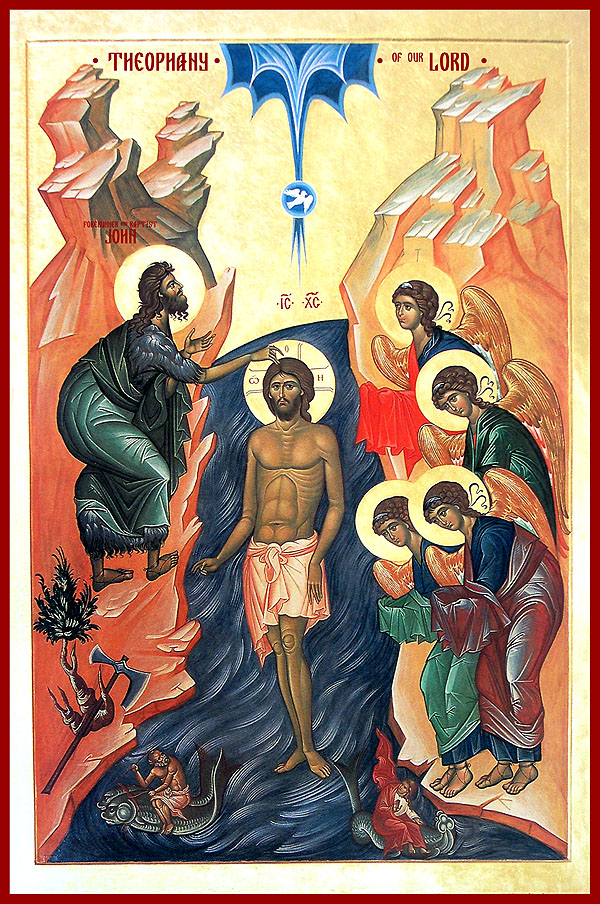
On January 6th our Holy Orthodox Christian Church celebrates the Great Feast of the Theophany of our Lord and God and Savior Jesus Christ. This is one of the greatest of the Christian year and is in a class with Pascha and Nativity. In English, we are accustomed to hearing this Feast called "The Epiphany," a word which means "manifestation." On this day, the Holy Orthodox Church celebrates the remembrance of the Baptism of Jesus Christ in the River Jordan at the hands of Saint John the Baptist and Forerunner. Because of the great significance of the Holy Feast, the day before (The Eve of the Feast, January 5th), is kept as a vigil, with a strict fast.
My beloved spiritual children in Christ Our Only True God and Our Only True Savior,
CHRIST IS IN OUR MIDST! HE WAS, IS, AND EVER SHALL BE. Ο ΧΡΙΣΤΟΣ ΕΝ ΤΩ ΜΕΣΩ ΗΜΩΝ! ΚΑΙ ΗΝ ΚΑΙ ΕΣΤΙ ΚΑΙ ΕΣΤΑΙ.
+++
PREPARING FOR THE GREAT FEAST OF THEOPHANY
On January 6th our Holy Orthodox Christian Church celebrates the Great Feast of the Theophany of our Lord and God and Savior Jesus Christ. This is one of the greatest of the Christian year and is in a class with Pascha and Nativity. In English, we are accustomed to hearing this Feast called "The Epiphany," a word which means "manifestation." On this day, the Holy Orthodox Church celebrates the remembrance of the Baptism of Jesus Christ in the River Jordan at the hands of Saint John the Baptist and Forerunner. Because of the great significance of the Holy Feast, the day before (The Eve of the Feast, January 5th), is kept as a vigil, with a strict fast.
The Hymn of the Feast of Theophany is chanted: "When Thou were baptized in Jordan, O Lord, the worship of the Trinity was made manifest; for the voice of the Father bare witness unto Thee, calling Thee His Beloved Son, and the Spirit, in the form of a dove, confirmed the steadfastness of that word. O Christ Our God, Who did manifest Thyself and do enlighten the world, glory to Thee!"
It is our holy Tradition to hold the Service of the Blessing of the Waters on this day. In ancient times, there were two blessings: one of the water intended for the baptism of those who were about to be received into the Church, and the other a solemn outdoor blessing of the rivers, lakes, and other bodies of water. This latter blessing was in imitation of the tradition of the Christians of Jerusalem who went to the Jordan River to celebrate the festival and in memory of the consecration of the waters of the Jordan at the time Christ was baptized therein. There is an old tradition that upon the Eve of the Theophany and throughout the days closely following, all the waters of the earth are especially sacred, because of their part in the Baptism of the Lord.
Present practice is to bless the waters at the conclusion of the Divine Liturgy on the January 6th. The Officiating Priest prays that the Almighty God, Father, Son and Holy Spirit, will grant sanctification, blessings, purification, and bodily health to those who partake of the Holy Water or are anointed or sprinkled therewith. After the Divine Service he sprinkles all faithful Christians present, and offers the bottles filled with Holy Water for personal and home use throughout the year.
In the days following the Theophany (Epiphany), the Parish Priest goes about blessing the homes and businesses of the faithful Orthodox Christians for their spiritual and material protection and welfare throughout the year to come. It is duty of the Church to sanctify the lives of its faithful, to make them holy, and to insure their salvation by every means at her command.
Saint John of San Francisco reminds of the following: "On Theophany, the Day of the Lord's Baptism, every year a great miracle is performed. The Holy Spirit, coming down upon the Water, changes its natural properties. It becomes incorrupt, not spoiling, remaining transparent and fresh for many years. This Holy Water receives the grace to heal illnesses, to drive away demons and every evil power, to preserve people and their dwellings from every danger, to sanctify various objects whether for church or home use. Therefore, Orthodox Christians with reverence drink Holy Water -- a Great Agiasma (holy thing), as the Greeks call it."
Every Orthodox Christian believer should always have at home enough Holy Water to last the whole year and make use of it at every need: In case of illness, leaving on a journey, whenever one is upset, students prior to examinations, etc. Believers who drink a little Holy Water daily, before eating any kind of food and after they offer their prayers, receive God's blessing.
+
THE DIVINE SERVICE OF THE GREAT HOURS ON THE EVE OF THEOPHANY
In completing the Twelve Days of Christmas, that is the Festal Cycle of the Theophany of the Incarnate Son and Logos/Word of God, Jesus Christ, we come to the Feat of Theophany. A particular feature of the Church Tradition is the divine Service of the Great and Royal Hours, on the Eve.
In fact, this service is not a unified whole, but rather four separate ones linked together. Since they are celebrated together, without any obvious breaks between them, they are thought as one. They are the services of the First, Third, Sixth and Ninth Hours, which make up the familiar Monastic rule of the services of the Great Hours.
The names come from the fact that they were held at particular times during the Byzantine day. Like the Hebrew system of time keeping, that in Byzantium was based on the watches of the day and the night. The first hour of the day in Byzantium was what we would call six o'clock - nationally, sunrise-while the First Hour was held at six o'clock in the evening-representing sunset. The service of First Hour was held at six o'clock in the morning, the Third Hour at nine o'clock, the Sixth at noon and the Ninth at three o'clock in the afternoon.
The reason the Hours on the Eve of Theophany are called 'Great' and "Royal" is because of their Festal content and because they're dedicated to the Baptism of Christ, the King of All, while structurally they are longer and more splendid (Scriptural reading, three hymns and so on). The Hours on the Eve of Christmas and Great Friday also bear this title.
____________________
"Glory Be To GOD For All Things!" -- Saint John Chrysostomos
+++
With sincere agape in His Divine Theophany,
The sinner and unworthy servant of God
+Father George
The Office of Thanksgiving at the New Year
After the Divine Liturgy is ended, the Deacon says: Bless, Master.
Priest: Blessed is the Kingdom of the Father, and of the Son, and of the Holy Spirit, now, and ever, and unto ages of ages.
Cantor: Amen.
THE OFFICE OF THANKSGIVING AT THE NEW YEAR
After the Divine Liturgy is ended, the Deacon says: Bless, Master.
Priest: Blessed is the Kingdom of the Father, and of the Son, and of the Holy Spirit, now, and ever, and unto ages of ages.
Cantor: Amen.
Reader: O Come, let us worship God Our King. O come, let us worship and fall down before Christ, Our King and Our God. O come, let us worship and fall down before the Very Christ, Our King and Our God. O come, let us worship and fall down before Him. (Three reverences.)
Psalm 65
Praise is awaiting You, O God, in Zion; And to You the vow shall be performed. O You who hear prayer, To You all flesh will come. Iniquities prevail against me; As for our transgressions, You will provide atonement for them.
Blessed is the man You choose, And cause to approach You, That he may dwell in Your courts. We shall be satisfied with the goodness of Your house, Of Your holy temple.
By awesome deeds in righteousness You will answer us, O God of our salvation, You who are the confidence of all the ends of the earth, And of the far-off seas; Who established the mountains by His strength, Being clothed with power; You who still the noise of the seas, The noise of their waves, And the tumult of the peoples. They also who dwell in the farthest parts are afraid of Your signs; You make the outgoings of the morning and evening rejoice. You visit the earth and water it, You greatly enrich it; The river of God is full of water; You provide their grain, For so You have prepared it. You water its ridges abundantly, You settle its furrows; You make it soft with showers, You bless its growth.
You crown the year with Your goodness, And Your paths drip with abundance. They drop on the pastures of the wilderness, And the little hills rejoice on every side. The pastures are clothed with flocks; The valleys also are covered with grain; They shout for joy, they also sing.
(The psalmist prays for those who have been fruitless, and have become full of good harvest through faith in God. In the Orthodox Church, v. 4 is used often in prayers for the departed, and for their rest in a place of peace.)
Then the Deacon says the following Litany:
In peace let us pray to the Lord. For the peace that is from above, and for the salvation of our souls. For the peace of the whole world; for the welfare of God's Holy Churches, and for the union of all. For this holy Temple, and for those who with faith, devoutness and in the fear of God have entered therein. For our Archbishop Nathaniel; for the honorable Presbytery, the Diaconate in Christ; for all the clergy and the laity. For this city, and for every city and land, and for the those who with faith dwell therein. That he will graciously accept this present thanksgiving and supplication of us unworthy sinners on His most heavenly Altar, and in His compassion and have mercy upon us. That our prayers may be well-pleasing in His sight, and that He will forgive us and all His people their transgressions, both voluntary and involuntary, which we have wickedly committed in the year that is past. That He will bless the beginning and continuance of this year with the grace of His love for mankind; and will grant unto us peaceful times and favorable seasons, and that we may live without sins...
The Priest offers the following Prayer:
O Master, Lord Our God, the Source of life and of immortality, the Author of all created things both visible and invisible, who has place all seasons and years in Thy power, and dost direct all things with Thy Most-Wise and All-Gracious Providence: We thank Thee for Thy bounties, which Thou hast poured out upon us during our life that is past, and we entreat Thee, O All-Bountiful Lord! Bless the crown of the coming year with Thy goodness: preserve Thy beloved servants, our president, and all the authorities; Multiply the days of their life in health unalterable, and grant them progress in all virtues. Bestow Thy good things from above upon all Thy people, as also health and salvation, and good furtherance in all things. Deliver Thy Holy Church, this city, parish and all cities and lands from every evil assault, and vouchsafe unto them peace and tranquility; and grant that we may always offer thanksgiving unto Thee, the Father Who is from everlasting, together with Thine Only-begotten Son, and Thine All-Holy, Good, and Life-Giving Spirit, God glorified in one Essence, and to hymn Thine All-Holy Name.
Exclamation:
Glory to Thee, O God, Our Benefactor, unto ages of ages. Amen.
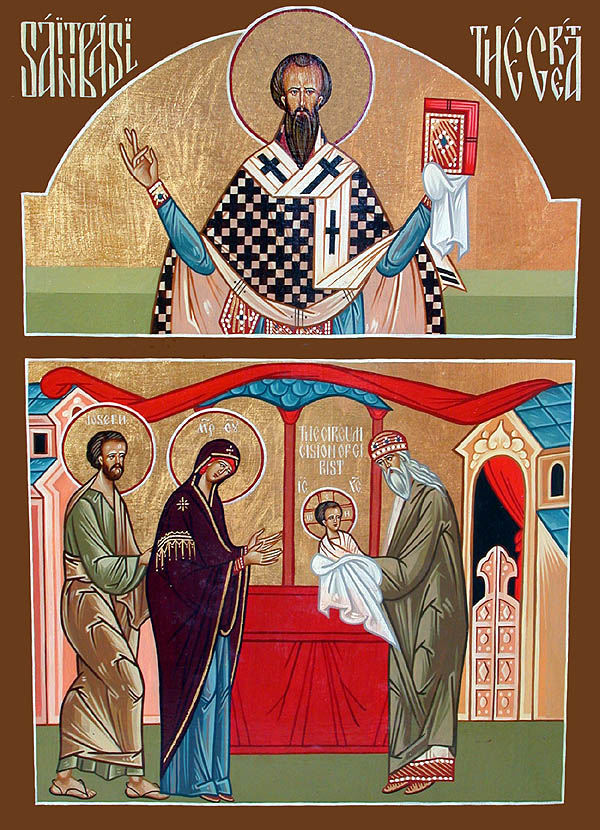
Priest: May Christ, Our True God, Who for our salvation condescended to be circumcised in the flesh, through the prayers of His Most Holy Mother, and of all Saints, have mercy upon us and save us, forasmuch as he is gracious and loveth mankind.
(The holy service above is not presented in its entirety.)
MAY OUR LORD AND SAVIOR JESUS CHRIST BLESS US ALL SO THAT WE MAY HAVE A PEACEFUL, HEALTHY, PROSPEROUS AND SPIRITUALLY UPLIFTING NEW YEAR 2019!
With agape in Christ,
+Father George
January 1-Feast of Saint Basil the Great
Saint Basil, preeminent among hierarchs, wisest of saintly teachers, and wondrous favorite of God, was born in Cappadocia toward the end of the Great Constantine's reign. His father was also named Basil, and his mother, Emmelia. He learned to read at the age of seven, and progressed so rapidly in his studies that five years later he was already engaged in philosophical inquiry. Eventually, he forsook his homeland and moved to Athens, the fount of Hellenic (Greek) wisdom, where he took lessons with the renowned teacher Evvulus, at the same time visiting the schools of Hemerius and Proeresius.

My beloved spiritual children in Christ Our Only True God and Our Only True Savior,
CHRIST IS BORN! GLORIFY HIM!
+++
ON JANUARY 1ST OUR HOLY ORTHODOX CHRISTIAN CHURCH COMMEMORATES OUR FATHER AMONG THE SAINTS BASIL THE GREAT, ARCHBISHOP OF CAESAREA IN CAPPADOCIA.
[Compiled from the writings of Amphilochios, Bishop of Amaseia, and other trustworthy sources.]
+
Saint Basil, preeminent among hierarchs, wisest of saintly teachers, and wondrous favorite of God, was born in Cappadocia toward the end of the Great Constantine's reign. His father was also named Basil, and his mother, Emmelia. He learned to read at the age of seven, and progressed so rapidly in his studies that five years later he was already engaged in philosophical inquiry. Eventually, he forsook his homeland and moved to Athens, the fount of Hellenic (Greek) wisdom, where he took lessons with the renowned teacher Evvulus, at the same time visiting the schools of Hemerius and Proeresius. Basil soon equaled then surpassed his teachers, who were amazed at his diligence and intelligence, and still more at his modesty and purity. In Athens, Basil became friends with Saint Gregory the Theologian, later Bishop of Nazianzus and for a time Patriarch of Constantinople; with Julian, future Emperor of Greece and Rome, and apostate from God; and with the sophist Libanius. Between Basil and Gregory, a warm and unbreakable bond of brotherly love was formed, for both were meek, chaste, and upright. So close did they become, that they seemed to share a single soul.
The wondrous Basil devoted much effort to attain an understanding of Divine mysteries, to the point of neglecting to eat while he resolved whatever question was troubling him. Having dedicated himself for fifteen years to mastering Greek learning, the Saint concluded his studies with investigations into astronomy, but no secular knowledge sufficed to quench his thirst for the waters of true wisdom. One night, while he was meditating on the Only Wise and True God, a Divine ray penetrated his heart, kindling in him a fiery longing to comprehend the Holy Scripture on the most profound level. Leaving Athens and his friend Gregory (who has become a teacher of rhetoric), Basil went to Egypt.
In Antioch Archbishop Meletius ordained Basil to the Diaconate. In Antioch Basil occupied himself with studying the Holy Scripture. Before long he departed for Cappadocia, his homeland. As he was nearing Caesarea, Leontius, Archbishop of that city, had a dream in which he was told of his approach and that Basil would eventually inherit his See. The next morning, Leontius summoned his Archdeacon and several esteemed clergymen, commanding them to go to the eastern gates of the city and bring the stranger that would find there. Leontius was amazed when Basil was presented to him because he was the same man he saw in the dream. He glorified God and asked him his name and whence he had come. Thereupon, he ordered the table set and summoned the clergy and the most eminent citizens. When everyone had assembled, he explained to them his dream. With one voice the clergy exclaimed, "God has indicated your successor to you because of your virtuous life! Do with him as you think best. The Lord has clearly chosen him, and he is worthy of all respect."
In Caesarea Basil became a monk and imitated the manner of life he had observed while visiting the ascetics in Egypt, Palestine, Syria, and Mesopotamia. He was ordained Presbyter (Priest) by Hermogenes, who became Archbishop after Leontius died, and he was appointed instructor of all the monks living in the Diocese. When Hermogenes departed this world, the people wished to have the holy Basil as their Prelate, remembering how he had been forechosen and considering him worthy of the episcopacy, but the Saint, who disliked being held in high esteem, hid from them. Saint Basil retired into the wilderness of Pontus.
The affectionate letters he wrote Saint Gregory the Theologian convince his good friend to join him there. They lived an angelic life together, and soon numerous monks had assembled at their retreat. Guided by the Holy Spirit, the Saints compiled a rule for coenobites. The blessed Emmelia, Saint Basil's mother, who resided in a village across the river Iris, provided their food. She was already a widow and was devoting her remaining years to pleasing God.
Before long, Archbishop Eusebius surrendered his spirit into God's hands while resting in Basil's arms. The Great Basil was elevated to the Archiepiscopal Throne and consecrated by numerous bishops, among whom was Saint Gregory of Nazianzus, father of Saint Gregory the Theologian. Though old and weak, Gregory commanded that he be taken to Caesarea, since he was determined to persuade Basil to be consecrated and prevent the Arians (heretics) from capturing the See. Saint Basil governed the Church of Christ well and ordained his brother Peter to the Priesthood.
Several years passed, and the blessed Basil asked God to send down the grace of the Holy Spirit to enlighten his understanding and give him wisdom so that he might offer the unbloody sacrifice using his own words. Until that time the Greek-speaking Christians had celebrated the Divine Liturgy only in Hebrew. Saint Basil prayed for seven days; then the Holy Spirit descended and he went into ecstasy. Coming to himself he celebrated the Liturgy daily for some time and prepared for the awesome task of writing the new version of the sacred service. Finally, with prayer on his lips and his heart full of faith, the Great Hierarch began work. That night he returned to church, and while he was setting out bread and wine on the Table of Preparation (Prothesi), the Lord appeared to him with the holy Apostles. Saint Basil fell prostrate, but Christ raised him up and said, "In accordance with your supplication, your mouth shall be filled with praise, and you will perform the service using your own words". The Lord shone with glory so bright that Basil, who was shaking with fear, could not endure to look upon Him. When the vision ended, the Saint took a scroll and wrote in Greek the following words: "Let my mouth be filled with praise, that I may hymn Thy glory" (Psalm 70). Then he began the service, the Liturgy that came to be known by his name (The Liturgy of Saint Basil the Great), with such prayers as, "O Lord Our God, Who has fashioned us and brought us into this life", and the prayer at the Elevation: "Attend, O Lord Jesus Christ Our God, from Thy Holy habitation and from the Throne of the Glory of Thy Kingdom, and come Thou to sanctify us, Thou Who art seated on high with the Father, yet invisibly remainest with us here. By Thy Mighty hand vouchsafe to bestow the Holy Things which are for the holy upon us, and through us upon the people". Afterwards, Saint Basil recorded these prayers and the others on the scroll. The clergy of the higher rank saw a heavenly Light illuminating the Sanctuary and the Bishop as he offered the Holy Eucharist, and radiant men clothed in white garments surrounding the Great Hierarch. Awestruck, they fell to the floor, weeping and Glorifying God.
While in church and still instructing the newly baptized at length in the mysteries of Eternal Life and addressing a final discourse to his rational sheep. Then, having exchanged a last kiss with everyone and forgiven all, he thanked God for the ineffable blessings he had enjoyed throughout his lifetime and surrendered his soul into the hands of the Lord. The holy Basil was 45 years old when he departed this life. He shepherded the Church of God for eight years, six months, and sixteen days in all. (Source: The Great Collection of the Lives of the Saints)
_______________________
"Glory Be To GOD For All Things!" - Saint John Chrysostomos
+++
With sincere agape in His Holy Nativity,
The sinner and unworthy servant of God
+Father George
January 1-The Feast of the Circumcision of the Lord
Eight (8) days after His Nativity, our Lord Jesus Christ deigned to be circumcised. He submitted to circumcision, first of all, to fulfill the Law. "Think not that I am come to destroy the Law", said He; "I am not come to destroy, but to fulfill" (St. Matthew, Ch. 5). He subjected Himself to the Law to free transgressors subject to the Law, as the holy Apostle teaches: When the fullness of time was come, God sent forth His Son, made of a woman, made under the Law, to redeem them that were under the Law" (Galatians, Ch. 4).

My beloved spiritual children in Christ Our Only True God and Our Only True Savior,
CHRIST IS BORN! GLORIFY HIM!
+++
ON THE FIRST DAY OF THE MONTH OF JANUARY OUR HOLY ORTHODOX CHRISTIAN CHURCH COMMEMORATES THE FEAST OF THE CIRCUMCISION OF THE LORD JESUS CHRIST
Eight (8) days after His Nativity, our Lord Jesus Christ deigned to be circumcised. He submitted to circumcision, first of all, to fulfill the Law. "Think not that I am come to destroy the Law", said He; "I am not come to destroy, but to fulfill" (St. Matthew, Ch. 5). He subjected Himself to the Law to free transgressors subject to the Law, as the holy Apostle teaches: When the fullness of time was come, God sent forth His Son, made of a woman, made under the Law, to redeem them that were under the Law" (Galatians, Ch. 4). By being circumcised, He demonstrated also that He had truly assumed human flesh, silencing the heretics who taught that His birth was an illusion. Christ's circumcision clearly showed that He had put on our nature, for how can fleshless being undergo circumcision? Saint Ephraim the Syrian asks, "If Christ was not in the flesh, who was it that Joseph circumcised? Verily, Christ was incarnate, was circumcised as the Son of man, was reddened by His own infant blood; He suffered and cried from pain, in accordance with human nature" (Saint Ephraim, Homily on the Transfiguration of the Lord). Furthermore, His physical circumcision foreshadowed our spiritual circumcision. Fulfilling the ancient, external Law, He ushered in the new, spiritual law. The Old Testament commanded that fleshly man of the New Testament is taught to cut off the passions of the soul: anger, jealousy, pride, unclean desires, and other sinful inclinations. Christ was circumcised on the eighth (8) day to indicate that we are enrolled as inheritors of the future life by being marked with His blood, for the eighth day is the symbol of eternity, according to the Teachers (Fathers) of the Church. In the fourth ode of the Canon for the feast, the Venerable Stephen of Saint Savva's Lavra writes, "The eighth day, whereon the Master was circumcised, is an image of the everlasting life of the age to come." And Saint Gregory of Nyssa tells us, "The Law dictated that a child be circumcised on the eighth day, the number eight being symbolic of the future age." (Saint Gregory of Nyssa, Homily on the Lord's Circumcision. The number seven in the Holy Scripture indicates the fullness of time so that all the millennia from the beginning of creation till the present are spoken as
"seven days"; the eighth day, then, is the age to come. Tr.)
Circumcision was the Old Testament foretype of Holy Baptism and of the expurgation of ancestral ('original') sin by Christ's blood shed willingly at the Passion. As such, it could not actually wipe out the transgression of our first parents. The ancient rite was an antecedent of true purification but was not the cleansing itself, which our Lord (Who submitted the New Testament Baptism of grace by water and the Spirit for Old Testament circumcision) performed when He took sin "out of the way, nailing it to His Cross" (Col., Ch. 2). Circumcision was a punishment, as it were, for ancestral ('Original') sin, and a reminder that children are conceived in iniquities, as David says, (Psalm 50[51]). Like the scars of sin on their souls, the scars of circumcision remained on the flesh of infants. Christ, however, was born sinless: like us in every other way, He was a stranger to all iniquity. The brass serpent which Moses fashioned in the wilderness resembled a living snake, but had no venom; similarly, Christ, while possessing our nature, was born supernaturally and without sin of a blameless, unwedded mother. He had no need of enduring the painful wounds of circumcision, being sinless and Himself the Giver of the Law; nonetheless, He underwent the rite like a sinner. In coming to us, He assumed the transgressions of the whole world, as the Apostle says, "The Father "made Him to be sin for us, Who knew no sin" (2 Cor., Ch.5). By His circumcision, the Master showed even greater humility than by His Nativity, for at the Nativity He "made Himself of no reputation, and was made in the likeness of men" (Phil., Ch. 2), as Saint Paul confesses; but at the circumcision the Blameless One appears as a sinner, enduring pain, the penalty for sin. The Innocent One suffered innocently and could say with David, "Then did I restore that which it took not away" (Psalm 68), that is, "I suffered for sins I did not commit." Circumcision was the beginning of Christ's sufferings on our behalf, a foretaste of the cup from which He drank the bitter dregs on the Cross, when He cried, "if is finished" (St. John, Ch. 19). Now blood drips from the extremity of His flesh; later, rivers of blood will flow from every member of His body. It is helpful to gain proficiency at an early age in skills needed for later life, so He begins to suffer in infancy, becomes accustomed to suffering, and as a grown man can endure the cruelest of sufferings...
On this day the Divine Babe also received the name Jesus. When the Archangel Gabriel descended from heaven and appeared to the Most Pure Virgin Mary, he made known that her Son would be called thus; whereupon, she consented to the tidings and cried, "Behold the handmaid of the Lord; be it unto me according to thy word" (St. Luke, Ch. 1). Immediately, the Logos/Word of God assumed flesh and took up his dwelling in her immaculate, most sacred womb. At His circumcision, the name disclosed by the Herald before the Virgin conceived was formerly given to Christ the Lord to announce the coming of our salvation. Jesus means salvation, as the same Angel explained to Joseph in a dream, saying, "Thou shalt call His name Jesus, for He shall save His people from their sins" (St. Matthew, Ch. 1). Similarly, the holy Apostle Peter declared, "There is none other name under heaven given among men, whereby we must be saved" (Acts, Ch. 4). The saving name of Jesus was reserved by the Pre-Eternal counsel of the Holy Trinity for our salvation, and on this day the righteous Joseph brings it forth like a priceless pearl from heaven's treasury, so that it may be used to redeem the whole human race. In it are revealed, "the hidden and secret things" of God's wisdom (Psalm 50). It shines on the world like the sun, as the Prophet tells us: "To you that fear My name shall the Sun of Righteousness arise" (Malachi, Ch. 4). It fills creation with the fragrance of myrrh, as it is written: "Thy name is ointment poured forth" (Song of Sol., Ch. 1). It is poured out and no longer hidden. So long as myrrh is kept enclosed in a jar, its aroma is trapped, but when the seal is broken fragrance fills the air. Similarly, while Jesus' name remained spoken on in pre-eternal counsels, its power remained unknown, sealed as it were, in a jar. When the Infant's Blood was spilled during circumcision, however, it descended from heaven to earth like the sweet smelling myrrh of grace. Now "every tongue" confesses "that Jesus Christ is Lord, to the glory of God the Father" (Phil. Ch. 2). [Source: The Great Collection of the Lives of the Saints)
(To be continued)
__________________________________
DIVINE SERVICES ON JANUARY 1ST:
Orthros (Matins) at 9:00 a.m.
Divine Liturgy at 10:00 a.m.
_________________________________
Please Note: There is no better way to usher in the New Year for an Orthodox Christian and all people, then to begin it with thanksgiving, praise, and worship to our All-Merciful and All-Loving God. We believe that He is always in control of His creation, which includes us and our lives, and therefore with true humility and reverence, we begin by trusting in his loving kindness and compassion. We believe that we depend on Him for everything and that we can do nothing without Him.
Instead of making superficial resolutions that will never be fulfilled by us, let us instead, renew our commitment to follow Him, and make prayer and worship part of our life. It is there, in our sacred church, that we will find comfort, assurance of salvation, peace, and hope. It is there that by the grace of God we strengthen our personal communion with Him.
It seems that on that wonderful and first day of the new year that we would all come together to express our undying love to Him and strengthen the love for one another.
Think of this brand new day as a type of Sunday (Kyriaki) Lord's Day of which it is!
I pray to see you all on New Year's day to celebrate and rejoice a 'new beginning' and a future filled with hope, joy, peace, and a true spirit of brotherhood.
__________________________
"Glory Be To GOD For All Things!" - Saint John Chrysostomos
+++
With sincere agape in His Divine Birth,
The sinner and unworthy servant of God
+Father George
Commemoration of the 14,000 Holy Innocents
When Herod "saw that he was mocked of the Wise Men" (St. Matthew, chapter 2), became "exceeding wroth", both with them and the newborn King of the Jews. He was angry with the Magi because they had failed to return and tell him where the Child was, and with Christ, because he was afraid to lose his kingdom. He thought Christ wished to establish an earthly empire, and failed to understand that the Lord's Kingdom is not of this world. He, therefore, poured out his anger upon innocent children. He sent soldiers armed as if for battle to Bethlehem, with orders to slay every child that was "two years old and under, according to the time which he had diligently inquired of the wise men".

My beloved spiritual children in Christ Our Only True God and Our Only True Savior,
CHRIST IS BORN! GLORIFY HIM! ΧΡΙΣΤΟΣ ΓΕΝΝΑΤΑΙ! ΔΟΞΑΣΑΤΕ!
+++
THE COMMEMORATION OF THE HOLY 14,000 INFANTS SLAIN AT HEROD'S ORDER IN BETHLEHEM (+December 29th)
When Herod "saw that he was mocked of the Wise Men" (St. Matthew, chapter 2), became "exceeding wroth", both with them and the newborn King of the Jews. He was angry with the Magi because they had failed to return and tell him where the Child was, and with Christ, because he was afraid to lose his kingdom. He thought Christ wished to establish an earthly empire, and failed to understand that the Lord's Kingdom is not of this world. He, therefore, poured out his anger upon innocent children. He sent soldiers armed as if for battle to Bethlehem, with orders to slay every child that was "two years old and under, according to the time which he had diligently inquired of the wise men".
He was infuriated by the Wise Men's disdain for his authority and employed every means at his disposal to find out where the Child was, but without success, because Joseph had left for Egypt soon after the rites of purification were performed. For a whole year Herod vainly searched for Christ. Then necessity required him to visit Caesar in Rome, and he became very worried that the people would acclaim the Child king and he would lose his throne. Therefore, he decided to destroy all the infants in Bethlehem, and with them, Christ the Lord. The slaughter of the innocents took place twenty-one months after the Star appeared, in the year following the Nativity, on the 29th of December; therefore, the Holy Church commemorates these blameless sufferers on this day. Because he wished to be certain he had achieved his aim, fearful Herod slew "all the children from two years old and under." "Do not marvel that every infant two years old or less was put to death," says Saint John Chrysostomos. The raging tyrant was a coward, so his order was intended to allow the soldiers no possibility for error" (St. Chrysostom's 7th Homily on Matthew). Efthimius Zigavenus' explanation agrees with Saint John Chrysostom's: "Herod knew that the star appeared some time before the Child was born, and to prevent Christ's escape, commanded that no babe less than two years old survive."
On that day the saying of the Prophet Jeremiah was fulfilled: "In Rama was there a voice heard, lamentation and weeping, and great mourning, Rachel weeping for her children, and would not be comforted, because they are not" (Jeremiah, Ch. 31; Matthew, Ch. 2). Rama was a city on a hill within the allotment of the Tribe of Benjamin. Rachel is another name for Bethlehem, since Rachel, mother of Benjamin and wife of the Patriarch Jacob, was buried there. When the infants were slaughtered in Bethlehem, that is, in Rachel, "the lamentation, and weeping, and great mourning" of the mothers could be heard in Rama, which is not far away.
Both Saint John Chrysostomos and Saint John of Damascus describe how the mothers mourned their slain babes. Saint John Chrysostomos writes: "The mothers pleaded with the murderers, 'Why do you butcher our children? What offence have they committed against you or your king?' But the soldiers were too busy with their grisly work to reply. Nothing could calm the women, who were in a frenzy and cried out with ever-increasing desperation, 'Mercy! Mercy! Have you no mothers? Do you not have wives? Are you not put to shame by our naked breasts? What if these were your children? Have compassion on us; slay us rather than our little babies. We cannot bear to see them destroyed! Take our lives first! Wet your swords with our blood! If these children have committed some wrong, put us to death with them.'
Soon after the massacre of the holy children, divine retribution overtook Herod. According to Saint Theophylact, he "came to a miserable end, with fever, spasms of the bowels, itching, swelling of the feet, rotting of the private parts, breeding of worms, difficulty in breathing, trembling, and spasms in very member, until he spat out his evil soul" (Saint Theophylact, Explanation of Saint Matthew). It is said that he was not satisfied with slaughtering the children of Bethlehem, and that shortly before expiring he executed many of the most noble and eminent citizens of Jerusalem. Herod saw to the destruction of his accomplices, and God to Herod's death: thus the whole band of murderers was wiped off the face of the earth.
Saint Epiphanius, Herod's associate would not permit the holy and wise teacher, that esteemed Prophet, who proclaimed Christ in the Temple before all, to be given a fitting burial. Moreover, they were parties to the murder of the Prophet Zacharias. Saint Gregory of Nyssa, Saint Cyril of Alexandria, and Saint Andrew of Crete tell us that when the Most Pure Virgin Mary entered the Temple with the Child to be cleansed, Prophet Zacharias allowed her to stand with the virgins rather than with the wives. Seeing this, the Scribes and Pharisees were filled with indignation, but Prophet Zacharias announced that this mother remained a virgin after giving birth ('Ever-Virgin'). "Human nature, like everything else, is subject to its Creator;" he said; "therefore, if God so wills, it is possible for a maiden to give birth and not lose her virginity. This Mother is indeed a virgin, and I will not deprive her of the right of standing with the virgins."
The Scribes became furious with Zacharias. They reported to Herod that the Prophet was a brazen law-breaker who had permitted a mother to stand where she ought not and that he had proclaimed the seedless conception of her Son. Within a few days Joseph fled with Mary to Egypt and the unsuccessful search for the Child began. During that time the Scribes' anger at Saint Zacharias and the elder did not cool. Saint Symeon soon breathed his last and was deprived of an honorable burial, while Prophet Zacharias was put to death by Herod, at the instigation of the Scribes. Prophet Zacharias refused to reveal where his son John (St. John the Baptist and Forerunner) was during the massacre of the Bethlemite children, so the king's executioners slew him between the Temple and the Altar. In this way the Scribes and Pharisees rewarded him for permitting the Most Pure One (Theotokos) to stand in the place appointed for virgins.
The holy infants slaughtered for Christ, they reside on high with the Angels, "for of such" children is 'the kingdom of God" (St. Matthew, Ch. 7; St. Mark, Ch. 4; Saint Luke, Ch. 6), in Christ Jesus Our Lord. Unto Him be glory forever. Amen.
_________________________________
"Glory Be To GOD For All Things!" - Saint John Chrysostom
+++
With sincere agape in His Divine Birth,
The sinner and unworthy servant of God
+Father George
St. Stefanos (Stephen), Protomartyr and Archdceacon-December 27
The bloodthirsty hypocrites, preparing to stone Christ's good and faithful servant, removed their outer garments so that they could move more freely, and laid them at the feet of a young man names Saul (later known as Paul), a kinsman of the victim. Saul, it is written, "was consenting unto" Stephen's death (Acts, Ch. 8), being more infuriated with him than any of the others, on account of his fanatical devotion to the ancient Law. "He was very sorry," Saint Chrysostom tells us, "that he did not have innumerable hands with which to stone Stefanos (Stephen), but consoled himself with the thought that may false witnesses were found to kill the martyr, and that he was able to guard their clothing."

My beloved spiritual children in Christ Our Only True God and Our Only True Savior,
CHRIST IS BORN! GLORIFY HIM!
+++
THE HOLY PROTOMARTYR AND ARCHDEACON STEFANOS (STEPHEN)
Part II
The bloodthirsty hypocrites, preparing to stone Christ's good and faithful servant, removed their outer garments so that they could move more freely, and laid them at the feet of a young man names Saul (later known as Paul), a kinsman of the victim. Saul, it is written, "was consenting unto" Stephen's death (Acts, Ch. 8), being more infuriated with him than any of the others, on account of his fanatical devotion to the ancient Law. "He was very sorry," Saint Chrysostom tells us, "that he did not have innumerable hands with which to stone Stefanos (Stephen), but consoled himself with the thought that may false witnesses were found to kill the martyr, and that he was able to guard their clothing."
While the Saint was being murdered in the Valley of Jehoshaphat (the valley of Jehoshaphat is situated between Jerusalem and the Mount of Olives. Through it runs the torrent of Kedron, which has many rocks scattered on its banks), the Most Pure Virgin, with Saint John the Theologian and Apostle, was standing on a hill some distance away, praying fervently to her Son and Lord that He strengthen Saint Stefanos and enable him to endure, and that He receives the Archdeacon's soul into His hands. Oh, how sweet was the death of the holy Protomartyr (First-Martyr)! As the Lord Jesus watched from heaven, and His sweetest Mother and the beloved Disciple looked down from the heights, stones rained upon him. Bloody, weak, and dying, but still standing, he called out, "Lord Jesus, receive my spirit" (Acts, Ch. 7); then his thoughts turned to his slayers and "he fell prostrate." He prayed more fervently for them than he had for himself: his heart ached with compassion for the murderers, and he 'cried with a loud voice, Lord, lay not this sin to their charge.' And when he had said this, he fell asleep." Thus the valiant struggler and Protomartyr finished his course, lying amid blood-stained rocks. His soul flew up through the heavens to reign forever with the King and Lord of Glory, Whom he had been deemed worthy to behold before his death.
The holy Archdeacon was ordained by the Apostles soon after Pentecost. He suffered on the twenty-seventh day of December during the year following Christ's Ascension. He was just over thirty years old and was a handsome man, but the beauty of his soul far surpassed that of his countenance.
Saint Stefanos (Stephen's) corpse was thrown out to become food for beasts and birds and lay a day and a night without burial. On the second night Gamaliel, the renowned teacher of the Jews of Jerusalem (who later, with his son Abib, believed in Christ), sent honorable and trustworthy men to remove the holy relics secretly. Shedding bitter tears, they reverently buried the holy remains on Gamaliel's property in the village called Kaphargamala, which was two miles from Jerusalem. And who would not have wept, asks Saint John Chrysostom, seeing the gentle lamb's body, battered by stones?
Many years later the pious Empress Evdokia, wife of Theodosius the Lesser, went to Jerusalem. At the place where the holy Protomartyr Stefanos was killed and his blood stained the ground, the Empress, wishing to honor Christ, built a magnificent church dedicated to the Saint. Unto our God be glory forever. Amen. (Source: The Great Collection of the Lives of the Saints)
________________________
"Glory Be To GOD For All Things!"--Saint John Chrysostomos
+++
With sincere agape in Our Divine Redeemer,
The sinner and unworthy servant of God
+Father George