
St. Nicholas the Wonderworker, Archbishop of Myra (Part II)
When Nicholas grew up, he showed himself to be an honorable man. He shunned vain conversations, avoided familiar speech with women and refrained from gazing upon them, and spent his time in mental prayer and reading spiritual books.

My beloved spiritual children in Christ Our Only True God and Our Only True Savior,
CHRIST IS IN OUR MIDST! HE WAS, IS, AND EVER SHALL BE. Ο ΧΡΙΣΤΟΣ ΕΝ ΤΩ ΜΕΣΩ ΗΜΩΝ! ΚΑΙ ΗΝ ΚΑΙ ΕΣΤΙ ΚΑΙ ΕΣΤΑΙ.
+++
SAINT NICHOLAS THE WONDER-WORKER (Part II)
The Ordination to the Priesthood of Saint Nicholas
When Nicholas grew up, he showed himself to be an honorable man. He shunned vain conversations, avoided familiar speech with women and refrained from gazing upon them, and spent his time in mental prayer and reading spiritual books. At length, he was deemed worthy of the Priesthood and was ordained by Bishop Nicholas. Just as Saint Nicholas was about to be ordained to the Priesthood, Bishop Nicholas was inspired by the Holy Spirit to utter, before the entire congregation, these Prophetic words regarding his nephew: "Brethren, I see a new sun rising above the earth. Father Nicholas shall comfort and console many of the afflicted and shall dispatch many souls to the Kingdom of the Heavens. Blessed is the flock that shall be vouchsafed such a shepherd; for he will nourish the souls entrusted to him on the pasturage of piety. We shall all find him a ready helper in misfortunes and tribulations." Indeed, all these divine predictions came to be, as the passage of time would clearly evince.
After the Saint was ordained to the Priesthood, one could not recount all his virtues and the good deeds he performed. He engaged in vigils, fasts, continence, and prayers on behalf of the people. Much of this was witnessed by his uncle, Bishop Nicholas, who marveled to find such dedication.
Father Nicholas lost his parents at an early age. He was left not a little inheritance, which he distributed for the poor's food and shelter. He clothed the naked and cared for the orphan and widow. The inheritance was not spent on desires devoid of reason, costly raiment, and all sorts of entertainment, as those pastimes engaged in by today's young people. Although his modest fortune was being distributed towards numerous acts of charity, yet Father Nicholas carefully watched for situations where the need was the greatest.
The Three Maidens
At that time, there was a very wealthy man at Patara who had three beautiful maiden daughters. From the enemy's malice, this father had fallen on hard times and into deep poverty. He then conceived the criminal notion of committing his virgin daughters to harlotry, that by means of this profession their family of four might procure life's necessities. Though the wretched father of these three daughters was resolved to put his scheme into effect, yet the All-Good God, knowing the secret things of the heart, desired to deliver the souls of those three girls from perdition and, at the same time, reveal the concealed virtue of the Saint. What did God therefore dispense in His economy? During that same day, when the father revealed his plan to convert his home into a brothel and to sell his daughters into prostitution, Saint Nicholas, by Divine grace, learned of this impending catastrophe and abhorred it. Thereupon, he was determined to do something about it and made haste to save the maidens' souls from this predicament. The Priest Nicholas bound three hundred (300) gold coins in a handkerchief and secretly went by night to that formerly wealthy father's house. The Saint observed an open window of the house, and cast the handkerchief laden with coins through the window. It landed with a noise, but the Saint did not tarry to see how or by whom it might be retrieved. He instead quickly took himself away under the cover of night, lest any should recognize him; for he was ever mindful of the Gospel words: "Be taking heed not to do your alms before men, in order to be seen by them; otherwise you have no reward with Your Father Who is in the heavens" (St. Matthew 6:11). Moreover, Father Nicholas did not wish to embarrass the sensibilities of the former wealthy man who was now in penury. Thus, he was resolved to act secretly, even as the Savior pronounced in the Sacred Gospel: "When thou are doing alms, let not thy left hand know what thy right hand is doing, so that thine alms (charity) might be in secret (St. Matthew 6:3, 4). The Saint wished to avoid the praise of men that he might receive only praise from God.
Thus, Saint Nicholas practiced almsgiving (charity) in secret. The following morning, when the father and three daughters arose, it was the father who found the bound handkerchief inside his house. He picked it up and untied the knot. Imagine his surprise at beholding the coins! He stood there as one beside himself, and then rubbed his eyes, scarcely believing what lay before him, thinking it was an illusion. After he had composed himself somewhat, he set about collecting and stacking the coins that he might calculate the amount. He found the sum to be exactly three hundred gold coins. What feelings do you think filled his soul in that hour? On the one hand, he rejoiced for the good fortune he was vouchsafed; but, on the other hand, he was filled with desire to learn the identity of his patron. Since he could identify no one as his probable benefactor, he gave thanks to God. Straightway, that same day, after using some of the money for the family's immediate needs, he betrothed his eldest daughter to a certain wealthy man of that city. The father of the bride cherished the hope that, as God dispensed to provide for his firstborn daughter with a dowry, He would furnish dowries for his other two daughters. Thus, after the eldest was duly married, the father's conduct in the use of the money pleased the Saint immensely, as this was according to God's will in the case of all three daughters' futures. Saint Nicholas, with the intention of assisting the second daughter, the prepared another handkerchief with the same amount of coinage. He went quietly and secretly to the house When the father and his two remaining daughters arose in the morning, the father quickly looked to see if he had received anything.
Once again, he discovered a tied handkerchief, which unfurled to reveal the sum of three hundred florins. He marveled at this second occurrence and became consumed with curiosity to learn who had the goodness to bestow such generous gifts. He began imploring God with tears and saying, "God and Lord of mercy, Who dispenses in Thine economy the salvation of man and Who wishes not the death of the sinner but that he should return to life and live. Thou art He Who descended from out of the heavens on account of our sins: reveal to me Thy faithful slave and my benefactor, that I might know who it is that wrought such charity that I might be ransomed from the hands of the devil." This was the prayer and longing of the father. The father next betrothed his second daughter. He still maintained his hope in God that, as the first two daughters were provided for handsomely, in like manner he would find assistance in the matter of his youngest daughter.
From that day, the father was ever attending to that open window in the even his benefactor should appear. The father's plan was to run and see who might be his patron. After the holy Priest Nicholas beheld that the second daughter entered into lawful marriage, he wished to help establish the third daughter. He again prepared a handkerchief with another three hundred coins. The Saint approached the open window secretly by night. Below the window, inside the house, the father with his third daughter waited for their secret benefactor. Then suddenly a bound handkerchief flew in through the window and made a sound as it hit the floor. The father quickly took to his heels. He flung open the door to his house and hastened to overtake the fleeing figure whom he detected at a distance. "Stop! Stop!" he cried, "Do not hide thyself from me!" The Priest Nicholas, observing he was being pursued, ran to avoid being found out. The father immediately recognized Father Nicholas, because the Priest was well-known for both his virtue and noble bearing. The father fell before the Saint's feet and with tears began saying, "I thank thee, O slave (servant) of God, that thou didst pity me, the wretched one, and performed these charitable acts on my behalf, the miserable one. If thou had not overtaken me in my sin, I should have perished in both soul and body in a vile manner." The father attempted to kiss the saint's feet, but Father Nicholas drew away. The Saint, seeing that he was discovered, wished to exact a promise from the father and said, "For the sake of the kindness shown you, do me the favor of saying nothing regarding it for as long as I live; otherwise, I shall hold you responsible before God." The Saint uttered these words and immediately departed. After she was married, the father continued his life in peace, mindful of giving glory to God. Overwhelmed with gratitude, the father kept the secret of this great good rendered by the Saint, and so it was made known much later. It is a deed which encourages us to aspire to such heights as the Saint. His many other acts of kindness and generosity remained concealed, even as he wished. No one learned of his charities, vigils, fasts, and other virtues. God alone fully knows the labors of Saint Nicholas. Nevertheless, we, from the one history given, may ascertain his other achievements done in secret. Again, the Saint was loath to receive the praise of men, for he sought only God's glory. The fact is, however, that as much as Father Nicholas kept concealing his works, so God wished to reveal His servant and honor him; for the good works (works of charity) done by Saint Nicholas honored God.
On account of this history and the Saint's many similar acts, he became the patron of children and the model of the cheerful giver who expects nothing in return. In the East, he is especially venerated by sailors. In Northern Europe, his name was changed to Santa Claus. It was popularized in America by the Dutch Protestants of New Amsterdam, who had converted the name Saint Nicholas to Saint Klaes and then to Santa Claus. Sadly, "Santa Clause" is a caricature and a symbol of consumerism and materialism and Saint Nicholas, his Christian life, virtue, his example of true giving have become obscured. (Source: The Great Synaxaristes of the Orthodox Church)
________________________
"Glory Be To GOD For All Things!"--Saint John Chrysostomos
+++
With sincere agape in His Holy Diakonia (Ministry),
The sinner and unworthy servant of God
+Father George
St. Nicholas the Wonderworker, Archbishop of Myra in Lycia
Nicholas, the namesake of victory ("the name Nikolas come from nike, or the later form nikos, meaning "victory", and laos, which means "people." The etymology of the name may be interpreted as "victorious people, or "victorious with the people." Thus, the Saint's name signifies either victory over a people, that is, either victory over vices, or a victory in the full sense; because by his way of life and doctrine, he taught the peoples to conquer sins and vice.") and our Wonderworking (Miracle-working) Father among the Saints, was born in Patara, a city of Lycia (Southwestern region of Asia Minor or Turkey).
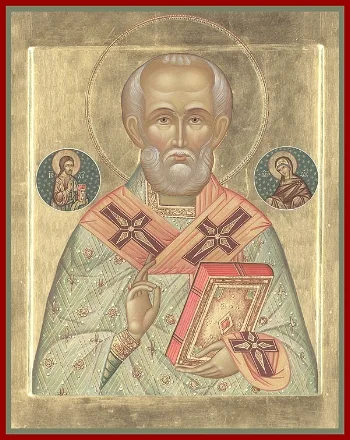
My beloved spiritual children in Christ Our Only True God and Our Only True Savior,
CHRIST IS IN OUR MIDST! HE WAS, IS, AND EVER SHALL BE. Ο ΧΡΙΣΤΟΣ ΕΝ ΤΩ ΜΕΣΩ ΗΜΩΝ! ΚΑΙ ΗΝ ΚΑΙ ΕΣΤΙ ΚΑΙ ΕΣΤΑΙ.
+++
ON THE 6TH OF DECEMBER, OUR HOLY CHURCH COMMEMORATES OUR HOLY FATHER AMONG THE SAINTS, THE WONDER-WORKER, NICHOLAS, ARCHBISHOP OF MYRA IN LYCIA.
Nicholas, the namesake of victory ("the name Nikolas come from nike, or the later form nikos, meaning "victory", and laos, which means "people." The etymology of the name may be interpreted as "victorious people, or "victorious with the people." Thus, the Saint's name signifies either victory over a people, that is, either victory over vices, or a victory in the full sense; because by his way of life and doctrine, he taught the peoples to conquer sins and vice.") and our Wonderworking (Miracle-working) Father among the Saints, was born in Patara, a city of Lycia (Southwestern region of Asia Minor or Turkey). The exact date of his birth is unknown. He flourished during the 300s A.D., the epoch of the impious autocrats Diocletian (384-305 A.D.) and Maximian (286-305 A.D.). Maximian was adopted by Diocletian as his colleague in 286 A.D. Both abdicated power in 305 A.D., in favor, respectively, of the august Galerius (305-311 A.D.) of the East and Constantius 1st (305-306 A.D.) of the West, but Maximian again assumed imperial power in 306 A.D. Saint Nicholas was Archbishop of Myra (a metropolis of Lycia) at that time and continued his episcopacy through the reign of Emperor Constantine I the Great (306-337 A.D.) Constantine was the sole Augustus in the West after the defeat in 312 A.D. of Maxentius (308-312 A.D.), a rival Augustus in the West. In 324 A.D., Constantine became sole Emperor after the death of Augustus Licinius (308-324 A.D.) of the East, who had been sharing power with Galerius until the latter's death. Miximinus (308-314 A.D.), who commanded Asia Minor, was overthrown by Licinius in 324 A.D. Emperor Constantine the Great, upon issuing the Edict of Milan (313 A.D.), ensured full religious freedom for Christians, thus allowing the Christian church to emerge from the catacombs. Saint Nicholas participated in the First Ecumenical Synod at Nicaea, which convened in 325 A.D.
After giving this brief background of Saint Nicholas, we ask that you give great heed to his life's account, which was compiled by Saint Symeon the Metarphrastes. The reader shall receive joy, gladness, and sweet delight.
What wisdom and skill, my Christian brethren, must be in the hands of painters who can imitate the Truth and present things as they appear! More satisfactory, however, and fit for the purpose is the written word, which can clearly describe what is depicted in an image, because the word articulates for the mind and incites the soul toward good works and emulation of people of excellence more than the inanimate image. Indeed, all the narratives and accounts concerning the Saints of God are able to attract the listener to virtue and the practice of doing good. The life of our Holy Father Nicholas and his accomplishments are also able to inspire one to implementation of such deeds as his. This reading offers great delight and joy both to reader and listener who shall eagerly await to hear the next episode of his life. "I am come now," says the hagiographer, "that I might recount the deeds and practices of Saint Nicholas, O blessed Christians; so I beseech you to give ear with fitting diligence."
In the East, in the region of Lycia, there was a city known as Patara which, as was earlier mentioned, was the birthplace of our great Father Nicholas the Wonder-worker. He was the scion of Christian parents, Theophanes and Nonna. They were neither very poor that they might be despised by others, nor very rich that they might become arrogant in their thoughts. They had what was sufficient for their needs; and yet, at the same time, they were able to help the poor with their alms. The virtue of the parents was reflected in their infant son. The Lord says in the Holy Scripture, "The tree is known from the root" (Saint Matthew 12:33). "The parents begat n other son, either before or after their Nicholas, thus making it evident another son would not be able to attain the virtue of Nicholas. Even as infant, Nicholas displayed what he would later become. Every day, except Wednesday and Friday, he took the breast as other infants. He took nourishment only from his mother's right breast, as presaging that he would stand to the Lord's right with the blessed. He partook once daily and only after the setting of the sun. Thus, he abstained and fasted till the ninth hour, before he was eating solid foods. Saint Nicholas practiced strict temperance during his entire life, especially on Wednesday and Friday. The infant was sanctified by the prayer and piety of both his parents, so that from his youth Nicholas' heart and soul were devoted to God. After the birth of Nicholas, his parents, adopted the celibate life. At his Baptism, the infant Nicholas afterward stood up straight in the font for three hours, thus glorifying the Holy Trinity.
This type of behavior was manifest from his youth, which presaged his asceticism and sanctify in adulthood. When he was about five and came of school age, he received sufficient lessons in letters. He avoided the dissolute pleasures and adventures of his peers. Those children who were disorderly or spoke unbecoming words, he turned his back to an avoided. He loved to regularly attend church and keep company with prudent and elderly men, from whom he might receive beneficial spiritual advice, which was his chief work and pursuit. From his youth, whatever he could understand of the sacred writings and Holy Scripture, he was in the habit of committing to memory. On account of his quick mind and the grace of the Holy Spirit, he attained wisdom and knowledge. The Bishop of Patara, who was his father's brother, was also named Nicholas. He also took notice of the lad's pursuits and manner of life. He recommended to the parents that they consecrate their son to the service of God. The parents readily heeded the bishop's good recommendation and consecrated to the Lord the child whom they had received from Him as a gift. (Source: The Great Synaxaristes of the Orthodox Church)
(To be continued. Next: Ordination to the Priesthood)
----------------------------------------------
PLEASE NOTE: The person and image of this great Saint of the Church has been violated, disfigured and distorted by the secular world. It is most important that we rely on our Holy Orthodox Christian Tradition on who he was as a historical figure and a great Saint of our Church. Hopefully you will take time to read his life and works and pass them on to your children. Saint Nicholas, as well as all the Christian Saints, Martyrs, Fathers, Mothers, and Confessors, were, and are, real, and true followers of Christ God. The Saint of the Church are known as 'the friends of Christ.'
As Orthodox Christians we are inspired, taught, and guided by them to come to the knowledge of the Truth, Christ. We learn through their good and virtuous example of what it means to be a genuine Christian and how to live and grow in Christ. The Saints are also our friends who constantly intercede and pray for our salvation.
Every Orthodox Christian who is serious about learning his/her Christian faith must read the lives of the Saints and emulate them in every possible way.
_________________________________
DIVINE SERVICES FOR THE FEAST OF SAINT NICHOLAS:
Vespers will be conducted tonight (Wednesday) at 7:00 p.m. followed by the holy service of Artoklasia (Blessing and 'Breaking' of the Five-Loaves of bread).
Orthros (Matins) on Thursday at 9:00 a.m. followed by the Divine Liturgy at 10:00 a.m.
_________________________________
"Glory Be To GOD For All Things!" -- Saint John Chrysostomos
+++
With sincere agape in His Holy Diakonia (Ministry),
The sinner and unworthy servant of God
+Father George
Our Holy Father Sava the Sanctified

My beloved spiritual children in Christ Our Only True God and Our Only True Savior
CHRIST IS IN OUR MIDST! HE WAS, IS, AND EVER SHALL BE. Ο ΧΡΙΣΤΟΣ ΕΝ ΤΩ ΜΕΣΩ ΗΜΩΝ! ΚΑΙ ΗΝ ΚΑΙ ΕΣΤΙ ΚΑΙ ΕΣΤΙ ΚΑΙ ΕΣΤΑΙ.
+++
OUR HOLY FATHER SAVA THE SANCTIFIED (+ DECEMBER 5TH)
The unknown village of Mutalaska, in the province of Cappadocia, became famous through this great light of the Orthodox Church, for Saint Sava was born there. He left the home of his parents, John and Sophia, at the age of eight and became a monk in a nearby monastery called 'Flavian's'. After ten years, he moved to the monasteries of Palestine, staying longest in the monastery of Saint Efthimius the Great (January 20th) and Theoctistus. Efthimius, who had the gift of discernment, foretold that he would be a famous monk and leader of monks, and that he would found a monastery that would be greater than any other of that day. After Saint Efthimius's death, Sava went into the desert, where he lived for five years as a hermit in a cave which an Angel of God showed him. After that, when he had become a perfected monks, he began by Divine Providence to gather round him many desirous of the spiritual life. They very quickly grew in number, so that Sava had to build both a church and many cells (kellia). Some Armenians also came to him, and he set aside a cave for them, and they celebrated the services there in their own language. When his father died, his aged mother Sophia came to him and he made her a nun and gave her a cell away from the monastery, where she lived in asceticism till her death. This Holy Father endured many attacks from those close to him, from heretics and from demons. But he overcame them all in these ways: those close to him he won over by his goodness and forbearance, the heretics by an unshakeable confession of the Orthodox Christian faith, and the demons with the sign of the Cross and the invocation of God's aid. He had a particularly severe battle with the demons on the mountain of Castellium, where he founded the second of his seven monasteries. He and his neighbor, Theodosius the Great, are considered to be the greatest lights and pillars of Orthodoxy in the East. Kings and Patriarchs were brought to the right Faith by them, and these holy and wonderful men, strong in the power of God, served each and every man as an example of humility. Saint Sava entered into rest in 532 A.D. at the age of 94, after a life of great labor and great reward.
Among all his other great and good works, let this be remembered above all, that he compiled the first Order of Services for use in monasteries, now known as the Jerusalem Typikon.
(Source: The Prologue from Ochrid)
+
FOR CONSIDERATION
A man may be great in some skill, as a statesman or a military leader, but no-one amongst men is greater than the man great in faith, hope and love. The greatness of the faith and hope in God held by Saint Sava the Sanctified is best shown by the following incident: One day the monastery treasurer came to St. Sava and said he would not be able to sound the semantron the following Saturday and Sunday to summon the brethren for the common service and meal, because there was not a trace of flour in the monastery, nor anything at all to eat or drink. For the same reason, even the Divine Liturgy was impossible. The Saint replied without hesitation: "I shall not cancel the Divine Liturgy because of a lack of flour. He who commanded us not to be concerned for bodily things is faithful to His word, and is able to sustain us in a time of hunger.' And he placed all his trust in God. In this extremity, he was prepared to send some of the church vessels and vestments to be sold in the city, so that the divine services might not be foregone, nor the brothers' customary meal. But, before Saturday dawned, some men, moved by Divine Providence, brought thirty mules laden with wheat, wine and oil to the monastery. 'Shall we not strike the semandron and gather the fathers?' The treasurer was ashamed of his lack of faith, and begged the Abbot's (Egoumenos) forgiveness. Saint Sava's biographer called him 'severe with demons, but mild with men'. Some monks rebelled against Saint Sava, and were driven from the monastery by order of Patriarch Elias. They built themselves huts on the bed of the Tekoa river, and lived there in dire straits without the bare necessities of life. Hearing that they were starving, Saint Sava loaded mules with flour and took them to them himself. Seeing that they had no church, he built them one. At first the monks received him with hatred, but afterwards they returned his love with love, and repented of their former evil towards him.
(Please note: Semandron is a long piece of flat wood, shaped for resonance, which is struck rapidly with a mallet. It became widely used in place of a church bell under Turkish rule, when Christians were forbidden to ring bells.) [The Prologue from Ochrid]
____________________________
"Glory Be To GOD For All Things!" -- Saint John Chrysostomos
+++
With sincere agape in His Holy Diakonia,
The sinner and unworthy servant of God
+Father George
The Value of the Old Testament
The Old Testament is made up of 49 books. Together with the New Testament, which consists of 27 books, it constitutes Holy Scripture. The Old Testament has been used continuously in the worship of the Church from the beginning until today. The Psalms are used the most, but readings from other books are also included in various services. Apart from passages inserted in prayers in the Divine Liturgy as well as other services, excerpts from the Old Testament are scattered throughout the language used in worship.

My beloved spiritual children in Christ Our Only True God and Our Only True Savior,
CHRIST IS IN OUR MIDST! HE WAS, IS, AND EVER SHALL BE. Ο ΧΡΙΣΤΟΣ ΕΝ ΤΩ ΜΕΣΩ ΗΜΩΝ! ΚΑΙ ΗΝ ΚΑΙ ΕΣΤΙ ΚΑΙ ΕΣΤΑΙ.
+++
THE VALUE OF THE OLD TESTAMENT
By His Eminence Metropolitan of Nafpaktos HIEROTHEOS
The Old Testament is made up of 49 books. Together with the New Testament, which consists of 27 books, it constitutes Holy Scripture. The Old Testament has been used continuously in the worship of the Church from the beginning until today. The Psalms are used the most, but readings from other books are also included in various services. Apart from passages inserted in prayers in the Divine Liturgy as well as other services, excerpts from the Old Testament are scattered throughout the language used in worship.
In spite of the abundant use made of Old Testament passages in the worship of the Church, many Christians do not read the Old Testament. It is noteworthy that, whereas most of us have read all the New Testament, we do not read the Old Testament at the same time. I could add that we are completely ignorant of it. The Holy Fathers of the Church examine many books of the Old Testament in detail. Saint John Chrysostomos, for instance, reveals the treasures of the Old Testament in a large number of commentaries.
This is important because the Old and New Testaments are closely related. I should like to emphasize a few points that reveal the spiritual link between them. Firstly, the same Holy Spirit inspired the writing of all the books of Holy Scripture. Secondly, the divine inspiration of the holy Prophets and Apostles is not a momentary enlightenment but their inspiration through illumination and deification (theosis). This means that the Old Testament also speaks about illumination and deification (theosis), and they exist there as well. In the analysis of the Prophet Samuel in this book, we shall see that Samuel's mother Hannah, had attained to illumination, because she had noetic prayer, ("noetic is the adjective formed from nous. The nous is the eye of the soul; the purest part of the soul; the highest attention. Noetic prayer is prayed with the nous within the heart, when the nous frees itself from its enslavement to the rational faculty or reason and returns to the heart."), but Samuel also reached deification (theosis). We are also well aware that when Saint Gregory of Nyssa wanted to describe the path that the Christian should follow to be saved, he analyzed the figure of Moses, in his renowned work The Life of Moses. These examples show that illumination and deification (theosis) exist in the Old Testament too. However, this deification (theosis) is temporary. Death is not abolished and the Church is not yet the Body of Christ. There is therefore an identity of experience between the Old and New Testaments. Thirdly, the Old Testament speaks constantly about the coming of the Messiah, whereas the New Testament speaks of the fact that the Messiah has come. In general, the Old Testament is Christ-centered, since it refers to appearances of the Unincarnate Logos/Word. What is more, there are many testimonies in the Old Testament to the Triune God. It is characteristic that, when the Holy Fathers want to speak about the Holy Trinity, they use many arguments from the Old Testament.
After these opening remarks we ought to consider the great figure of the Prophet Samuel. However, as Samuel is the child of Elkanah and Hannah, we shall speak first about his parents.
Elkanah, the Prophet Samuel's father, had two wives, Hannah and Peninnah. It should, of course, be stated, that at the time polygamy prevailed. He had children by Peninnah but Hannah was barren, so he had no children by her. In those days, however, childlessness was regarded as a curse, so Hannah had a problem. Elkanah went up to Shiloh with his two wives to offer sacrifice to God. After the sacrifice he gave Peninnah portions of the sacrifice for herself and for each of her children, whereas he only gave one portion to Hannah. This caused Hannah to grieve. Whenever Elkanah offered sacrifice to the Lord the same thing happened. Nevertheless, Elkanah loved Hannah very much and tried to console her.
As we study this account three points come to our attention: firstly, God's Providence; secondly, Hannah's despondency; and thirdly, Elkanah's reaction. (Source: The Seer: The Life of the Prophet Samuel and its Relevance Today. Birth of the Theotokos Monastery)
(To be continued. Next: God's Providence)
________________________
"Glory Be To GOD For All Things!" -- Saint John Chrysostomos
+++
With sincere agape in His Holy Diakonia (Ministry),
The sinner and unworthy servant of God
+Father George
Holy and Great Martyr Barbara
This famous follower of Christ was betrothed to Him from her early years. Her father, Dioscorus, was a pagan in the city of Heliopolis in Egypt and was famed for his wealth and standing. Dioscorus shut up his only daughter, who was both intelligent and beautiful, in a high tower, surrounded her with all possible comforts, gave her a host of attendants, set up idols for worship and built her a bathroom with two windows.

My beloved spiritual children in Christ Our Only True God and Our Only True Savior,
CHRIST IS IN OUR MIDST! HE WAS, IS, AND EVER SHALL BE.
+++
ON DECEMBER 4TH OUR HOLY ORTHODOX CHRISTIAN CHURCH COMMEMORATES THE FEAST OF THE HOLY AND GREAT MARTYR BARBARA
This famous follower of Christ was betrothed to Him from her early years. Her father, Dioscorus, was a pagan in the city of Heliopolis in Egypt and was famed for his wealth and standing. Dioscorus shut up his only daughter, who was both intelligent and beautiful, in a high tower, surrounded her with all possible comforts, gave her a host of attendants, set up idols for worship and built her a bathroom with two windows. As she gazed through the windows of the tower upon the earth below and the starry sky above, Barbara's mind was opened by the grace of God, and she came to know Him as the One, True God and Creator, although she had no human teacher to bring her to the knowledge of Him. Once, when her father was away from the city, she came out of the tower and, by God's Providence, met some Christians who told her about the True Christian faith. Barbara's heart was set on fire with love for Christ. She had a third window cut in the bathroom as a symbol of the Holy Trinity and traced a Cross with her finger on one wall of it, which etched itself deep in the stone as if cut by a chisel. A spring of water gushed forth from the bathroom floor from her footprint, and it later gave healing from sickness to many. When Dioscorus, her father, found out about his daughter's faith, he beat her harshly and drove her from the tower, chasing after her to kill her, but a cliff opened and hid Barbara from her irate father. When she appeared again, Dioscorus took her to Marcian, the governor of the city, who handed her over for torture. The innocent Barbara was stripped and beaten until her entire body was covered in bloody wounds, but the Lord Himself appeared to her in the prison with many Angels and healed her. A certain woman Juliana, beheld this and conceived a desire for martyrdom herself. Both of them were fearfully tortured and taken around the city to be mocked, then their breasts were cut off and much blood flowed from them. They were finally let out to the place of execution, and Juliana was slain by soldiers while Barbara was killed by her own father. On the same day, lightning struck Dioscorus's house, killing both him and Marcian. Saint Barbara suffered in 306 A.D., and her wonderworking holy relics are preserved in Kiev. Glorified in the Kingdom of Christ, she has appeared many times down to our own days, sometimes alone and sometimes in the company of the Most Holy Mother of God.
+
SAINT JOHN DAMASCENE (+DECEMBER 4TH)
He was first a Minister of Caliph Abdul-Malek, and then became a monk in the Monastery of Saint Sava the Sanctified. For his ardent advocacy of the veneration of holy icons, while still a courtier during the reign of the iconoclast emperor Leo the Isaurian, he was slandered by the emperor to the Caliph, who had his right hand cut off. John fell down in prayer before the holy icon of the Most Holy Mother of God, and his hand was re-joined to his arm and miraculously healed. When he beheld this wonder, the Caliph repented, but John no longer desired to remain at court as a nobleman but to withdraw to a monastery. There, he was from the beginning a model of humility and obedience, and of all the works of asceticism prescribed for monks. He wrote the hymns for the Parting of the Soul from the Body (funeral service), put together the Octoechos, the Irmologion, the Menologion, and the Paschal Canon, and wrote many theological works of an inspired profundity. A great monk, hymnographer and theologian, and a great warrior for the Truth of Christ, Damascene (Damascenos) is counted among the Great Holy Fathers of the Church. He entered peacefully into rest in about 749 A.D., being seventy-five years old.
+
FOR CONSIDERATION
"Obedience, coupled with humility, is the basis of the spiritual life and the foundation of salvation -- the foundation also of the whole edifice of the Church of God."
_______________________
"Glory Be To GOD For All Things!" - Saint John Chrysostomos
+++
With sincere agape in His Holy Diakonia (Ministry),
The sinner and unworthy servant of God
+Father George
Saint Porphyrios (Bairaktaris) the Kafsokalivia-December 2
Saint Porphyrios (Bairaktaris) the Kafsokalyvite (7 February 1906 - 2 December 1991) was an Athonite hieromonk known for his gifts of spiritual discernment, a type of clairvoyance which he sometimes called "spiritual television."

My beloved spiritual children in Christ Our Only True God and Our Only True Savior,
CHRIST IS IN OUR MIDST! HE WAS, IS, AND EVER SHALL BE.
+++
ON DECEMBER 2ND OUR HOLY ORTHODOX CHRISTIAN CHURCH COMMEMORATES THE FEAST OF SAINT PORPHYRIOS (BAIRAKTARIS) OF KAFSOKALIVIA
Saint Porphyrios (Bairaktaris) the Kafsokalyvite (7 February 1906 - 2 December 1991) was an Athonite hieromonk known for his gifts of spiritual discernment, a type of clairvoyance which he sometimes called "spiritual television."
He was born February 7 in the little village of Saint John Karystia, in the province of Evia, Greece. His parents, Leonidas and Eleni Bairaktaris (daughter of Antonios Lambrou), baptized him Evangelos. He was fourth out of five siblings. Only his youngest sister is still alive and is a nun.
His family was quite poor and so Evangelos left school at an early age to assist his family to make more money. At some stage, he found a job working at a grocery store in Chalkidiki and also Piraeus. He was taught to pray the Paraklesis by his father and all other religious matters.
He was tonsured a monk at the age of fourteen or fifteen with the monastic name Nikitas. He served in the Athonite skete of Kafsokalyvia, in the Cell (kellion) of Saint George, under two spiritual fathers: Father Panteleimon and Father Ionnakios. Forced by pleurisy to depart the Holy Mountain, he returned to his birthplace, where he was unexpectedly elevated to the priesthood at the age of 21 by Porphyrios III, Archbishop of Mount Sinai and Raithu.
With the outbreak of World War II, he became a hospital chaplain in Athens, in which post he continued for three decades (1940-1970). His later years were devoted to the construction of the Holy Women's Monastery of the Transfiguration of the Savior.
After 1984 he returned to Mount Athos, occupying the same cell which he had earlier in life been forced to abandon. Through his role as a spiritual father, Elder (Geronda) Porphyrios became known to an ever-wider circle of Orthodox followers. Several complications of stories and sayings attributed to him have been published.
His sainthood was declared by the Synod of the Ecumenical Patriarchate on November 27, 2013. In 2017 the Holy Synod of the Romanian Orthodox Church formally approved the inclusion of Saint Porphyrios the Kavsokalyvite into the Church's calendar on December 2 as well, including his troparion, kontakion, Synaxarion, and icon.
QUOTES
This is the way we should see Christ. He is our friend, our brother; He is whatever is good and beautiful. He is everything. Yet, He is still a friend and He shouts it out, "You are my friends, don't you understand that? We're brothers. I am not...I don't hold hell in my hands. I am not threatening you. I love you. I want you to enjoy life together with Me."
Love Christ and put nothing before His Love. He is joy, He is life, He is Light. Christ is Everything. He is the ultimate desires, He is everything. Everything beautiful is in Christ.
Somebody who is Christ's must love Christ, and when he loves Christ he is delivered from the Devil, from hell, and from death.
The life of the parents is the only thing that makes good children. Parents should be very patient and 'saintlike' to their children. They should truly love their children. And the children will share this love! For the bad attitude of the children, says father Porphyrios, the ones who are usually responsible for it are their parents themselves. The parents don't help their children by lecturing them and repeating to them 'advice', or by making them obeying strict rules in order to impose discipline. If the parents do not become 'saints' and truly love their children and if they don't struggle for it, then they make a huge mistake. With their wrong and/or negative attitude the parents convey to their children their negative feelings. Then their children become reactive and insecure not only to their home but to the society as well." (References: Wikipedia)
_________________________________
"Glory Be To GOD For All Things!" -- Saint John Chrysostomos
+++
With sincere agape in His Holy Diakonia (Ministry),
The sinner and unworthy servant of God
+Father George