
The Labors and Passion of the Holy Apostle Andrew the First-Called (Part II)
"Aegeates answered, 'Are you Andrew, who razes the temples of the gods and teaches the people the sorcerous faith which has recently appeared and which the emperors of Rome have ordered destroyed?'

My beloved spiritual children in Christ Our Only True God and Our Only True Savior,
CHRIST IS IN OUR MIDST! HE WAS, IS, AND EVER SHALL BE.
+++
THE LABORS AND PASSION OF THE HOLY APOSTLE ANDREW THE FIRST-CALLED (OUR PATRON AND PROTECTOR SAINT) [Part II]
"Aegeates answered, 'Are you Andrew, who razes the temples of the gods and teaches the people the sorcerous faith which has recently appeared and which the emperors of Rome have ordered destroyed?'
"The emperors of Rome," said Andrew, 'do not understand what was clearly demonstrated by the Son of God, Who came to the earth to save mankind: that the idols are not gods but the abodes (dwelling places) of unclean demons, enemies of the race of man, which teach men to anger God and cause Him to turn away from them. When God turns from men in anger, the demons lead them astray and enslave them. Finally, their souls issue forth naked from their bodies, possessed of nothing but their own sins.'
"The Jews nailed your Jesus to the Cross because He was a preacher of fables," scoffed Aegeates.
"Andrew replied, 'O, if only you could understand the mystery of the Cross and comprehend that it was out of love for us that the Creator of the human race endured voluntary crucifixion! He knew beforehand when He would suffer and prophesied that He would rise on the third day. At His Mystical (Last) Supper for us, He announced His betrayal, plainly foretold what would befall Him, and went unconstrained to the place where He was delivered into the hands of the Jews..."
"...Speak of these things to those who wish to hear you!' Aegeates said to Saint Andrew had concluded. 'But if you do not sacrifice to the gods, I will have you beaten with staves and then crucified upon the cross which you so glorify..."
"...Saint Andrew passed the entire night teaching the people. The next morning, the Proconsul Aegeates sat on his judgment seat and ordered that Saint Andrew be brought before him. He said to the Apostle, 'Do you agree to cease your foolish preaching of Christ, that you may enjoy the present life with us? It is utter insanity to surrender yourself to torture and fire voluntarily.'
"Answered the Saint, 'I would much prefer to see you believe in Christ and reject the idols. This would bring me true joy! It was Christ that sent me to this land, and I have gained many people for Him here...'
"...Enraged, Aegeates ordered that Saint Andrew be crucified. He did not wish the Apostle to die quickly, but as slowly and painfully as possible, so the hand his hands and feet tied to the cross rather than nailed to it. As the servants of the persecutor led the Saint to the place of execution, the people cried out, 'How has this righteous man, the friend of God, sinned? Why is he to be crucified?'
Saint Andrew entreated the crowd not to hinder his suffering and went to meet his end gladly, teaching the people without interruption. He caught sight of his cross some distance away and cried out in a loud voice, 'Hail, O cross, sanctified by the flesh of Christ and adorned by His members as with pearls! Until the Lord was crucified upon thee, thou wast a thing abhorrent to men, but now they love thee and clasp thee with yearning since the faithful know that thou art a token of great joy and that a rich reward is prepared for those who endure thee! I approach thee boldly and gladly; do thou accept me with joy, for I am the disciple of Him Who was suspended upon thee! O good cross, made beautiful and glorious by the limbs of the Lord which were affixed to thee, long have I desired thee and loved thee ardently! Long have I sought for thee, and now I have found thee, the desire of my heart. Take me from among men and convey me to my Teacher and Redeemer!'
"After saying this, Saint Andrew removed his clothing and gave it to his tormentors. Having bound his hands and feet to the cross with cords, they lifted him up. About twenty thousand (20,000) people stood watching, among whom was Stratocles, Aegeates' brother. He cried out with the others, 'This holy man suffers unjustly!' But Saint Andrew continued to strengthen those who believed in Christ and exhorted them to endure every transitory affliction, teaching them that no suffering can be compared with the reward earned by it.
"On the second day of Saint Andrew's crucifixion, the crowd went to Aegeates' house and cried, 'Remove our good, kind, meek, and wise teacher from the cross! Such a holy and honorable man does not deserve to suffer! Though he has been hanging on the cross for two days, he still does not cease to teach the Truth.'
"Fearing the people Aegeates hastened to take Saint Andrew down; but when Saint Andrew saw the Proconsul with his servants, he said, 'Why have you come here, Aegeates? If you wish to believe in Christ, the doors of grace will be opened to you, as I promised. But if you have come only to remove me from the cross, know that I do not wish to be brought down alive. Already I behold and worship my King; already I stand before Him...
"The servants could not succeed in untying the Saint. One after another, they tried to loose him, but were unable, because their hands at once became numb. Meanwhile, Saint Andrew cried with a loud voice, 'O Lord Jesus Christ, do not permit me to be taken down from the cross upon which I have been suspended for Thy Name's sake! Receive me, O my Teacher, Whom I love, Whom I know, Whom I confess, Who I long to see, through Whom I have become what I am! O Lord Jesus Christ, receive my spirit in peace, for the time hath come for me to go to Thee, Whom I so wish to behold! Receive me, O Good Teacher, and do not allow me to be taken down from the cross until Thou hast accepted my spirit!' As Saint Andrew spoke, a light resembling lightning flashed upon him from heaven in the sight of all. So brilliantly did it shine around him that the corruptible eye of man could not bear to gaze upon him. The heavenly light continued to shine for about an hour, and when it vanished, the spirit of the Holy Apostle departed and went to stand in the Light of the Lord.
"Maximillia, the chaste, holy, and noble wife of the Proconsul, who had come to believe in Christ, learned that Saint Andrew had departed unto the Lord. She took down his body from the cross with great reverence, and anointing it with costly ointments, placed it in her own tomb.
"Aegeates was furious with the people and considered how he might wreak vengeance on them, punishing those who had arisen against him openly. As for Maximillia, it was his intention to denounce her to the Emperor himself. While he was devising his plans, a demon suddenly possessed him, and he perished in torment in the middle of the city..."
"These things took place on the last day of the Month of November, in the city of Patas in Achaia, Greece, where, even till the present day, many blessings are bestowed on the people through the prayers of the Holy Apostle. The fear of God came upon everyone living in Christ, Who desired to save all men and to lead them to the knowledge of the Truth (I Timothy 2). Unto Him be glory unto the ages of ages. Amen."
Thus concludes the account of the passion of the Holy Apostle Andrew written by the Presbyters and Deacons of Achaia.
Many years later, the holy relics of the Holy Apostle Andrew were translated to Constantinople by the holy Martyr Artemius, at the behest of the Emperor Constantine the Great. They were placed together with the holy relics of Saint Luke the Evangelist and Saint Timothy, the Disciple of the Holy Apostle Paul, in the most splendid church of the Holy Apostles, beneath the sacred table of oblation.
Through the prayers of Thine Apostle, O Christ God, confirm Thy faithful in Orthodoxy, and save us! Amen. (Source: The Great Collection of the Lives of the Saints)
_____________________________
DIVINE SERVICES FOR THE FEAST OF SAINT ANDREW:
This evening the divine service of Great Vespers and Artoklasia at 7:00 p.m.
On Friday morning, November 30th:
Orthros (Matins) at 9:00 a.m.
Divine Liturgy at 10:00 a.m.
____________________________
"Glory Be To GOD For All Things!" -- Saint John Chrysostomos
+++
With agape in His Holy Diakonia (Ministry),
The sinner and unworthy servant of God
+Father George
The Labors and Passion of the Holy Apostle Andrew the First-Called (November 30)
Saint Andrew, the First-Called Apostle of Christ was a native of the city of Bethsaida, the son of a Hebrew named Jonah and brother of the holy chief of the Apostles Peter. Disdaining the vanity of this world and preferring virginity to wedlock, he did not wish to marry, and having heard that the holy Forerunner and Baptist John was preaching repentance by the Jordan, he forsook all things and became his disciple. When his teacher pointed to Jesus as He passed by, saying, "Behold the Lamb of God" (St. John, Ch. 1), Andrew and another disciple, whom many believe to have been the Evangelist John (who wrote these things in his Gospel), left the Baptist and followed Christ.

My beloved spiritual children in Christ Our Only True God and Our Only True Savior,
CHRIST IS IN OUR MIDST! HE WAS, IS, AND EVER SHALL BE. Ο ΧΡΙΣΤΟΣ ΕΝ ΤΩ ΜΕΣΩ ΗΜΩΝ! ΚΑΙ ΗΝ ΚΑΙ ΕΣΤΙ ΚΑΙ ΕΣΤΑΙ.
+++
THE THIRTIETH DAY OF THE MONTH OF NOVEMBER THE LABORS AND PASSION OF THE HOLY APOSTLE ANDREW THE FIRST-CALLED [OUR PATRON SAINT]
Saint Andrew, the First-Called Apostle of Christ was a native of the city of Bethsaida, the son of a Hebrew named Jonah and brother of the holy chief of the Apostles Peter. Disdaining the vanity of this world and preferring virginity to wedlock, he did not wish to marry, and having heard that the holy Forerunner and Baptist John was preaching repentance by the Jordan, he forsook all things and became his disciple. When his teacher pointed to Jesus as He passed by, saying, "Behold the Lamb of God" (St. John, Ch. 1), Andrew and another disciple, whom many believe to have been the Evangelist John (who wrote these things in his Gospel), left the Baptist and followed Christ. Andrew knew from the books of the Prophets that Jesus was truly the long-awaited Messiah, so he hurried to find his brother Simon Peter, to whom he declared, "We have found the Messiah, which is, being interpreted, the Christ!" He then led Peter to Jesus. Afterwards, while he was fishing with Peter off the shore of the Sea of Galilee and Jesus called to them, saying, "Follow Me, and I will make you fishers of men?" Andrew dropped his nets and without delay obeyed the Lord's summons, following Christ together with his brother Peter. Thus Andrew is known as the first-called because he became a follower of Jesus Christ before any of the other Holy Apostles.
After the Lord's voluntary Passion, and Resurrection, Saint Andrew, like the other Holy Apostles, received the Holy Spirit, Who descended on him in the form of a tongue of fire. When the Holy Apostles divided the countries of the earth among themselves, it fell to Andrew to spread the Gospel in the lands of Bithynia and the Propontis, in Chalcedon, Byzantium, Thrace, Macedonia, and as far as the Black Sea and the Danube, as well as in Thessaly, Hellas, Achaia, Amisus, Trebizond, Heraclea, and Amastris. Saint Andrew did not merely pass through these lands and cities; he underwent numerous afflictions in every place where he preached Christ. Strengthened by the Lord's all-powerful succor, he gladly endured every misfortune.
Especially great sufferings befell Andrew in the city of Sinope. There the people cast him to the ground, bound him hand and foot, and dragged him about, beating him with switches and stoning him all the while. Although they severed his fingers and shattered his teeth, he was made completely whole by the grace of his Savior and Teacher. After leaving that city, Andrew continued on his way to Neo-Caesarea, Samosata, and the countries of the Alans, Abchasians, Zychians, and Bosporians. From there he sailed to Byzantium, where he was the first to preach Christ. He instructed many in the faith there, ordained Presbyters (Priests), and consecrated as Bishop Stachys, whom Saint Paul mentions in his Epistle to the Romans.
Then, returning to the apostolic labor of spreading the Gospel of Christ, Saint Andrew passed through Pontus, the lands bordering the Black Sea, Scythia, and the Chersonese. By God's Providence he reached the river Dnieper in the land of Russia, and halting beneath the hills of Kiev, said to those with him, "Do you see these hills? Believe me: on them the grace of God will shine, and a mighty city will rise. God will cause many churches to be built here and will enlighten the future land of Russia with Holy Baptism." As he climbed the hills, the Saint blessed them, and he sat up a cross, prophesying that the people who dwelt there would receive the faith from the Apostolic See which he had established in Byzantium.
After passing through towns in the North, in the region where Novgorod the Great now stands, Saint Andrew continued on to Rome and Epirus. Then he returned to Thrace where he confirmed the Christians in the faith, appointing bishops and teachers for them. Having traveled through many other lands, he reached the Peloponnesus, and entering the city of Patras, a city of Achaia, lodged with an honorable man named Sosius, whom he raised up from his bed of sickness. As a result of this miracle, Saint Andrew succeeded in converting the entire city of Patras to Christ in a short time. The holy Apostle also restored the health of Maximillia, wife of the Proconsul Aegeates. After her healing, she also came to believe in Christ. Likewise, the wise Stratocles, the Proconsul's brother, and many others were healed when the Holy Apostle Andrew laid his hands on them. Because of this, Aegeates became very angry, seized the Holy Apostle, and commanded that he be crucified. Concerning these things the Presbyters and Deacons of the land of Achaia wrote the following:
"We, the Presbyters and Deacons of the Church of Achaia, write to all churches of the East, West, South, and North to tell of the Passion of the Holy Apostle Andrew, which we beheld with our own eyes. Peace be unto you and to all who believe in the One God, perfect in Trinity: the True, Unbegotten Father; the True Begotten Son; and the True Holy Spirit, Who proceeds from the Father and rests in the Son! This is the faith we were taught by the Holy Andrew, the Apostle of Jesus Christ, whose suffering we beheld and wish to relate, as much as we are able.
"The Proconsul Aegeates was on his way to the city of Patras, intending to compel those who believed in Christ to sacrifice to idols. Before reaching the city, however, he was met by Saint Andrew, who said to him, 'It would behoove you, a judge of men, to come to know Him Who is your Judge and dwells in heaven. Acknowledge the True God and worship Him, turning away from the false divinities you now adore!" (Source: The Great Collection of the Lives of the Saints)
(To be continued)
________________________________
"Glory Be To GOD For All Things!" - Saint John Chrysostomos
+++
With sincere agape in His Holy Diakonia,
The sinner and unworthy servant of God
+Father George
The Nativity Fast Continues (Part II)
A journey is, by its nature, an act of movement, of transportation, of growth. What is left behind, newness is perceived and embraced, growth of understanding takes place. And even if the journey comes to a close in the same physical location from which it began, that place is transformed for us by the journey through which we have re-approached it. The aid shelter on a street corner in London is no different after a journey to the Middle East; but after witnessing there first-hand the struggles and torments of poverty, of suffering, of sorrow, the meaning and importance of that small shelter is indeed different for me.

My beloved spiritual children in Christ Our Only True God and Our Only True Savior,
CHRIST IS IN OUR MIDST! HE WAS, IS, AND EVER SHALL BE. Ο ΧΡΙΣΤΟΣ ΕΝ ΤΩ ΜΕΣΩ ΗΜΩΝ! ΚΑΙ ΗΝ ΚΑΙ ΕΣΤΙ ΚΑΙ ΕΣΤΑΙ.
+++
THE NATIVITY FAST CONTINUES (Part II)
A journey is, by its nature, an act of movement, of transportation, of growth. What is left behind, newness is perceived and embraced, growth of understanding takes place. And even if the journey comes to a close in the same physical location from which it began, that place is transformed for us by the journey through which we have re-approached it. The aid shelter on a street corner in London is no different after a journey to the Middle East; but after witnessing there first-hand the struggles and torments of poverty, of suffering, of sorrow, the meaning and importance of that small shelter is indeed different for me.
Here the importance of the fast. As the Nativity approaches, that great feast of cosmic significance and eternal, abounding joy for which heaven and earth together rejoice, the fast calls me to consider: Do I rejoice? Why do I rejoice? The hymnography of the Church makes it clear that this is a feast for the whole world, for all creation; and the fast calls me to take my place in that creation, to realize that, despite all my infinite unworthiness, Christmas is a miracle for my soul too.
"Make ready, O Bethlehem: let the manger be prepared, let the cave show its welcome. The truth has come, the shadow has passed away; born of a Virgin, God has appeared to men, formed as we are and making godlike the garment He has put on. Therefore Adam is renewed with Eve, and they call out: "Thy good pleasure has appeared on earth to save our kind."
Adam and Eve, all of mankind, are renewed and made alive in the Incarnation of God in Christ, Who 'appeared on earth to save our kind." Fallen flesh, so long bound to death, so long yearning is for growth and maturation into the fullness of life, is sewn into the garment of Christ and at last made alive. There is a pleasing old saying, with perhaps more than a touch of truth to it, that mankind drew its first full breath at the infant Christ's first cry.
We are called, then, to approach this Great Mystery as God's condescension into our own lives, personally and collectively. The Canon of Orthros (Matins) for the Holy Nativity lays it out clearly: 'He establishes a path for us, whereby we mount up to heaven.' The Divine Nativity is not only about God's coming down to us, but about our rising up to Him, just as sinful humanity was lifted up into the Person of Christ in the Incarnation itself.
We are called to arise, then, during the fast that is the journey into this Feast. 'O blessed lord who seest all, raise us up for above sin, and establish Thy singers firm and unshaken upon the foundation of the faith'. The faithful take up this call through the abandonment of those things which bind, rather than free, in order that a focus on God as 'all in all' might become ever more real and central to daily life.
Meals are lessened and regimented, that a constant, lingering hunger may remind us of the great need we each have for spiritual food that goes beyond our daily bread. The number of Church services is gradually increased, that we may know whence comes that true food. Sweets and drink are set aside, that we might never feel content with the trivial and temporal joys of this world. Parties and social engagements are reduced, that we might realize that all is not so well with us as we often take it to be. Anything which holds the slightest power over us, whether cigarettes or television, internet, travel or recreation, is minimized or -- better -- cast whole aside, that we might bring ourselves to be possessed and governed only by God.
The fast is an ascetic time, designed by the Church to strip away common stumbling blocks into sin, to provide us with the means of self-perception that we lack in our typical indulgence, and to begin to grow the seeds of virtue. All these are necessary if we are ever to know even partially, or appreciate even menially, the 'depth of the riches of the wisdom and knowledge of God'. We must take up the task of our own purification, gifted by God and achieved only through His grace, that we might approach Him on Christmas Day as did the Magi and the shepherds in Bethlehem.
"Come, O Ye faithful, inspired by God let us arise and behold the Divine condescension from on high that is made manifest to us in Bethlehem. Cleansing our minds, let us offer through our lives virtues instead of myrrh, preparing with faith our entry into the feast of the Nativity, storing up treasure in our souls and crying: Glory in the highest to God in Trinity, Whose good pleasure is now revealed to men, that in His love for mankind He may set Adam free from the ancestral curse."
True Joy in the Mystery of the Nativity
The Church journeys toward the Birth of Christ God, steered by the ship that is the Nativity fast. She does so with the knowledge that unless she struggles up the mountain that is desperately too steep for her to climb, she will never know the breadth of the gift that is the mountain's leveling by the hand of God. Resurrection unto life is the ultimate gift of the Incarnation, but unless a man understands that he is dead, he will never know the meaning of resurrection.
The feast is a holy and blessed tool that brings us closer to such self awareness. It reveals to us who we are, perhaps more importantly who we are not, and makes us more consciously aware of that for which we stand in need. Then and only then, with eyes opened -- even only partially -- by the ascetic endeavor, we will truly know the Life-Giving Light of the Nativity of Christ. We will hear with awe the proclamation of the hymn at vespers, taking the mystery presented therein as united directly to us:
"Come, let us greatly rejoice in the Lord as we tell of this present mystery. The middle wall of partition has been destroyed; the flaming sword turns back, the cherubim withdrew from the tree of life, and I partake of the delight of Paradise from which I was cast out through disobedience. For the express Image of the Father, the Imprint of His eternity, take the form of a servant, and without undergoing change He comes forth from a Mother who knew not wedlock. For what He was, He has remained, True God: and what He was not, He has taken upon Himself, becoming man through love for mankind. Unto Him let us cry aloud: God born of a Virgin, have mercy upon us! (Sticheron of Vespers of the Nativity).
We will never fully comprehend this ineffable mystery; some knowledge is properly God's alone. But by His grace through the ascetic effort, we will come to understand -- perhaps most of us, only to be the slightest degree -- how this mystery is our own mystery, how His life is our own life, and how the salvation of Christmas day is, indeed, our own salvation. And with this realization, joy: joy far greater than a mere entrance into the temple on Christmas Day could ever bring us. This is the joy of the age-old journey of man, our own journey, come to its fulfillment in the awe-inspiring mystery of God Himself become a man. With this joy in our hearts, we shall embrace the hymnographer's words as our own:
"Today the Virgin comes to the cave to give birth ineffably to the Pre-Eternal Logos/Word. Hearing this, be of good cheer, O inhabited earth, and with the Angels and the shepherds glorify Him Whose will it was to be made manifest a young Child, the Pre-Eternal God" (Kontakion Hymn of the Forefeast).
______________________
"Glory Be To GOD For All Things!" - Saint John Chrysostomos
+++
With sincere agape in His Holy Diakonia,
The sinner and unworthy servant of God
+Father George
The Nativity Fast Continues
The Nativity Fast as all Orthodox Christians know is a period of abstinence and penance in preparation for Christmas. Sometimes the fast is called St. Philip's Fast (or the Philippian Fast), as it traditionally begins on the day following the Feast of Saint Philip the Apostle (November 14th).

My beloved spiritual children in Christ Our Only True God and Our Only True Savior,
CHRIST IS IN OUR MIDST! HE WAS, IS, AND EVER SHALL BE.
+++
THE NATIVITY FAST CONTINUES
The Nativity Fast as all Orthodox Christians know is a period of abstinence and penance in preparation for Christmas. Sometimes the fast is called St. Philip's Fast (or the Philippian Fast), as it traditionally begins on the day following the Feast of Saint Philip the Apostle (November 14th).
During the course of the fast, a number of feast days celebrate those Old Testament Prophets who prophesied the Incarnation; for instance: Obadiah (November 19), Nahum (December 1), Habbakuk (December 2), Zephaniah (December 3), Haggai (December 16), Daniel and the Three Holy Youths (December 17). These last are significant not only because of their perseverance in fasting, but also because their preservation unharmed in the midst of the fiery furnace is interpreted as being symbolic of the Incarnation--the Ever-Virgin Mary conceived God the Logos/Word in her womb without consumed by the fire of the Godhead.
As is true of all of the four Orthodox fasts, a Great Feast falls during the course of the fast; in this case, the Entry of the Theotokos (November 21st). After the Apodosis (leave-taking) of that feast, hymns of the Nativity are chanted on Sunday and higher-ranking feast days.
The liturgical Forefeast of the Nativity begins December 20th, and concludes with the Paramony (Eve of the feast) on December 24th.
Sunday of the Forefathers
Two Sundays before the Holy Nativity (hence, between 11 and 17 December of each year), the Church calls to remembrance the ancestors of the Church, both before the giving of the Law of Moses and after, like Adam, "and on through Seth, Enoch, Noah, Abraham, Isaac, Jacob, King David, and other" biblical righteous. Seth, son of Adam, started the descendance of the Son of God.
The Menaion (liturgical book) contains a full set of hymns for this day which are chanted in conjunction with the regular Sunday hymns from the Octoechos. These hymns commemorate various biblical persons, as well as the Prophet Daniel and the Three Young Men. There are also a special Epistle (Colossians 3:4-11), and Gospel (St. Luke 14:16-24) readings appointed for the Divine Liturgy on this day.
Sunday of the Holy Fathers
The Sunday before Nativity is even broader in its scope of commemoration than the previous Sunday, in that it commemorates all of the righteous men and women who please God from the creation of the world up to Saint Joseph the Betrothed. The Menaion book provides an even fuller service for this day than the previous Sunday. At the Vespers portion of the All-Night Vigil three Old Testament "parables" (paroemiai) are read: Genesis 14:14-20, Deuteronomy 1:8-17 and Deuteronomy 10:14-21. The Epistle which is read at the Divine Liturgy is a selection from Hebrews 11:9-40; the Gospel is the Genealogy is of Christ from the Gospel of Saint Matthew (1:1-25).
Paramony (Christmas Eve)
Christmas Eve is traditionally called Paramony (Greek: παραμονή). Paramony is observed as a strict fast day, on which those faithful who are physically able to, refrain from food until the first star is observed in the evening or after the Vesperal Divine Liturgy of Saint Basil the Great, when a meal with wine and oil may be taken. On this day the Royal Hours are celebrated in the morning. Some of the hymns are similar to those of Theophany (Epiphany) and Great and Holy Friday, thus trying the symbolism of Christ's Nativity to his death on the Cross. The Royal Hours are followed by the Vesperal Divine Liturgy of Saint Basil which combines Vespers with the Divine Liturgy.
During the Vespers, eight Old Testament lections ("parables") which prefigure or prophesy the Incarnation of Christ are read, and special antiphons are chanted. If the Feast of the Nativity falls on a Sunday or Monday, the Royal Hours are chanted on the previous Friday, and other Paramony the Vesperal Divine Liturgy of Saint John Chyrsostom is celebrated in the morning, with its reading and antiphons, and the fasting is lessened to some degree--a meal with wine and oil being served after the Liturgy.
Fasting During the Afterfeast
On December 25, the Afterfeast of the Nativity of Christ begins. From this day to January 4 (the day before Theophany Eve) is a fast-free Period. The Eve of the Theophany (January 5th) is another strict fast day (Paaomony).
A Time of Preparation
The Fast of the Nativity is the Church's wise solace and aid to human infirmity. We are a forgetful people, but our forgetfulness is not unknown in God, and our hearts with all their misconceptions and weakened understanding are not unfamiliar to the Holy Spirit our God Who guides and sustains this Church. We who fall far from God through the magnitude of our sin, are called nonetheless to be close to Him. We who run afar off are called to return. Through the fast that precedes the great Feast of the Incarnation -- which itself is the heart and substance of our calling -- the Church helps draw us into the full mystery of what that call entails.
Like Great Lent, the Fast of the Nativity is a journey. "Come, O ye faithful, and let us behold where Christ is born. Let us join the Magi, kings from the east, and follow the guiding star'. Let us "join the Magi", let us 'follow' and 'behold.' The One Who will crush the head of the serpent, of sin and the devil and all that is counter to the life God offers, is Him to Whom the star leads us. The fast of the Nativity is our journey into the new and marvelous life of the Holy Trinity, which is offered by God but which we must approach of our own volition. In this act, we are joined to the story of our fathers. The gift of a new land and great blessings was freely given by God to Abraham, but in order to obtain it, 'Abram went, as the Lord had told him' (Genesis 12:4).
A journey is, by its nature, naturally ascetic. Unless my life is already very humble, I cannot take the whole of my possessions on a journey. I cannot transport social and political ties along a journey's path. I can never be too reliant on the plans I have made for my journey: a control lying beyond the self must be admitted and accepted. This is the spirit to which the fast calls us. (Referances: Orthodox Church in America, Pravmir Com.)
(To be continued)
_________________________________-
"Glory Be To GOD For All Things!" -- Saint John Chrysostomos
+++
With sincere agape in His Holy Diakonia,
The sinner and unworthy servant of God
+Father George
Holy Great Martyr Katherine, the Wise Virgin (Part II)
Katherine awoke, marveling at what she had seen and heard in the dream. The next morning, she went with a number of her maids to the cell (kellion) of the holy elder (geronda) and fell down in tears at his feet. She told him what she had seen in the dream and asked what she must do to gain the love of Him Whom she so desired. The godly elder spoke to her at length of the mysteries of the True Christian faith, beginning with the creation of the world and our forefather Adam and continuing up to the Second Coming of the Master Christ. He told her of the ineffable glory of Paradise and the terrible and eternal torments of hell, and she, being a learned and wise maiden, straightway understood and believed with her whole heart. Then she received Holy Baptism at the elder's hands, and he instructed her to pray fervently to the Most Holy Theotokos as before.
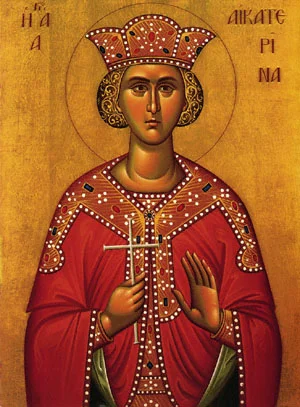
My beloved spiritual children in Christ Our Only True God and Our Only True Savior,
CHRIST IS IN OUR MIDST! HE WAS, IS, AND EVER SHALL BE.
+++
THE HOLY GREAT MARTYR KATHERINE, THE WISE VIRGIN (+November 25th)
Part II
Katherine awoke, marveling at what she had seen and heard in the dream. The next morning, she went with a number of her maids to the cell (kellion) of the holy elder (geronda) and fell down in tears at his feet. She told him what she had seen in the dream and asked what she must do to gain the love of Him Whom she so desired. The godly elder spoke to her at length of the mysteries of the True Christian faith, beginning with the creation of the world and our forefather Adam and continuing up to the Second Coming of the Master Christ. He told her of the ineffable glory of Paradise and the terrible and eternal torments of hell, and she, being a learned and wise maiden, straightway understood and believed with her whole heart. Then she received Holy Baptism at the elder's hands, and he instructed her to pray fervently to the Most Holy Theotokos as before.
Having thus put off the old man and clothed herself with the robe of the renewal of the spirit, Katherine returned home and passed the night in fasting and tearful prayer until she again fell asleep. Once more, she beheld the Queen of Heaven holding the Divine Infant, Who looked upon Katherine calmly and with great compassion. The Mother of God asked her Son, "Is this maiden acceptable to You, my Son?"
Christ answered, "She pleases me greatly, for she is now as fair and delightful as she once was black and unsightly, as wealthy and wise as she was formerly poor and foolish. I truly love her, and wish to take her as My bride forever."
Katherine fell to the floor and cried, "O Most Glorious Master, I am unworthy to behold Thy Kingdom! I ask Thee only to number me among Thy servants!"
Offering her hand to the maiden, the Most Holy Theotokos said to her Son, "Give her, my Child, a ring as a token of Your betrothal to her, granting her a place in Your Kingdom."
The Master Christ then gave Katherine a most beautiful ring, saying, "Lo, today I choose you to be My betrothed for all eternity. Take care to keep this trust inviolate, and promise yourself to no earthly bridegroom." With this, He became invisible, and the vision came to an end. When the maiden awoke, she saw on her right hand a wondrous ring and felt such joy and gladness that from that hour her heart was a prisoner of Divine Love. So great was the change which came upon her that she gave heed no more to worldly things, thinking only of her beloved Bridegroom day and night. For Him alone did she long, and her thoughts were ever with Him, whether she was awake or asleep.
At the time the impious Emperor came to Alexandria. Full of blind zeal for his lifeless gods, he was himself, as it were, without heart or mind. Wishing to celebrate a splendid feast in honor of the gods, he sent word to every nearby city and land, commanding the people to bring sacrifices and to come worship together. A multitude of people assembled some bringing oxen, others sheep, while the poor among them brought birds or something else of the kind...
"...The right-believing and virtuous Katherine saw how the souls of men were being deceived and led to perdition, and her heart was grievously wounded because she felt deep compassion for them. Stirred up by divine zeal, she took some of her servants and went to the temple where the useless oblations were being offered. As she entered it, the gaze of all was caught by her indescribable beauty, which testified to the comeliness of her soul. "Tell the Emperor," she said, "that I have something of great importance to say to him."
The Emperor commanded that Katherine is brought before him. Entering his presence, she prostrated herself, rendering him due homage. Then she said boldly, "Know, O Emperor, that you have been led astray by the demons, for the idols you serve are lifeless and subject to corruption. Great is the shame of the blind, foolish men who worship such vile things! Accept the words of your wise philosophers Diodorus, who says that your gods were once impious men and that because of the notable deeds they worked during their lifetime, the people raised up pillars and statues in their honor. Later generations were unaware of the intention of their forefathers, who erected these things only as memorials. Counting the statues as worthy of reverence, the people began to worship them as gods. Believe the words of your teachers, O Emperor, and do not make yourself guilty of the perdition of many souls. In this way, you may escape the eternal torment that awaits you. Come to know the One, True God, Who is every-existent, Unoriginate, and Immortal, and became man in the last times for our salvation. By Him, kings reign and nations are ruled, and the whole world is sustained. He created and upholds all things by His word, for He is the Almighty and All-Good God, Who has no need of your sacrifices and takes no delight in the slaughter of innocent beasts but commands only that we steadfastly keep His Commandments."
Hearing this, the Emperor was greatly enraged, remaining speechless for a long time. Unable to reply to Katherine's words, he said only, "Leave us now to offer sacrifice, and we will hear you at another time."
The Emperor commanded that the holy virgin is kept under close guard and immediately sent the following decree to every city in his dominion: "Emperor Maxentius to all the learned philosophers and orators in the lands under my rule: Hail! Come to me, all of you who serve the wisest god Hermes and call upon the Muses as patrons of erudition, and stop the mouth of a certain learned maiden who has appeared as of late and mocks our gods, calling their histories myths and fables. Come, that you may display your knowledge of the wisdom of the ancients, be acclaimed by men, and receive from me gifts as rewards for your labors!"
Fifty chosen rhetoricians, skilled in debate and mighty in declamation, assembled in Alexandria. The Emperor addressed them thus: "Prepare yourselves diligently and carefully to contend with the maiden and to prevail in the dispute with her concerning the gods. Do not be slack in your efforts because it is with a woman that you debate, but make every effort to overcome her as though she were the mightiest of opponents and the wisest of orators. Display all your learning, for I have tried her and found her to be wiser than Plato; strive your best in the debate against her, sparing no exertion. If you prevail over her, I will bestow upon your rich gifts, but if you are vanquished, you shall be rewarded only with bitter death."
Katherine was led before the Emperor and the philosophers, to be made a spectacle unto all. The vainglorious philosopher who answered the Emperor immediately began to boast before Saint Katherine and asked, "Is it you who shamelessly and foolishly reviles our gods?"
"It is I," the Saint answered meekly. "But I do not revile them shamelessly and foolishly as you say. I speak the truth gently and lovingly, proclaiming that your gods do not exist." After a long debate and hearing the wise Katherine speak about the True God, the philosopher was amazed and fell silent. The Emperor saw that his champion had been vanquished and left speechless, and commanded the other rhetoricians to enter into the dispute with the holy virgin, but they refused, saying, "We are unable to withstand the Truth. If the most learned of our number was overcome and silenced, what can we hope to accomplish?"
The Emperor was moved to wrath and ordered that a great fire be prepared in the middle of the city to burn alive all the philosophers and orators. When they learned of the sentence pronounced upon them, they fell at the Saint's feet, beseeching her to pray for them to the One True God so that He might forgive them the sins they had committed in ignorance and deem them worthy of Holy Baptism and the gift of the Holy Spirit.
The Saint responded joyfully. Saint Katherine traced over each of the philosophers and orators the sign of the Christ's Sacred Cross. Full of hope and gladness, they went joyfully to their martyrdom.
The Emperor became very angry and commanded that Katherine be stripped of her purple robe, left naked, and beaten mercilessly with leather straps. For two hours the servants lashed the martyr upon the shoulders and belly until the whole of her virginal body was covered with stripes and the ground was dyed red with blood that flowed like a river from them, but the Saint endured with such bravery that those who beheld her could only marvel.
As the Saint was speaking, the Eparch Khursaden, a cruel man and a merciless persecutor, wishing to gain Maxentius' good will, said, "I know a torture, O Emperor, that will enable you to prevail over this maiden. Command that four wooden wheels be fixed to a single axle, and have spearheads and other sharp weapons of iron driven through their rims. Order two wheels turned to the right and two the left. Have the maiden tied down beneath them, and the turning wheels will tear apart her flesh. But first, show the wheels to her! Having seen them, I believe she will consent to obey you. If she refuses, then deliver her to a cruel death."
The Saint was led to the place of torture, and the wheels were spun before her with great force so that she would be frightened. The persecutor said to her, "Do you see the torments prepared for you?" Bitter will be your death if you do not worship the gods!"
"I have told you many times that I intend to remain a Christian. Waste no more time and do as you wish," the Saint replied. Seeing that he could neither frighten her nor turn her from Christ, the Emperor commanded that Katherine be tied down and the wheels turned vigorously so that her members would be severed by the sharp instruments and she would perish cruelly. But as soon as the torture began, an Angel of God descended from heaven and loosed the Saint from her bonds, preventing her from being injured. The wheels he broke into pieces, which flew in every direction from the force of the blows, killing numerous unbelievers. Seeing this glorious rescue, the crowd cried out, "Great is the God of the Christians!"
Finally, the Emperor pronounced his sentence, condemning her to be beheaded outside the city. The soldiers led her to the place of execution, and many people followed her, men and women alike lamenting the approachable death of the fair and wise maiden. "Cease your useless weeping," the Saint replied. "You should rejoice instead, for I will soon behold my beloved Bridegroom, Jesus Christ, my Creator, and Savior. He is the adornment of martyrs, their crown and glory, and summons me to reign with Him and to rejoice for endless ages amid the ineffable good things of Paradise. Do not weep for me but for yourselves: because of your unbelief, you shall be condemned to unending tortures in the fires of hell."
When she reached the place of execution, Saint Katherine prayed thus: "O Lord Jesus Christ my God, I thank Thee that Thou hast set my feet upon the rock of patience and has guided my steps. Stretch forth now Thy hands, which Thou did once stretch out upon the Cross, and receive my soul...Look down also from the heights, O Lord, upon the people who stand here, and guide them to the Light of Thy knowledge. Grant whatever they request to those who, through me, come to call upon Thy Holy Name, if their petitions would be to their benefit, that they may hymn Thy Majesty unto the ages."
Completing her prayer, Saint Katherine said to the executioner, "Do as you have been commanded."
He raised his sword, and when he cut off the Martyr's head, milk flowed from her neck instead of blood. Such of the faithful as were worthy beheld how an Angel came at that moment and reverently took her holy relics away, leaving them on Mount Sinai. Unto Christ God, Who reigns with the Father and the Holy Spirit in one Godhead, be glory unto the ages. Amen.
_______________________
"Glory Be To GOD For All Things!"--Saint John Chrysostomos
+++
With sincere agape in His Holy Diakonia,
The sinner and unworthy servant of God
+Father George
Holy Great Martyr Katherine, the Wise Virgin
During the reign of the impious and pagan Roman emperor Maxentius, there lived in the city of Alexandria a maiden named Katherine. She was of royal lineage, very beautiful and tall, and had reached the age of eighteen. She was also most learned, having studied all the writings of the Hellenes (Greeks), and had acquainted herself with the authors of antiquity: Homer, Virgin, Aristotle, Plato, and others. It was not, however, only the philosophers that she had read: she knew well the books of the physicians Asclepius, (Asclepius was the Greek god of medicine), Hippocrates, and Galen. Moreover, she has entirely mastered the arts of rhetoric and dialectic and knew many languages, so that all were amazed at her learning. Numerous rich men of noble birth came to ask her hand of her mother, who held the Christian faith secretly because of the great persecution raised up against the faithful at the time by Maxentius.

My beloved spiritual children in Christ Our Only True God and Our Only True Savior,
CHRIST IS IN OUR MIDST! HE WAS, IS, AND EVER SHALL BE.
+++
ON THE TWENTY-FIFTH DAY OF THE MONTH OF NOVEMBER OUR HOLY ORTHODODOX CHRISTIAN CHURCH COMMEMORATES THE FEAST OF THE HOLY GREAT MARTYR KATHERINE, THE WISE VIRGIN
[From Metaphrastes and The Anthology printed in Moscow and according to The Martyrologion and other sources, Maximian was Emperor of the East at that time.]
During the reign of the impious and pagan Roman emperor Maxentius, there lived in the city of Alexandria a maiden named Katherine. She was of royal lineage, very beautiful and tall, and had reached the age of eighteen. She was also most learned, having studied all the writings of the Hellenes (Greeks), and had acquainted herself with the authors of antiquity: Homer, Virgin, Aristotle, Plato, and others. It was not, however, only the philosophers that she had read: she knew well the books of the physicians Asclepius, (Asclepius was the Greek god of medicine), Hippocrates, and Galen. Moreover, she has entirely mastered the arts of rhetoric and dialectic and knew many languages, so that all were amazed at her learning. Numerous rich men of noble birth came to ask her hand of her mother, who held the Christian faith secretly because of the great persecution raised up against the faithful at the time by Maxentius. Katherine's mother and relatives often counseled the maiden to marry so that the royal inheritance passed down from her father would not fall into the hands of strangers and thus be lost to her family, but the wise Katherine loved virginity greatly and did not wish to be married. She answered those who urged her, "If you wish me to enter into wedlock, find me a youth who possesses the four things which I have (as you well know) in greater measure than all other maidens, not one that is inferior to me and unworthy of my hand. Look about for a young man who is of noble lineage, wealthy, handsome, and learned; if he is lacking in one of these things, he is not worthy of me."
Unable to find such a youth, Katherine's relatives said, "Although the sons of emperors and great princes are highborn and wealthier than she, not one is as handsome or as wise."
Said Katherine, "I do not desire a bridegroom who is uneducated."
Now the spiritual father of Katherine's mother, a holy man who ever sought to please God, lived in a secret place outside the city. Taking her daughter with her, Katherine's mother went to visit him and to receive good counsel concerning this matter. Seeing that the maiden was beautiful and modest and that that she spoke with prudence and wisdom, he made it his purpose to bring her to know Christ, the King of Heaven. He said, "I know a wondrous Youth Who is Infinitely greater than you in every way. His countenance is brighter than the rays of the sun, and it is by His wisdom that all things are governed, both in the material world and the spiritual. His riches are spread throughout the whole world yet never fail, and He is unimaginably illustrious."
Thinking that the elder was speaking of some earthly prince, the maiden's heart was troubled. The expression on her face changed, and she asked him if what he had said was true. He assured her that he had spoken the truth and that the Youth possessed so many other gifts that it was impossible to tell of them all.
"Whose Son is the Youth Whom you praise thus?" asked the maiden.
The elder (geronda) replied, "He has no father on earth, for He was born in a manner surpassing nature, from the most noble, holy, and pure of virgins. It was because of her surpassing purity and Holiness that she was deemed worthy to bear Him as her Son. Immortality has been bestowed upon both her soul and body, and she has been translated (metastasis) above the heavens, where the Angels revered her as the Queen of all creation."
"Is it possible for me to see the Youth of Whom you relate such wondrous things?" asked Katherine.
"If you do as I say," the elder replied, "you will be deemed worthy to behold His radiant countenance."
Then Katherine said to him, "I see that you are a wise and venerable elder; therefore, I believe that you speak the truth. I am prepared to do whatever you say, if only I may see Him Whom you praise."
The elder gave Katherine an icon of the Most Holy Theotokos holding the Divine Infant in her embrace, and said, "This is the image of the Virgin Mother of the Child of Whom I have told you such marvelous things. Take it to your home, lock the doors of your room, and fervently pray till dawn to her who is depicted on it, beseeching her to permit you to behold her Son. Her name is Mary. I believe that if you call upon her with faith, she will hearken unto you and grant you the desire of your heart."
The maiden took the holy icon and returned home. That night, she shut herself in her room and prayed as the elder had instructed her. While praying, she fell asleep from weariness and beheld in a dream the Queen of the Angels holding the Holy Child as on the icon. He shone with Light brighter than the rays of the sun, but Katherine could not see His face, which He turned away toward His Mother. Wishing to behold His countenance, Katherine moved to the other side of the room, but Christ again turned His face away. After He had done this thrice, the Holy Virgin said to Him, "Behold my Child, how fair and virtuous is Your handmaiden Katherine!"
To this He replied, "No, she is black and unsightly. I cannot bear to look upon her."
"Is she not more learned than any scholar, wealthy, and of exceedingly noble birth?" asked the Most Holy Theotokos.
"I say to you, Mother, that she is a foolish pauper and baseborn, and I will not look at her until she forsakes impiety," said Christ.
Then the Lord's Most Blessed Mother said to Him, "I beseech You, sweetest Child, do not disdain her whom You have created. Show her what she must do the delight in Your glory and to see Your most radiant face, which Angels desire to behold."
"Let her return to the elder who gave her the icon," said Christ, "and do as he says. Then she will see Me and find grace in My sight." (Source: The Great Collection of the Lives of the Saints)
(To be continued)
___________________________
"Glory Be To GOD For All Things!"-Saint John Chrysostomos
+++
With sincere agape in His Holy Diakonia,
The sinner and unworthy servant of God
+Father George