
The Feast Day of the Holy Unmercenaries Sts. Cosmas and Damianos (Damian)
Unmercenaries (Anargiroi) and Wonderworkers (Miracle workers), they were brothers in the flesh and in the spirit, born somewhere in Asia of a pagan father and a Christian mother. After their father's death, their mother Theodota devoted all her time and energy to the bringing-up of her sons as true Christians. God helped her, and her sons grew as two choice fruits and as two holy lamps.

My beloved spiritual children in Christ Our Only True God and Our Only True Savior,
CHRIST IS IN OUR MIDST! HE WAS, IS, AND EVER SHALL BE. Ο ΧΡΙΣΤΟΣ ΕΝ ΤΩ ΜΕΣΩ ΗΜΩΝ! ΚΑΙ ΗΝ ΚΑΙ ΕΣΤΙ ΚΑΙ ΕΣΤΑΙ.
+++
ON NOVEMBER 1ST OUR HOLY ORTHODOX CHRISTIAN CHURCH COMMEMORATES THE FEAST DAY OF THE HOLY UNMERCENARIES SAINT COSMAS AND DAMNIANOS (DAMIAN)
Unmercenaries (Anargiroi) and Wonderworkers (Miracle workers), they were brothers in the flesh and in the spirit, born somewhere in Asia of a pagan father and a Christian mother. After their father's death, their mother Theodota devoted all her time and energy to the bringing-up of her sons as true Christians. God helped her, and her sons grew as two choice fruits and as two holy lamps. They were skilled in medicine and ministered to the sick without payment (unmercenaries), and so fulfilled Christ's command: "Freely have you received, freely give" (St. Matthew 10:8). They were so strict in their unpaid ministry to men that Cosmas became greatly enraged with his brother Damianos when he took three eggs from a woman, Palladia, and gave orders that, after his death, he should not be buried with his brother. In fact, holy Damianos had not taken those eggs as a payment or reward for healing Palladia's sickness, but because she had sworn by the Most Holy Trinity that he should have them. However, after their death in Fereman, they were buried together in obedience to a revelation from God. These two holy brothers were great miracle-workers both during their lifetime and after their death. A farm laborer, on lying down to sleep at one time, was attacked by a snake, which entwined itself around his mouth and stomach. This poor man would have breathed his last in the greatest torment had he not at the last moment invoked the help of Saints Cosmas and Damianos. Thus the Lord glorified forever by miracles those who glorified Him here on earth by their faith, purity, and mercy. (Source: The Prologue from Ochrid)
__________________
There was another man who lived near the church of the Holy Physicians Cosmas and Damianos, whose name was Malchus. Once, as he was about to depart on a long journey he took his wife to the church and said, "Since I shall be gone for a very long time, I commit you to the protection of Saints Cosmas and Damianos. Remain in our house until I send you a man who will show you a secret sign (which sign he showed her). I shall send him at a time pleasing to God, after which you may come to me."
Having entrusted his wife to the Saints, Malchus went on his way. A few days later, the devil assumed the appearance of a man who was their acquaintance and came to Melchus' wife. He showed her the sign her husband had revealed to her and told her to follow him, saying, "Your husband has sent me to take you to him."
The woman said, "I know the sign you showed me, but I do not intend to go. My husband committed me to the protection of the holy Unmercenaries Cosmas and Damianos. If you wish to take me to my husband, first come with me to the Saints' church, lay hold of the corner of the Altar, and swear that you will do me no harm along the way."
The devil agreed and went to the church with the woman, and grasping the corner of the Altar, declared this oath: "I swear by the might of Cosmas and Damianos that I will do you no harm along the way and that I will take you directly to your husband."
Believing the lying demon, the woman departed with him. The deceiver led her to a desolate and untrodden place where he meant to slay her. But she lifted up her eyes to heaven in desperation and cried out to God in her heart, "O God, by the prayers of Saints Cosmas and Damianos, deliver me from the hand of this murderer!"
Immediately those speedy helpers, the holy Unmercenaries Cosmas, and Damianos appeared, shouting at the devil. When he saw them, he abandoned the woman and fled. He ran to a high cliff and falling into the abyss below, vanished. After this, the Saints led the woman back to her home. She bowed down before them and said, "I thank you, my lords, for having delivered me from a bitter death. But I pray you, tell me who you are, for I will be indebted to you till the end of my life."
They answered her, "We are Christ's servants Cosmas and Damianos. Your husband committed you to us when he left on his journey; therefore, we hastened to your aid, and by the grace of God delivered you from the devil."
Hearing this, the woman fell to the ground, full of fear and joy, but the Saints became invisible. Then she cried out, praising God and giving thanks to the Lord and His holy servants Cosmas and Damianos. She went to the church, where she fell prostrate before the holy icons of the Saints and told all the people of the compassion the Lord had shown her through the prayers of His servants. These were the words of the prayer she uttered upon entering the church: "O God of our fathers, the God of Abraham, Isaac, Jacob, and of their righteous see! I thank Thee, Who didst quench the fire of the furnace wherein the three youths were cast and didst help Thy handmaiden Thecla in the arena; for Thou didst deliver me also, who am a sinner, from the snares of the devil, by the intercessions of Thy servants Cosmas and Damianos. I worship Thee, Who workest wondrous and most glorious miracles; and I glorify Thee, the Father, Son, and Holy Spirit, unto the ages. Amen." (Source: The great collection of The Lives of the Saints)
____________________________
DIVINE SERVICES AT SAINT ANDREW NOVEMBER 1:
Orthros (Matins) at 9:00 a.m.
Divine Liturgy at 10:00 a.m.
______________________________
"Glory Be To GOD For All Things!" - Saint John Chrysostom
+++
With sincere agape in His Holy Diakonia,
The sinner and unworthy servant of God
+Father George
Imitation of Christ (Part IV)
Before us is a great goal--to be a new creation and to imitate and partake of Christ. To achieve it, one must correct oneself and break one's self-will, moving from pride to meekness; from passion to abstinence; from hot-temperedness to gentleness and hospitality; from self-centeredness and greed to compassion; from suspiciousness and jealousy to being supportive and well-wishing; from light-mindedness to wisdom in God; from cowardice and faint-heartedness to bravery and courage; all things changing for the good.

100,000 Martyrs of Tbilisi by the Mongols
My beloved spiritual children in Christ Our Only True God and Our Only True Savior,
CHRIST IS IN OUR MIDST! HE WAS, IS, AND EVER SHALL BE. Ο ΧΡΙΣΤΟΣ ΕΝ ΤΩ ΜΕΣΩ ΗΜΩΝ! ΚΑΙ ΗΝ ΚΑΙ ΕΣΤΙ ΚΑΙ ΕΣΤΑΙ.
+++
IMITATION OF CHRIST (Part IV)
By His Grace Bishop Alexander (Mileant)
The High Calling
Before us is a great goal--to be a new creation and to imitate and partake of Christ. To achieve it, one must correct oneself and break one's self-will, moving from pride to meekness; from passion to abstinence; from hot-temperedness to gentleness and hospitality; from self-centeredness and greed to compassion; from suspiciousness and jealousy to being supportive and well-wishing; from light-mindedness to wisdom in God; from cowardice and faint-heartedness to bravery and courage; all things changing for the good.
God helps us in every way; however we ourselves must also actively participate in this noble endeavor (synergy). Here lie a multitude of obstacles. Often, our nature and essence contradict and act against the Christian lifestyle. This puts in a kind of despair which the Holy Fathers of the Church called "spiritual despondency" (katathlepsi). Such temptation to despair comes from the devil. As he tempted Christ when our Lord was near exhaustion, so he tries to tempt us at the weakest moments of our lives. Cunning (Poneria) and insidious dragon! ('O Poneros' or 'Evil One'). Therefore, "watch and pray, lest you enter temptation. The spirit indeed is willing, but the flesh is weak" (St. Matthew 26:41), remembering always that "if indeed we suffer with Him...we may also be glorified together" (Romans 8:17).
Prayer, attending church services, fasting, abstinence, confession, holy communion, study of the Holy Scripture, spiritual reading, thinking about God, works of charity - all these are necessary means for our internal regeneration and are our footprints in following Christ. However, if we forget the goal, our means yield little benefit and can become dead attributes.
We must treasure the Holy Orthodox Church and our union with her, because she alone preserves the True, Authentic understanding and essence of Christianity, while many so-called denominations threw away from their "Christianity" everything that seemed outwardly difficult and unpleasant. They have deprived themselves and their followers of the regenerative force of the Christian faith, leaving only pleasing external appearances and "inspirational" sayings. For the person looking for the real spiritual life, Orthodoxy alone gives all that is needed - the grace in its Mysteries (Sacraments) and the spiritual experience and wisdom of the Holy Fathers. Though not all are called to be great achievers, through the True Faith the riches of Christ are abundantly available to all. With such riches available to us, it is tragic that many, through misguided beliefs, worldly cares, and passions, are diverted and cut off from spiritual progress and salvation.
"Therefore strengthen the hands which hang down, and the feeble knees" (Hebrews 12:12), remembering that every good effort brings us closer to Christ, and that each victory over temptation is our victory with Him. We will follow victoriously the One Who said, "Take My yoke upon you, and learn from Me; for I am meek and lowly in heart, and you will find rest for your souls. For My yoke is easy and My burden is light" (Saint Matthew 11:29-30).
____________________________
"Glory Be To GOD For All Things!" -- Saint John Chrysostom
+++
With sincere agape in His Holy Diakonia (Ministry),
The sinner and unworthy servant of God
+Father George
Imitation of Christ (Part III)
The holy Apostle Peter summarizes the content of the Christian life this way, "Therefore, since Christ suffered for us in the flesh, arm yourselves also with the same mind, for he who has suffered in the flesh has ceased from sin, that he no longer should live the rest of his time n the flesh for the lusts of men, but for the will of God" (1 Peter 4:1). Here the conquest of sin is placed directly together with the voluntary crucifixion of the body with all of its passion and self-will (Galatians 5:24).

Apostle Mark of the Seventy
My beloved spiritual children in Christ Our Only True God and Our Only True Savior,
CHRIST IS IN OUR MIDST! HE WAS, IS, AND EVER SHALL BE. Ο ΧΡΙΣΤΟΣ ΕΝ ΤΩ ΜΕΣΩ ΗΜΩΝ! ΚΑΙ ΗΝ ΚΑΙ ΕΣΤΙ ΚΑΙ ΕΣΤΑΙ.
+++
IMITATION OF CHRIST (Part III)
By His Grace Bishop Alexander (Mileant)
The holy Apostle Peter summarizes the content of the Christian life this way, "Therefore, since Christ suffered for us in the flesh, arm yourselves also with the same mind, for he who has suffered in the flesh has ceased from sin, that he no longer should live the rest of his time n the flesh for the lusts of men, but for the will of God" (1 Peter 4:1). Here the conquest of sin is placed directly together with the voluntary crucifixion of the body with all of its passion and self-will (Galatians 5:24).
It all comes down to this elementary truth: due to the sinful, deteriorated state of our nature, the soul and body remain in a constant battle. When the body is satiated, the spiritual power of man declines and becomes dull, weak, and powerless. When a man voluntarily controls and weakens his body, his spiritual strength increases. The greatest ancient thinkers discovered that spiritual reinforcement and the rejection of physical pleasure immediately increases the spiritual richness within us. The more we lose physically, the more we gain spiritually.
This is why the main thrust of the Holy Scripture is an encouragement to struggle. The life of a Christian is to imitate Christ by carrying one's cross and following Him: "And he who does not take up his cross and follow after Me is not worthy of Me" (St. Matthew 10:38). When the holy Disciples asked Christ how many would be saved, the Lord replied, "Strive to enter through the narrow gate, for many, I say to you, will seek to enter and will not be able" (St. Luke 13:24), "...Seek first the kingdom of God, and His righteousness, and all these things shall be added unto you" (St. Matthew 6:33, 6:19-34). And although this is only in instances, it must be our goal in life. "Let your waist be girded and your lamps burning" (St. Luke 12:35; St. Mark 13:33-37); "Be kindly affectionate to one another with brotherly love, in honor giving preference to one another; not lagging in diligence, fervent in spirit, serving the Lord; rejoicing in hope, patient in tribulation, continuing steadfastly in prayer; distributing to the needs of the saints, given to hospitality" (Romans 12:11).
However, when we talk about the necessity of the spiritual struggle, we must remember that in Christianity it is significant that we do not have spiritual life except through the imitation of Christ. Spiritual life may be dull, evil and gloomy - the "spirituality" of demons. Hinduism with its yoga exercise allows growth in "spirituality" and some abilities of the soul; however the results are completely the opposite of the soul's salvation. Roman Catholicism, separated from Apostolic teaching and tradition, has developed its own methods of "scorning the body," but its spiritual feats retain a gloomy rigidity, a life-less discipline, and a legalistic requirement far from the true goal.
Christianity as an imitation of Christ is a religion of joy. Nervousness, austerity, and gloominess contradict the Orthodox Christian understanding of true struggle. In the Sermon on the Mount, Christ calls men to the Kingdom of eternal happiness: "Blessed are the poor in spirit...blessed are they that mourn...blessed are the meek..." (St. Matthew 5). The greatest Orthodox ascetics always reflected in themselves a bright and happy mood. By talking with Saint Seraphim of Sarov, Saint Elder Ambrose of Optina, Saint John of Kronstadt, Saint Herman of Alaska and others, people felt peace of mind, inner comfort, and happiness. All real hermits were very strict with themselves but very lenient and pleasant to others, as we ought to be.
(To be continued)
____________________________________
"Glory Be To GOD For All Things!" - Saint John Chrysostom
+++
With sincere agape in His Holy Diakonia,
The sinner and unworthy servant of God
+Father George
Imitation of Christ (Part II)
The Lord Jesus Christ Himself followed the difficult path of man's misfortune, leading a hard life and going to His death for our sakes. This path is an example to virtuous seekers struggling to live righteously in an egotistical, sinful and even theomachist society. Yet, He did this to show us the road to salvation and spiritual regeneration. Through His Grace, He helps us on our every step; He encourages us and gives us strength. He takes away our sins, since we cannot escape from sin by ourselves. The obstacle to spiritual regeneration is within us - we are the main obstacle to our own salvation.

Martyr Anastasia the Roman
My beloved spiritual children in Christ Our Only True God and Our Only True Savior,
CHRIST IS IN OUR MIDST! HE WAS, IS, AND EVER SHALL BE. Ο ΧΡΙΣΤΟΣ ΕΝ ΤΩ ΜΕΣΩ ΗΜΩΝ! ΚΑΙ ΗΝ ΚΑΙ ΕΣΤΙ ΚΑΙ ΕΣΤΑΙ.
+++
IMITATION OF CHRIST (Part II)
By His Grace Bishop Alexander (Mileant)
The Lord Jesus Christ Himself followed the difficult path of man's misfortune, leading a hard life and going to His death for our sakes. This path is an example to virtuous seekers struggling to live righteously in an egotistical, sinful and even theomachist society. Yet, He did this to show us the road to salvation and spiritual regeneration. Through His Grace, He helps us on our every step; He encourages us and gives us strength. He takes away our sins, since we cannot escape from sin by ourselves. The obstacle to spiritual regeneration is within us - we are the main obstacle to our own salvation.
Despite sinfulness, one should not despair. All the Saints had their faults and suffered from various temptations; when they fell, they rose again through repentance.
It is wonderful that with God's help, they achieved such advanced spiritual levels, gathering wisdom and experience in order to help others follow them on the road to spiritual regeneration. The Lord Himself proved that they follow the Truth by giving them gifts of miracle-working and the ability to look into the future. Poor, rich, peasants, kings, scholars, and slaves make us this pious multitude of Saints, all having one thing in common: the christian struggle (in Russian: podvig. In Greek: ascesis). All followed the "narrow path" created by Christ, all voluntarily abstaining from the carnal pleasures offered to them, and all "have crucified the flesh with its passions and desires" (Galatians 5:24; see also Romans 6:6).
Let us take, for example, the valuable and encouraging life of the holy Apostle Paul.
Autobiographical notes are scattered throughout Saint Paul's writings, giving us an understanding of his inner motivation and struggle. The mission God entrusted to him required complete self-sacrifice. Since the holy Apostle emphasized faith so greatly, it may appear to the unknowing eye that spiritual feats are not necessary. Protestants often use him as scriptural evidence of their teaching that spiritual struggle is unnecessary since, as they erroneously believe, man is saved only by faith. And yet, according to his own words, Saint Paul frequently remained "in weariness and toil, in sleeplessness often, in hunger and thirst, in fasting often, in cold and nakedness..." (2 Corinthians 11:27). To keep within himself a spiritual awareness, he consistently "trained" himself with spiritual exercises, looking on his life as if he were competing in the Olympic Games. "Do you not know," he writes in his First Epistle to the Corinthians, "that those who run in a race all run, but one receives the prize? Run in such a way that you may obtain it. And everyone who competes for the prize is temperate in all things. Now they do it to obtain a perishable crown, but we for an imperishable crown. Therefore I run thus: not with uncertainty. Thus I fight not as one who beats the air. But I discipline my body and bring it to subjection, lest when I have preached to others, I myself become disqualified" (1 Corinthians 9:24-27).
Evidently, he lived this way because he considered himself as one not yet having attained the heights of spiritual perfection; yet he knew it was his calling to reach them. "Not that I have already attained, or am already perfected; but I press on, that I may lay hold of that for which Christ Jesus has also laid hold of me. Brethren, I do not count myself to have apprehended; but one thing I do, forgetting those things which are behind and reaching toward those things which are ahead, I press toward the goal for the prized of the upward call of God in Christ Jesus. Therefore, let us, as many are mature, have this in mind; and if in anything you think otherwise, God will reveal this even to you. Nevertheless, to the degree that we have already attained, let us walk by the same rule, let us be of the same mind. Brethren, join in following my example, and note those who so walk, as you have us for a pattern" (Philippians 3:12-17).
Undoubtedly, the holy Apostle Paul understood true Christianity far better than many contemporary leaders of sects do today. If he willingly enslaved himself to voluntary struggle, it is because he knew this was necessary for spiritual growth. "I beseech you therefore, brethren, by the mercies of God, that you present your bodies a living sacrifice, holy, acceptable to God, which is our reasonable service" (Romans 12:1). He wrote often to his Christian contemporaries, calling them to follow his way of life (Phil. 3:17; Thess. 3:7; Hebrews 13:7).
We would be spiritually perfect if we were free from the deficiencies of sin and passion, immune from any temptation, totally to the spiritual way of life, full of real love for God and for our neighbor, completely sinless. In this case, spiritual struggle would no longer be necessary, as it is unnecessary for the Angels and the Saints in the Heavenly Kingdom. In the present situation, it remains our goal to become perfect both with the help of God and personal struggle.
(To be continued)
______________________________________
"Glory Be To GOD For All Things!" - Saint John Chrysostom
+++
With sincere agape in His Holy Diakonia,
The sinner and unworthy servant of God
+Father George
The Holy Feast of the Agia Skepi or Holy Protection of the Mother of God
The Protection of the Mother of God is one of the most beloved feast days on the Orthodox Christian calendar among the Slavic Orthodox peoples, commemorated on October 1st. The holy feast is celebrated additionally on October 28th in the Greek Orthodox tradition. It is also known as the feast of the Virgin Mary's Cerement.
My beloved spiritual children in Christ Our Only True God and Our Only True Savior,
CHRIST IS IN OUR MIDST! HE WAS, IS, AND EVER SHALL BE. Ο ΧΡΙΣΤΟΣ ΕΝ ΤΩ ΜΕΣΩ ΗΜΩΝ! ΚΑΙ ΗΝ ΚΑΙ ΕΣΤΙ ΚΑΙ ΕΣΤΑΙ.
+++
ON 28TH OF OCTOBER OUR HOLY GREEK ORTHODOX CHURCH COMMEMORATES THE FEAST OF AGIA SKEPI OR HOLY PROTECTION OF THE MOTHER OF GOD
The Protection of the Mother of God is one of the most beloved feast days on the Orthodox Christian calendar among the Slavic Orthodox peoples, commemorated on October 1st. The holy feast is celebrated additionally on October 28th in the Greek Orthodox tradition. It is also known as the feast of the Virgin Mary's Cerement.
In most Slavic languages the word "cerement" has a dual meaning of "veil" and "protection." The Greek skepi (Σκέπη), has a complex meaning. First of all, it refers to a cloak or shroud, but it also means protection or intercession.
The Feast
The feast day celebrates the appearance of the Mother of God (Theotokos) at Vlachernae in the 10then century. At the end of Saint Andrew of Constantinople's life, he, and his disciple Saint Epiphanius, and a group of Christians, saw the Mother of God, Saint John the Baptist, and several other Saints and Angels during a vigil in the Church of Vlachernae, near the city gates. The Vlachernae Palace church was where several of her relics were kept. The holy relics were her robe, veil, and part of her belt (zoni) that had been transferred from Palestine during the 5th century.
The Theotokos approached the center of the church, knelt down and remained in prayer for a long time. Her face was drowned in tears. Then she took her veil (cerement) off and spread it over the people as a sign of protection. During the time, the people in the city were threatened by a barbarian invasion. After the appearance of the Mother of God, the danger was averted and the city was spared from bloodshed and suffering.
In recent years, the Feast of the Holy Protection (Agia Skepi) has become associated with thanksgiving for the deliverance of the Greek Nation from the Italian invasion of 1940. These events are commemorated in Greece in a National Holiday know as "Oxi Day" or "No Day," referring to the response of the Prime Minister Metaxas to Mussolini's ultimatum.
In recognition of this, and because of the many miracles of the Holy Ever-Virgin Mary which were reported by Greek soldiers during the Greco-Italian War of 1940-41, the Holy Synod of the Church of Greece elected in 1952 to transfer the Feast from October 1st to October 28th.
The Ecumenical Patriarchate also provides for this usage in its parishes in Greece and in the Greek Diaspora, and it is generally observed now throughout the Greek-speaking world. The observance includes the chanting of a Doxology incorporating hymns recognizing the Protection of the Theotokos over the Greek nation, as well the kontakion "O Champion Leader."
About the Holy Icon of the Feast
Two different events that took place four hundred years apart are combined in this one holy icon. Both events took place in the former Church of Vlachernae in Constantinople.
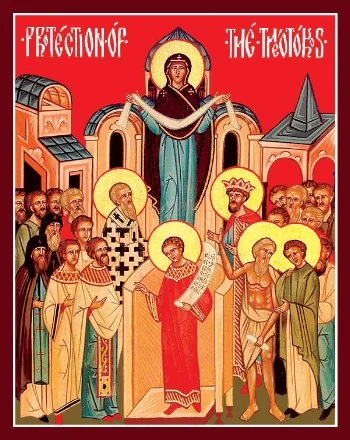
The holy icon of the Feast, Protection of the Mother of God, shows the Theotokos standing above the faithful with her arms outstretched in prayer and draped with a veil. On both sides of her are Angels. On the lower right of most holy icons of this feast, are Saints Andrew and his disciple Epiphanius who saw this vision of the Mother of God, with the Twelve Apostles, bishops, holy women, monks and martyrs, spreading her veil in protection over the congregation. Saint Epiphanius is wearing a tunic under his cloak and gestures in astonishment at the miraculous appearance, while Saint Andrew, Fool-for-Christ, is dressed only in a cloak.
Below the Theotokos, in the center of the holy icon, stands a young man with a halo, he is clothed in a deacon's sticharion. In his left hand, he is holding an open scroll with the text of the Kontakion hymn for Nativity in honor of the Mother of God. This is Saint Romanos the Melodist, the famous hymnographer whose feast is also celebrated on the same, October 1st. He is with his choir attended by the Emperor Leo the Wise together with the Empress and the Patriarch of Constantinople.
Hymns
Apolytikion (Dismissal) Hymn. Tone Fourth
Today the faithful celebrate the feast with joy illumined by your coming, O Mother of God. Beholding your pure image we fervently cry to you: "Encompass us beneath the precious veil of your protection; deliver us from every form of evil by entreating Christ, your Son and Our God that He may save our souls.
Kontakion Hymn. Tone Third
Today the Virgin stands in the midst of the Church and with choirs of Saints she invisibly prays to God for us. Angels and bishops worship, Apostles and Prophets rejoice together, since for OUR sake she prays to the Pre-Eternal God.
(References: Great Synaxaristes. Sources: The Miracles of the Virgin Mary at the Church of Vlachernae in Constantinople in 911 A.D. The Protection of our Most Holy Lady the Mother of God and Ever-Virgin Mary; Makarios, The Synaxarion: The Lives of the Saints of the Orthodox Church (Volume 1), Ormylia: 1998, pp. 249-250.)
With love in Our Savior Jesus Christ,
+Father George
The 28th of October-The Day Greece Said "Oxi" ("No")
At 3:00 a.m. on the morning of October 28th, 1940, Emanuel Grazzi, the Italian ambassador to Greece, delivered an ultimatum from Benito Mussolini to Prime Minister Ioannis Metaxas. He demanded that Metaxas allow the Italian army free passage to enter and occupy sites in Greece unopposed.
My beloved brothers and sisters in Christ,
OXI DAY: THE DAY OF NO!
At 3:00 a.m. on the morning of October 28th, 1940, Emanuel Grazzi, the Italian ambassador to Greece, delivered an ultimatum from Benito Mussolini to Prime Minister Ioannis Metaxas. He demanded that Metaxas allow the Italian army free passage to enter and occupy sites in Greece unopposed.
Faced with this demand, Metaxas delivered an unequivocal response in French, the diplomatic language of the day, "Alors, c'est la guerre." This brief phrase, "Then, it is war," was quickly transmuted into the laconic "Oxi," the Greek for no, by the citizens of Athens.
At 5:30 a.m., before the ultimatum had even expired, the Italian army poured the Greek Albanian border into the mountainous Pindos region of Northern Greece. There they met fierce and unexpected resistance.
Within six months, Ioannis Metaxas would be dead; his successor, Alexandros Koryzis would commit suicide; Mussolini would be humiliated and the Nazis (Germans) would raise the swastika over the Acropolis.
Despite Greece's ultimate fall to Axis powers, Metaxas' response resulted in a fatal diversion and delay for the Axis powers in general and the German army specifically. British military historian Sir John Keegan describes the Battle of Greece as "decisive in determining the future course of the Second World War."
For decades prior to the invasion, Greco-Italian relations had been difficult and complex: historically, both Italy and Greece could lay claim to some of the same territories. At various times the two nations tussled over the Dodecanes islands as well as the island of Kerkyra (Corfu) in the Ionian Sea. However, in 1928, then Prime Minister Venizelos had signed a Friendship Agreement with Italy, normalizing relations.
In 1939, the Italian invasion of Albania threatened this fragile accord. Albania collapsed under the Italian onslaught: Italian troops attacked on April 7th, almost immediately gaining control of all ports. King Zog and his family fled south to Greece that same day, abandoning their people.
On April 12th, the Albanian parliament voted to unite with Italy, deposing Zog, and accepting the Italian king, Victor Emmanuel III, in his stead.
The presence of Italian troops in Albania, just over the border from Northern Greece generated enormous tension between the two countries. Both Britain and France gave Greece a guarantee of "territorial integrity." Nonetheless, Italian forces committed numerous acts of aggression against Greece (Helas), including over flights of Greek territory and attacks against Greek naval vessels.
Metaxas began to prepare for war.
In a great irony, Italy's actions drove Metaxas, who had cultivated friendly trade relations with Nazi Germany, into the arms of Britain. While Metaxas initially favored Germany, King George II was a confirmed Anglophile. Italy's intervention provided the excuse for the king to push his Prime Minister toward closer relations with Britain.
Ioannis Metaxas had begun his career in the Greek army, eventually entering politics as a staunch royalist. By 1936 he held the post of Minister of War. That same year, a deadlock election led King George II to appoint Metaxasto the position of Prime Minister.
Within four months, Metaxas had declared a State of Emergency and suspended Parliament. For the remainder of his life, he ruled as a dictator. He is a deeply controversial figure in Greek history but his actions on October 28th contributed to the ultimate victory of the Allied forces.
Mussolini's advisors had assured him that the invasion of Greece (Helas) would take no more than two weeks. The Italian experience in Albania must have made this seem very plausible: like Albania, Greece was a small country with a correspondingly small army.
The difference lay in the territory: Italian forces entered Greece through the steep Pindos Mountains. This was rough wild terrain made worse by the onset of winter. As Italian troops moved southward towards the city of Ioanina, Greek troops took to the heights, bombarding the Italians from above.
The rough roads and deep snow made it difficult to supply the troops, while bad weather and continuous cloud cover prohibited the Italians from using their superior air power.
Meanwhile, the women of the local villages, accustomed to the territory, carried supplies and munitions on their backs to the Greek troops.
Argiris Balatsos recorded his encounter with several of these women in his diary:
"7 November 1940...I met women who were carrying ammunition. One was 88 years old. Another one told me that she had locked the kid in the shed so that she could come to help the army. During the night, I saw an old woman taking care of the two kids, while their mother was baking bread for the army under the candlelight."
The British, who has promised to aid Greece, were hard pressed themselves. By the autumn of 1940, they stood alone against the Germans and had no troops to spare for the defense of Greece (Helas).
However, British troops had occupied Crete on October 3rd, 1940 with the full permission of the Greek government. This freed Cretan troops, among the fiercest of Greek soldiers, to fight on the mainland in the Pindos Mountains.
Within three weeks, Greece was completely free of the invading forces and began a counterattack, driving deep into Italian held Albania.
Mussolini was humiliated and enraged. Hitler was also furious at what he viewed as Mussolini's blunder.
On January 29th, 1941, Prime Minister Metaxas died suddenly and unexpectedly from an inflammation of the pharynx that led to a toxic infection. Alexandros Koryzis, the Governor of the Bank of Greece, succeeded him in office.
By April, the small Greek army had been fighting for six months. Exhausted, they now face a new threat. Bulgaria had joined the Axis powers and the German army advanced toward the Greek-Bulgarian border. Here, the Greeks (Hellenes) had been well prepared for an invasion: Metaxas had built fortifications all along this border.
Unfortunately, the Germans also poured over the undefended border with Yugoslavia. Initially repulsed at the Metaxas line, the Germans quickly overcame the Greeks.
On April 18th Prime Minister Koryzis chose to shoot himself rather than face the German entry into Athens.
Just nine days later, German motorcycle troops entered Athens, driving straight to the Acropolis. There, they tore down the Greek flag and replaced it with a Swastika.
Despite their ultimate defeat, the Hellenes fought long and hard. For six months they occupied the Italian army, preventing them from advancing. In the end, the Germans were forced to delay the invasion of Russia in order to subdue the Greeks when the Italians failed in their efforts. This delay proved fatal for the Germans, extending their campaign against the USSR into the brutal winter.
Hitler's Chief of Staff, Field Marshal Wilhelm Keitel admitted during the Nuremberg Trials:
"...the unbelievably strong resistance of the Greeks delayed by two or more months the German attack against Russia; if we did not have this long delay, the outcome of the war would have been different in the Eastern Front and the war in general."
Churchill the Prime Minister of England paid homage to the Greek resistance by claiming "...Until now we would say that the Greeks fight like heroes. From now on we will say that heroes fight like Greeks."
Very likely the Hellenes were inspired by their own heroic past to wage a fierce fight against all odds. On October 28th, after rejecting Mussolini's demands, Metaxas addressed the Greek people, ending with this line from Aeschylus' play The Persians: "The struggle now is for everything!"
With these few words, he evoked the great Greek victory of Salamis over the invading Persian forces. Once more, the Hellenes were called to defend their country fiercely.
Every October 28th, Greeks at home and abroad honor the past by celebrating Oxi Day.
ZETO E ELLAS! ZETO TO ETHNOS!
With agape in Christ,
Fr. George