
Genuine and False Experiences of the Grace of God (Part II)
What are the experiences of grace that a Christian can receive so that his faith and Christian life will not be for him something mental and external, but a true spiritual feeling of God, a communion with God, a habitation of God in which the complete man participates.

Icon of the Mother of God the “Multiplier of Wheat”
My beloved spiritual children in Christ Our Only True God and Our Only True Savior,
CHRIST IS IN OUR MIDST! HE WAS, IS, AND EVER SHALL BE. Ο ΧΡΙΣΤΟΣ ΕΝ ΤΩ ΜΕΣΩ ΗΜΩΝ! ΚΑΙ ΗΝ ΚΑΙ ΕΣΤΙ ΚΑΙ ΕΣΤΑΙ.
+++
GENUINE AND FALSE EXPERIENCE OF THE GRACE OF GOD (Part II)
By Egoumenos (Abbot), Archimandrite George of our Holy Monastery of Saint Gregory (Gregoriou) - Holy Mountain
Forms of Experience of the Grace of God
What are the experiences of grace that a Christian can receive so that his faith and Christian life will not be for him something mental and external, but a true spiritual feeling of God, a communion with God, a habitation of God in which the complete man participates.
It is first and foremost an inner information that through faith in God, he will find the true meaning of his life. He feels that his faith in Christ is a faith that comforts him, internally; that it gives meaning to his life, and guides him, that it is a strong light that illumines him. When he perceives the Christian faith within himself this way, he begins to live the grace of God. God is not something external to him.
Another experience of the grace of God man receives when he hears in his heart God's invitation to repent for his dark and sinful deeds, to return to the Christian way of life, to confess, to enter the path leading to God. This voice of God that he hears inside him, is a preliminary experience of the grace of God. All the years that ne lives far away from God, one cannot understand anything.
He begins to repent: he confesses t the confessor for the first time in his life. After confession he feels a great peace and joy that he has never felt before. And then he says: "I have been comforted". This comfort is the visitation of divine Grace in a soul that has repented and one that God wishes to comfort.
The tears of a repenting Christian when he prays and asks to be forgiven by God or when he confesses are tears of repentance. Those tears are very comforting. They bring lots of peace to the soul of man. Man will then feel that these are the gift and the experience of divine Grace.
The deeper man repents and reaches a greater love for God and prays with a godly eros (love), whereby most of his tears of repentance become tears of joy, tears of love and divine eros. The tears that are above and beyond the tears of repentance are also proof of loftier visitation and experience of the Grace of God.
We approach to commune the Body and Blood of Christ having repented, confessed, with fasting and spiritual preparation. After receiving Holy Communion what do we feel? Deep peace in our soul, and spiritual joy. This too is a visitation of divine Grace and an experience of God.
There are, however, other, superior experience of God. The supreme experience of God is the vision (theoria) of the Uncreated Light. This was the Light the Holy Disciples of the Lord had seen on the Mount of the Transfiguration. They saw Christ shine like the sun with a Heavenly and Divine Light, which is not a material, created light, like the sun and other created lights. It was the Uncreated Light, namely the Light of God, the Light of the Holy Trinity. Those who are completely cleansed of their passions and sins, and who pray with a sincere and clean prayer, are the ones who are deemed worthy of this great experience of seeing the Light of God in this lifetime. This is the Light that will be shining in the Eternal Life. They not only see it from now, but they are also seen in this Light even now, for this Light envelops the Saints. We do not see it with our eyes, but the clean of heart and saints do see it. The bright halo that is painted around the heads of the Saints is the light of the Holy Trinity that has illumined and sanctified them.
In the life of Saint Basil the Great we read that when praying in his cell, they could see him entirely enveloped by the Light, and his cell was flooded by that Uncreated Light. We see the same thing in the lives of the Saints.
Therefore for someone to be found worthy of seeing the Uncreated Light, is one of the highest experiences bestowed by God, and is not given to everyone but to very few - to those who have progressed in spiritual life. According to Abba (Father) Isaac, in each generation, barely one person manages to clearly see the Uncreated Light. There are however even in our day Christians who are worthy of this unique experience of God.
Of course we need to stress that everyone who claims to have seen the Light does not mean that he has seen the Uncreated Light. The devil deceives them, and shows them other lights - demonically or psychologically - fooling them into believing that it is the Uncreated Light, when it is not. For this reason, every Christian that hears something or has a certain experience, must not readily accept it as though it comes from God, because he could be deceived by the devil. He must, however, confess it to his confessor who will then tell him whether it is from God or if it is a deceit of demons. A lot of caution is needed in such cases.
Determination of a Pure Experience of the Grace of God
Let us now look at the conditions which ensure whether different experiences we have are genuine and not false.
The first condition is that we should be persons of repentance. If we do not repent of our sins and cleanse ourselves of our passions we cannot see God. As the Lord says in His Beatitudes (Makarismoi), "Blessed are the clean of heart for they shall see God." The more man cleanses himself from his passions, repents and returns to God, the more he will feel and see God.
To attempt to achieve experiences of God through artificial means and methods - as is done by the heresies of Hinduism, Yoga, etc., is a mistake. Those experiences are not from God. Those are experiences derived through psychological means.
The Holy Fathers tell us: "Give blood and receive spirit." In other words, if you do not give the blood of your heart with your repentance, prayer, fasting, asceticism, you cannot receive the Grace of the Holy Spirit. True spiritual experiences are given to those who through humility do not ask for spiritual experiences but ask God for repentance and salvation. To those who are humble and say, "My God, I am not worthy of receiving a visitation of Your grace and Divine and Heavenly solace and spiritual pleasures." To those who through pride ask God to give them experiences, He will not give them true and genuine experiences due to their pride. So therefore the second condition is humility.
The third condition for receiving a true spiritual experience is to be within the bosom of the Church. Not outside the Church; because outside the Church the devil will deceive us. When a sheep becomes separated from the flock, it will be devoured by wolves. Within the flock there is safety. The Christian is safe, inside the Church. However, when he leaves the Church, he is exposed to his own deceits, and those of other people and of the demons. We have innumerable examples of many people who did not heed the Church and in their spiritual state, eventually fell victim to deceit. They even believed that they saw God or that they were visited by God when in reality the experiences they had were demonic and destructive. It also helps greatly to offer pure and fervent prayers. The Truth is, that during the time of prayer God gives most spiritual experiences to man, which is why those who pray with longing, zeal and patience, receive the gifts of the Holy Spirit and feel the grace of God.
False Experiences of the Grace of God
People have false experiences of God when they believe that by themselves, with their own powers, in heresies, in groups, in religious gatherings, outside the Church, they can receive the grace of the Holy Spirit. They gather around some new "prophet" acts as their leader and they believe they are receiving the grace of God.
It so happened that I was present at a gathering of Pentecostals in the States in 1966 during my visit there. Their "church" was a school assembly hall. At first, someone began to play some music with soft sounds which, as time moved on, became increasingly more intense, deafening and frantic, and aroused excitement in the assembly. The music finished and the preacher started. He too began with gentle tones and as he continued, he began to shout increasingly louder. He too eventually created as excited atmosphere. And after all the crowd had been subjected to auto suggestion and hysteria, they too began to shout and move their arms about frantically, while uttering totally unintelligible noises. I could sense that the Spirit of God was definitely not there, given that the Holy Spirit is a Spirit of peace and not of such turmoil and excitement. The Spirit of God does not visit through artificial and psychological means. I felt rather sorry for the children that were there with their parents, as they were to suffer the consequences of this mass neurosis.
(To be continued)
__________________________________
"Glory Be To GOD For All Things!" -- Saint John Chrysostom
+++
With sincere agape in His Holy Diakonia (Ministry),
The sinner and unworthy servant of God
+Father George
Genuine and False Experiences of the Grace of God
I am very pleased to see at this evening's meeting, a holy and blessed gathering, the honorable Presbytery, a pious crowd, who through the blessing and invitation of your Most Reverend Metropolitan and Head Shepherd, are gathered here so that all of us may confess our True faith to our God-Man Lord. Your presence this evening is not only the attendance of a lecture but also the witnessing of the Orthodox faith. As the Lord said in the Holy Bible: "Whoever confesses Me in front of men, I shall confess him in front of My Father in Heaven."
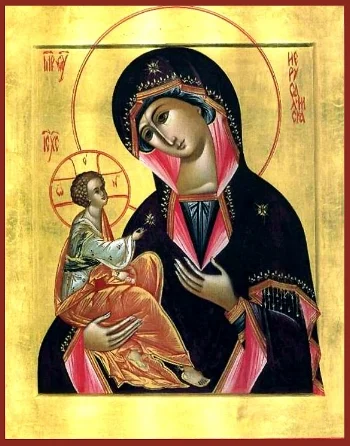
icon of the Mother of God “Jerusalem”
My beloved spiritual children in Christ Our Only True God and Our Only True Savior,
CHRIST IS IN OUR MIDST! HE WAS, IS, AND EVER SHALL BE. Ο ΧΡΙΣΤΟΣ ΕΝ ΤΩ ΜΕΣΩ ΗΜΩΝ! ΚΑΙ ΗΝ ΚΑΙ ΕΣΤΙ ΚΑΙ ΕΣΤΑΙ.
+++
GENUINE AND FALSE EXPERIENCE OF THE GRACE OF GOD
[Recorded speech of the Egoumenos (Abbot, Archimandrite George of our Holy Monastery of Saint of the Holy Mountain at Stratoni of Halkidiki, on 14/27 January 1989...Taken from the magazine "Saint Gregory" of the Holy Monastery of Gregoriou, of the Holy Mountain.]
I am very pleased to see at this evening's meeting, a holy and blessed gathering, the honorable Presbytery, a pious crowd, who through the blessing and invitation of your Most Reverend Metropolitan and Head Shepherd, are gathered here so that all of us may confess our True faith to our God-Man Lord. Your presence this evening is not only the attendance of a lecture but also the witnessing of the Orthodox faith. As the Lord said in the Holy Bible: "Whoever confesses Me in front of men, I shall confess him in front of My Father in Heaven."
The purpose of our life, as you know, is our union with God. As the Holy Bible says, man was created "in the image and the likeness of God, namely to unite with Him. The likeness of man with God, our holy Fathers call "Theosis". Can you see how great the purpose of man's life is? Not to simply become better, more virtuous, more courteous by God, by grace. And what is the difference between Holy God and the deified man? That our Maker and Creator is God in nature according to His nature, while we become gods by grace for although by nature we remain men, by His grace we are deified.
When man unites with God by grace, he receives also the experience of God; he can sense God. Otherwise how could we unite with God without feeling His grace?
Before the first-created ones in Paradise sinned, they could converse with God, they could feel Divine grace. God created man to be priest, prophet, king. Priest, to accept His existence and the world as gifts of God, to offer in return himself and the world to God eucharistically and doxologically. Prophet, to understand the mysteries of God. King, to reign over material creation and himself. To use nature, not as a tyrant but as a ruler. Not to abuse creation but use it thankfully. Today's man does not used nature logically but instead acts self-centeredly and foolishly, and as a result, destroy his natural surroundings and within it, destroy himself.
If man had not sinned and replaced his love and obedience to God with his selfishness, he would not have separated himself from God; he would have been king, priest and prophet. However, Holy God Who hurts for His creature, wishes to return man back to the state where he can again become a True priest, prophet and king. To be able to again attain the experience of God and united with Him. It is for this, that in the narrations of the Old Testament we see God gradually preparing mankind's salvation with the coming of His only Son. He thus provides the gifts like those that man had before his fall - for example, the gift of prophecy. In the Old Testament there were men, like the prophet Elijah, the prophet Isaiah, the prophet Moses, who received the prophetic gift and who sighted the glory of God. However this gift was not generally given to all, nor was it for the entire duration of their lives; it was a partial grace that God had given them for a specific purpose and for circumstantial occasions. Namely, whenever God wished these just men to proclaim the coming of Christ to the world or to declare His Will, they were given the capacity to receive experiences and revelations.
However, the prophet Joel had prophesied that a time will come when God will bestow the grace of the Holy Spirit - not only to select men and for a specific purpose - but to all people. Here is what the prophesy of Joel says: "... I shall put My Spirit upon all flesh", I shall give My Spirit to every person, "and your sons and daughters shall prophesy, your old men shall dream dreams, your young men shall see visions" (Joel 2:28). Namely, my people will see spiritual visions; they will see the mysteries of God. This pouring forth of the Holy Spirit took place during the days of the Pentecost. On that day, the grace of the Holy Spirit was bestowed upon the entire assembled Church. This grace was not bestowed during the period of the Old Testament because Christ was not yet incarnate. The communion of man with God to first be restored, for God to give the grace of the Holy Spirit to all the people. This communion Our Savior Christ achieved through His Incarnation.
The first union that God had with man in Paradise was not hypostatic, which is why it failed. The second union is hypostatic namely personal. In the hypostatic Person of Christ, human nature was united, undisturbed, properly, indivisibly, with the divine nature forever. No matter how much men sin, it is no longer possible for human nature to be separated from God, because in Jesus Christ, the God-man, it is united with the Divine Nature.
For man therefore to be able to receive the Holy Spirit, to become priest, king and prophet, to know the mysteries of God and to feel God, he must become a member of the Body of Christ, of the Church. Jesus Christ is the only One, True and Perfect Priest, King and Prophet. What Adam and Eve were created for and had failed on account of sin and selfishness, was effected by Christ. Now all of us, united with Christ, can partake in the three offices of Christ, the royal, the prophetic and the priestly. At this juncture we must clarify that with Holy Baptism and Chrismation, a Christian receives priesthood, but not the special priesthood that is obtained through tonsuring and through which the officiators of the Church receive the grace to perform the Mysteries (Sacraments) in the Church and to shepherd the lay flock.
Laity, however, is not only the non-priests but also those through Holy Baptism and Chrismation receive the right to be members of the people of God and the Body of Christ, and to participate in the three offices of Christ. In fact the more healthy, conscious and active member of the people of God and of the Body of Christ that the Christian is, the more closely he participates in the hierarchical, prophetic and royal right of Christ, and that far greater experience and feeling of His grace that he receives, we can see in the lives of the Saints of our Faith.
(To be continued)
___________________
"Glory Be To GOD For All Things!" -- Saint John Chrysostom
+++
With sincere agape in His Holy Diakonia (Ministry),
The sinner and unworthy servant of God
+Father George
Theosis, the True Purpose of Human Life (Part V)
Christ installs Himself in the heart of man through the Holy Mysteries (Sacraments): Holy Baptism, Chrismation, Holy Confession, and the Divine Eucharist. Those Orthodox Christians who are in communion with Christ have God and His Grace within them, in their hearts, because they have been baptized, chrismated, have confessed and have received Holy Communion.

Apostle Philip of the Seventy, one of the Seven Deacons
My beloved spiritual children in Christ Our Only True God and Our Only True Savior,
CHRIST IS IN OUR MIDST! HE WAS, IS, AND EVER SHALL BE.
+++
THEOSIS, THE TRUE PURPOSE OF HUMAN LIFE (Part V)
By Archimandrite George, Abbot (Egoumenos) of the Holy Monastery of Saint Gregorios - Mount Athos
The Holy Mysteries (Sacraments) and Prayer
Christ installs Himself in the heart of man through the Holy Mysteries (Sacraments): Holy Baptism, Chrismation, Holy Confession, and the Divine Eucharist. Those Orthodox Christians who are in communion with Christ have God and His Grace within them, in their hearts, because they have been baptized, chrismated, have confessed and have received Holy Communion.
The passions cover Divine Grace as ashes bury a spark. Through asceticism and prayer, the heart is cleansed of the passions, the spark of Divine Grace is rekindled, and the faithful Christian feels Christ in his heart, the center of his existence.
Every prayer of the Church helps to cleanse the heart, but the so-called prayer of a single phrase, also known as noetic prayer or prayer of the heart, is particularly helpful: "Lord Jesus Christ have mercy on me, a sinner." This prayer, which has always been handed down on the Holy Mountain, has the following advantage because it is only one sentence it helps us to concentrate our nous more easily. Concentration our nous, we immerse it in our heart, and then pay attention to make sure it is not busy there with other things and ideas, good or bad; that it is busy only with God.
The practice in this prayer of the heart, which with God's Grace may in time become continuous, is a whole science, a holy art which the Saints of our Faith describe in detail in their holy writings, and also in a large collection of Patristic texts called the "Philokalia."
This prayer helps and gladdens man, and when the Christian progresses in this prayer and at the same time his life follows the Holy Commandments of Christ and His Church, then he is worthy to receive the experience of Divine Grace. He starts to taste the sweetness of communion with God, to know from experience "O taste and see the Lord is good" (Psalm 34:8). For us Orthodox Christians, God is not an idea, something that we think about, that we discuss or read about, but a Person with Whom we come into living and personal communion. It is something we live, and somebody from Whom we receive experience.
Then we see what a great, unspeakable, and inexpressible joy it is to have Christ within us and to be Orthodox Christians.
Within their different concerns and everyday occupations, it helps Christians who are in the world so much to find at least a few minutes of silence to exercise themselves in this prayer.
Certainly, when fulfilled with humility and love, all labors and obligations directed to God sanctify us, but prayer is also required.
In a quiet room (perhaps after some spiritual reading, or after lighting a small oil lamp in front of the holy icons and burning incense), as far as possible away from noise and activity, and after other considerations and thoughts have fallen quiet, they should sink their nous into the heart by saying the prayer: "Lord Jesus Christ, have mercy on me, a sinner." How much peace and strength the psyches (the souls) draw from the silence of God! How much this strengthens them without nervous tension and anxiety, but have all their forces united in harmony!
Some people in other places seek silence of the psyche (soul) by using artificial means that are deluded and demonic, as in the so-called Oriental religions. They try to find a certain silence by using external exercises, meditation etc., to achieve a certain balance of psyche (soul) and body. The fault in all these is the properly speaking, even when man tries to forget the various considerations of the material world he does not have a dialogue with God, but only a monologue with himself, so that once again he ends up in anthropocentrism, and in this way, he fails.
+
GLOSSARY
Essence (ουσία-ousia): God's essence and His energies are pre-eternal and Uncreated. God's essence, that is His essential nature, is inaccessible and unknowable to us, and therefore will always remain a mystery.
The distinction between God's essence and His energies guarantees God's ultimate unknowability whilst simultaneously giving us the possibility to achieve intimate and personal communion with Him through His energies, for these are accessible to us.
Heart (καρδία-kardia): The heart is a biblical word little understood these days, yet it has a truly profound dimension. The heart is where union with God may be consummated; as such it has a spiritual dimension. More than an emotional center or a physical organ, the heart is a receptacle for all good and evil. The heart is our psychosomatic (soul and body) center, the deepest and most profound part of our being; it is our "inner man," out of which the energies of the psyche (soul) issue forth.
Nous (νούς-nous): The nous is our highest faculty. It has been called: the "eye of the psyche" ("soul"), the "eye of the heart," and also the "energy of the psyche (soul)." When cleansed, the nous resides and operates from within the heart; it can perceive God the spiritual principals and underlie creation; it is cognitive, visionary, and intuitive. The Metropolitan of Nafpaktos, Hierotheos said, "the nous is in the image of God. And in as much as God is Light, the nous too has light mirrored in it by the Grace of God."
After man's fall and the "fragmentation" of the psyche (soul); the nous will invariably identify itself with the mind, the imagination, the senses, or even the body -- losing sight of its pure unalloyed state.
Psyche (ψυχ-psyche): The most important and least understood of all Biblical words is the word psyche (soul). The Orthodox Christian understanding of psyche (soul) remains unified and unchanged. The psyche (soul) is a pure unalloyed essence which animates the body and gives it life; it is our immaterial nature, created yet eternal, comprising of our cognitive, conative, and affective aspects, including both the conscious and unconscious. It naturally follows that psychic health precedes salvation.
In order to encapsulate the full meaning of the word psyche (soul) as understood by traditional Christianity, we will have to combine the meanings of five English words: "soul," "life," "breath," "psyche," and "mind."
In the West, the soul has become a debased and ambiguous term; the psyche (soul), is an original biblical counterpart, has now constellated into two distinct conceptual fields. The words "soul," "life," and "breath" form one field. The words "psyche" (as in a modern psychology) and "mind" (as in the mind-body dichotomy) comprise the other field. As such, there is little or no connection between "psychic" health and the eternal animating principle known as "soul."
Repentance (μετάνοια-metanoia): Repentance means: a change of heart, a change of mind - its literal meaning is a change of nous (i.e., meta-nous). Repentance is more than regret or contrition, it requires a fundamental change of life.
Christ tells us that the path for approaching the Kingdom of God is repentance. A more accurate translation of Matthew 4:17, is "Keep repenting for the Kingdom is at hand;" in other words, not once but continually. We must continually re-direct ourselves until we achieve life's objective - union with God - as such repentance is a mystery.
Repentance is not legalistic; i.e., if a penance is given during confession by the spiritual confessor, this will be purely for therapeutic reasons, whose aim is to clear the nous and the heart from sin.
Sin (αμαρτία-hamartia): In Christianity, hamartia (sin) means "estrangement from God," or more accurately "failure to achieve one's destiny," correspondingly the verb harmatanein means "to fall short of one's destiny" - the original meaning was "to miss the mark." These words were later translated as "sin," "to sin."
The primary objective of human life is to unite with God; so any action or even thought that estranges us from God is a sin. As Saint Paul tells us, "The sting of death is sin" (I Corinthians 16:56); sin has no legalistic dimension, it is simply estrangement from life.
_________________________
"Glory Be To GOD For All Things!"--Saint John Chrysostom
+++
With sinner agape in His Holy Diakonia (Ministry),
The sinner and unworthy servant of God
+Father George
Theosis, the True Purpose of Human Life (Part IV)
Those who wish to unite with Jesus Christ, and, through Christ, with God the Father, recognize that this union is realized in the Body of Christ, which is our Holy Orthodox Church. Of course, this union is not with the Divine essence but with the deified human nature of Christ. But this union with Christ is not external, nor is it simply moral.
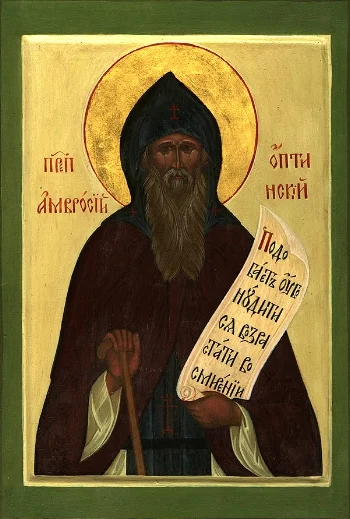
Venerable Ambrose of Optina
My beloved spiritual children in Christ Our Only True God and Our Only True Savior,
CHRIST IS IN OUR MIDST! HE WAS, IS, AND EVER SHALL BE. Ο ΧΡΙΣΤΟΣ ΕΝ ΤΩ ΜΕΣΩ ΗΜΩΝ! ΚΑΙ ΗΝ ΚΑΙ ΕΣΤΙ ΚΑΙ ΕΣΤΑΙ.
+++
THEOSIS, THE TRUE PURPOSE OF HUMAN LIFE (Part IV)
By Archimandrite George, Abbot (Egoumenos) of the Holy Monastery of Saint Gregorios - Mount Athos
The Church: The Place of Man's Theosis
Those who wish to unite with Jesus Christ, and, through Christ, with God the Father, recognize that this union is realized in the Body of Christ, which is our Holy Orthodox Church. Of course, this union is not with the Divine essence but with the deified human nature of Christ. But this union with Christ is not external, nor is it simply moral.
We are not followers of Christ in the way that one might perhaps follow a philosopher or a teacher. We are members of Christ's body, the Church. The Church is the Body of Christ, the real body, not a moral one, as some mistaken theologians have written, not having looked deeply enough into the spirit of the Holy Church. Despite our unworthiness and sinfulness, Christ takes us Christians and incorporates us into His body. He makes us members of Himself. We become real members of Christ, not just followers of a code of morality. As the holy Apostle Paul puts it, "we are members of His body, of His flesh, and of His bones" (Ephesians 5:30).
Certainly, depending on the spiritual state of Christians, they are sometimes living members of Christ's body, at other times they are dead. Even as dead members, we still do not cease to be members of Christ's body. For example, someone who is baptized has become a member of Christ's body. If he does not confess, does not take Holy Communion, does not live a spiritual life, he is a dead member of Christ's body, but when he repents, he immediately receives divine life. This permeates him and he becomes a living member of Christ's body. Someone like this does not need to be re-baptized, however, is not a member of Christ's body even if he lives a moral life according to human standards. In order to become a member of Christ's body, in order to be incorporated into Christ, he needs to be baptized.
Since we are members of Christ's body, Christ's life is offered to us and becomes our life. So we are enlivened, saved, and deified, yet we could not be deified if Christ did not make us members of His body; we could not be saved if the Holy Mysteries (Sacraments) of the Church did not exist. These make us one body with Christ, and as, according to the holy Church Fathers, we share the same body and the same blood as Christ...we are in fact one body and one blood with Christ.
Theosis and the Church
What a great blessing that we commune through the immaculate Mysteries (Sacraments)! Christ becomes ours; the life of Christ becomes ours; His blood becomes our blood. Saint John Chrysostom says that God has nothing more to give man than what He gives him Holy Communion. Man cannot ask anything more of God than what he receives from Christ in Holy Communion.
So, being baptized, chrismated, confessing, we commune through the Body and Blood of the Lord, and we too become gods by Grace; we unite with God; we are no longer strangers, for we have become familiar with God.
Inside the Church in which we unite with God, we live this new reality which Christ brought to the world: the new creation. This is the life of the Church, of Christ, which becomes ours as a gift from the Holy Spirit.
Everything in the Church leads to Theosis (Deification); the Holy Liturgy, the Mysteries (Sacraments), Divine Worship, the Gospel sermon, the fasting; all of these lead to this one thing. The Church alone is the place of Theosis.
The Church is not a social, cultural, or historical organization, and does not resemble other organizations in the world. It is not like the different establishments of the world. The world has fine institutions, fine organizations, fine establishments and other fine things, but our Orthodox Church is the unrepeatable, the sole place for the communion with God with man, for the Theosis of man. Only within the Church can man become god, and nowhere else: not in universities; not in social services; not in any of the fine and good things that the world has. None of these are able to offer what the Church offers, however good they may be.
No matter how much worldly institutions and systems progress, they can never replace the Church.
It is possible that we weak and sinful men go through crises and difficulties from time to time within the Church. It is possible for scandals to happen in the Church because we are as yet on the way to Theosis, and it is very natural that human weaknesses still exist. We are becoming gods, but not yet. So no matter how often these things occur, we will not leave the Church because within the Church we have the only possibility to unite with God.
For example, when we go to church to attend the service, we may meet people there who do not pay attention to the holy service; who hold conversations and distract our attention. Then along comes a seemingly reasonable thought which says: "What do you gain by coming to Church? Might it not be better to sit at home and pray in greater peace and comfort?"
However, we must contradict this evil thought with discretion: "Yes, perhaps I will have more outward peace at home, but I will not have God's Grace to deify and sanctify me. I will not have Christ, Who is present in His Church. I will not have His Holy Body and His Precious Blood, which are on the holy Altar in His Holy Church. I will not partake in the Mystical (Last) Supper of the Divine Liturgy. I will be cut off from my fellow brethren in Christ, together with whom we form Christ's body."
So, whatever may happen, we will not leave the Church, because only within it do we find the path to Theosis.
(To be continued)
__________________________
"Glory Be To GOD For All Things!"--Saint John Chrysostom
++ +
With sincere agape in His Holy Diakonia,
The sinner and unworthy servant of God
+Father George
Theosis, the True Purpose of Human Life
So, the Lord Jesus gives us this possibility to unite with God and turn to the primary purpose which God ordained for man. Therefore He is described in Holy Scripture as the Way, the Door, the Good Shepherd, the Life, the Resurrection, the Light. He is the New Adam who rights the wrong of the first Adam. The first Adam separated us from God with his disobedience and his egotism. With His love and His obedience to the Father, obedience unto death, to "death on the Cross", the Second Adam, Christ, brings us back once more to God. Once again He orients our freedom towards God, so that by offering Him our freedom, we unite with Him.

Apostle James the Son of Alphaeus
My beloved spiritual children in Christ in Our Only True God and Our Only True Savior,
CHRIST IS IN OUR MIDST! HE WAS, IS, AND EVER SHALL BE. Ο ΧΡΙΣΤΟΣ ΕΝ ΤΩ ΜΕΣΩ ΗΜΩΝ! ΚΑΙ ΗΝ ΚΑΙ ΕΣΤΙ ΚΑΙ ΕΣΤΑΙ.
+++
THEOSIS, THE TRUE PURPOSE OF HUMAN LIFE (Part III)
By Archimandrite George, Abbot (Egoumenos) of the Holy Monastery of Saint Gregorios - Mount Athos
The Contribution of the Theotokos to the Theosis of Man
So, the Lord Jesus gives us this possibility to unite with God and turn to the primary purpose which God ordained for man. Therefore He is described in Holy Scripture as the Way, the Door, the Good Shepherd, the Life, the Resurrection, the Light. He is the New Adam who rights the wrong of the first Adam. The first Adam separated us from God with his disobedience and his egotism. With His love and His obedience to the Father, obedience unto death, to "death on the Cross", the Second Adam, Christ, brings us back once more to God. Once again He orients our freedom towards God, so that by offering Him our freedom, we unite with Him.
The work of the New Adam pre-supposes the work of the New Eve, the Panagia who put right the wrong done by the old Eve. Eve drove Adam to disobedience. The New Eve, the Panagia, contributes to the Incarnation of the New Adam Who will guide the human race towards obedience to God. Therefore, as the first human person who achieved Theosis--in an exceptional and, of course unrepeatable, way--the Lady Theotokos played a role in our salvation which was not only fundamental, but both necessary and irreplaceable.
According to Saint Nicholas Cavasilas, the great 14th century theologian, if the Panagia, in her obedience, had not offered her freedom to God - had she not said "yes" to God -- God would not have been able to Incarnate. Once God had given freedom to man, He would not have been able to violate His gift, so He would not have been able to incarnate if there had not been such a pure, all-holy, immaculate psyche (soul) as the Theotokos, who would offer her freedom, her will, all of herself totally to God so as to draw Him towards herself and towards us.
We owe so much to Panagia. This is why our Church honors and venerates the Theotokos and Ever-Virgin Mary so much, so that Saint Gregory Palamas, summarizing Patristic Theology, says that our Panagia holds the second place after the Holy Trinity; that she is after God, the boundary between the created and the uncreated. "She leads those being saved," according to another find expression by a theologian of our Church. Recently Saint Nicodemus of the Holy Mountain, the steadfast luminary and teacher of the Church, pointed out that the Angelic ranks themselves are illumined by the Light they receive from the Panagia.
Therefore, she is praised by our Church as "more honorable than the Cherubim and incomparably more glorious than the Seraphim."
The Incarnation of the Logos/Word and the Theosis of man are the Great Mystery of OUR Faith and Theology.
Our Orthodox Church lives this every day with its Mysteries, with its hymns, with its icons, with its whole life. Even the architecture of an Orthodox church witnesses to this. The great dome of the churches, on which the Pantocrator (Jesus Christ) is painted, symbolizes the descent of Heaven to earth; it tells us that the Almighty Lord "bent down the Heavens and descended." The Evangelist Saint John writes that God became man "and dwelt among us" (St. John 1:14).
So, we represent the Theotokos (Mother of God) in the Apse of the holy Altar to show God comes to earth and to men through her, because He became man through the Theotokos. She is "the bridge by which God descended," and again, "she who conducts those of earth to heaven," the Platetera of the Heavens (Platetera ton Ouranon or she is more spacious than the heavens), the space of the uncontainable, who contained the uncontainable God within herself for our salvation.
To continue, our Churches show deified (theosis) men; those who became gods by Grace because God became man. In Our Orthodox Churches we can picture not only the Incarnate God, Christ, and His immaculate Mother the Lady Theotokos, but we also show the Saints around and below the Pantocrator; on all the walls of the church we paint the results of God's Incarnation; sainted and deified men.
Thus, when we enter an Orthodox Church and see the beautiful holy icons, this is an immediate experience through which we learn what God's plan is for man; what is the purpose of our life.
Everything in the Church talks to us about the Incarnation of God and the Theosis of man.
(To be continued)
_________________________________
"Glory Be To GOD For All Things!"--Saint John Chrysostom
+++
With sincere agape in His Holy Diakonia (Ministry),
The sinner and unworthy servant of God
+Father George
Theosis, the True Purpose of Human Life
The Church Holy Fathers say that God became man in order to make man a god. If God had not taken flesh, man would not be able to achieve Theosis (Deification).

St. Tikhon the Apostle to America
My beloved spiritual children in Christ Our Only True God and Our Only True Savior,
CHRIST IS IN OUR MIDST! HE WAS, IS, AND EVER SHALL BE.
+++
THEOSIS, THE TRUE PURPOSE OF HUMAN LIFE (Part II)
By Archimandrite George, Abbot (Egoumenos) of the Holy Monastery of Saint Gregorios - Mount Athos
The Incarnation of God: The Cause of Man’s Theosis
The Church Holy Fathers say that God became man in order to make man a god. If God had not taken flesh, man would not be able to achieve Theosis (Deification).
In the years before Christ, many wise and virtuous people had appeared. For example, the ancient Greeks had reached quite high standards of philosophy about the good and about God. Their philosophy, in fact, contained seeds of the truth, the so-called "spermaticos logos". Moreover, they were very religious people, but of course, they did not know the True God; they were idolaters, yet very pious and god-fearing people. They are not atheists, as certain ill-informed contemporaries of ours represent them; those who do not know enough about these things. For this reason, by attempting to remove its faith in God from the psyche of our devout people even without their consent, educators, teachers, politicians and civil governors act in a way inconsistent to the memory of the Greek race, and so they commit "hyvris" in the ancient meaning of the word. [Hybris has the same root as hybrid. Hybris originally meant to go against nature. In ancient Greece, the whole of nature was intimately connected with the divine, so by transgressing nature divine harmony was severed. Its modern meaning of overweening pride is also implied in that classical context.] In essence, they attempt to de-Hellenise our people, because the Tradition of the Greeks (Hellenes) (throughout our ancient, recent and modern history) is a Tradition of piety and respect for God. All the worldwide cultural contribution of Hellenism was and is based on this piety and respect for God.
In the philosophy of the ancient Greeks, we can perceive a certain yearning for the unknown God...for the experience of God. They were faithful and devout, but they did not have the True and completed knowledge of God, as they still lacked communion with Him, so that Theosis (Deification) was not possible for them.
In the Old Testament, we also find many just and virtuous people, but the full union with God, Theosis, only becomes possible--is only achieved--with the Incarnation of the Divine Logos/ Word.
This is the purpose of the Incarnation of God. If the purpose of man's life was simply to become morally better, there would be no need for Christ to come into the world, or for all these events of Divine Providence to happen; for the Incarnation of God; the Cross, the Death and Resurrection of the Lord, and all that we Christian believe to have happened through Christ. The human race could have been taught to become morally better by the philosophers, by the righteous men and teachers, or by the Prophets.
We know that Adam and Eve were beguiled by the devil and did not want to collaborate with God; they desired to become gods not through humility, obedience, or love; but through their own power, their own willfulness-egotistically and autonomously. That is to say that the essence of the fall is egotism. Thus, by adopting egotism and self-assertion they separated themselves from God, and instead of attaining Theosis, they attained exactly the opposite: spiritual death.
As the Church Fathers say, God is life. So whoever separates himself from God separates himself from life. Therefore, death and spiritual necrosis (i.e. physical and spiritual death) is the outcome of the disobedience of the first-created.
Falling Away From Theosis
We all know the consequences of the fall. Separation from God threw man into carnal, bestial and demonic life. The brilliant creation of God fell seriously ill, almost to death. What had been made "in the image" was darkened. Since the fall, man no longer has the qualifications he needs to proceed to Theosis, as he had before he sinned. In this situation of grave illness, almost lifeless, he can no longer re-orient himself towards God. Thus there is a need for a new root for humanity; a need for a new man, who will be healthy and able to redirect the freedom of man towards God.
This new root, the new man, is the God-Man (Theos-Anthropos or Theanthropos), Jesus Christ, the Son and Logos/Word of God, Who incarnates to become the new root, the new beginning, the new leaven of humanity.
As Saint Gregory Nazianzen, the Theologian says in his theological writings with the incarnation of the Logos/Word, a second communion between god and humanity is realized. The first communion was in Paradise. This was broken. Man was separated from God. The All-Good God then provided for another, a second communion which can no longer be severed, a union of God and men. This second communion of God and men happens in the person of Christ.
The God-Man Christ, the Son and Logos/Word of God, has two perfect natures: divine and human. These two perfect natures are joined "without change, without confusion, without separation, and without division" in the one person of Christ, according to the famous definition of the Fourth Holy Ecumenical Synod at Chalcedon, given under the guidance of the Holy Spirit. To summarize, this definition forms the whole theological armory of our Orthodox Church against Christological heresies of all kind throughout all ages. So we have one Christ with two natures, Divine and human.
Now, because Christ is the Eternal God-Man through the hypostatic union of the two natures in the Person of Christ, human nature is irrevocably unified with the divine nature because Christ is eternally God-Man.
As the God-Man, He ascended to heaven.
As the God-Man, He sits on the right hand of the Father.
As the God-Man, He will judge the world at Second Coming.
Consequently, human nature is now enthroned in the bosom of the Holy Trinity. No longer can anything cut human nature off from God. Now, after the Incarnation of the Lord--no matter how much we as men sin, no matter how much we separate ourselves from God-- if, through repentance, we wish to unite again with God, we can succeed. We can unite with Him and so become gods by Grace.
(To be continued)
Please note: For those of you who are "religiously illiterate" and cannot discern between what is authentic Orthodox Christian religious education, spirituality, theological knowledge, Orthodox Christian Tradition, and non-Orthodox Christian information, one needs to rely upon one's parish Priest who is theologically educated and has many years of experience.
What many contemporary Orthodox Christians know about the Church, unfortunately, is what is referred to as "yia-yialogy". "Yiayialogy" is far from being the true knowledge of OUR Holy Church. Primarily "yiayialogy" is superstition, and false understanding, of what we believe as Orthodox Christians. Be humble, open and thankful that you have a person, your Priest, and spiritual guide, who has been trained and is willing to teach you the true Faith. Today's typical Orthodox Christian believer has not even scratched the surface when it comes to possessing the vast knowledge, life and practice of Our Holy Orthodox Church. Therefore, everyone must make a concerted effort to ask questions, read Orthodox Christian literature, turn to Orthodox sources, and learn as much as possible about Our 2,000 year Holy Tradition and Faith.
________________________
"Glory Be To GOD For All Things!"-- Saint John Chrysostom
+++
With sincere agape in His Holy Diakonia,
The sinner and unworthy servant of God
+Father George