
Theosis, the True Purpose of Human Life
The idea of Theosis will be unfamiliar to the Western (Roman Catholic and Protestant) mind, although it is not a new concept to Christianity. When Christ said, "Repent, for the Kingdom of Heaven is at hand," this is a call to a life of Theosis.
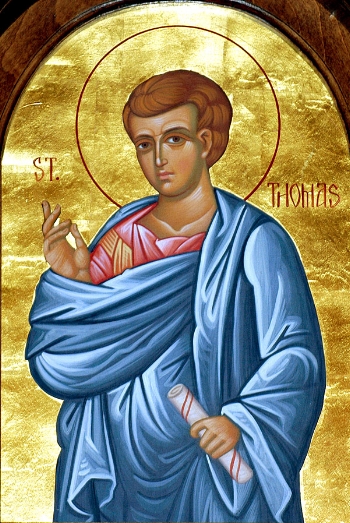
St. Thomas the Holy Apostle
My beloved spiritual children in Christ Our Only True God and Our Only True Savior,
CHRIST IS IN OUR MIDST! HE WAS, IS, AND EVER SHALL BE.
+++
THEOSIS, THE TRUE PURPOSE OF HUMAN LIFE
By Archimandrite George, Abbot of the Holy Monastery of Saint Gregorios - Mount Athos
The idea of Theosis will be unfamiliar to the Western (Roman Catholic and Protestant) mind, although it is not a new concept to Christianity. When Christ said, "Repent, for the Kingdom of Heaven is at hand," this is a call to a life of Theosis.
Theosis is personal communion with God "face to face" (cf., Genesis 32:30). To the Western mind, this idea may seem incomprehensible, even sacrilegious, but it derives unquestionably from Christ's teachings. Jesus Christ was the fulfillment of the Messianic dream of the Jewish race; (cf. cf., Deuteronomy 18:15-19), His mission to connect us with the Kingdom of God (St. Mark 1:15) - a Kingdom not of this world (Romans 14:17). When Jesus said, "You are gods," (St. John 10:34), be perfect, just as your Father in Heaven is perfect" (St. Matthew 5:48) or "the righteous will shine like the sun in the Kingdom of their Father" (St. Matthew 13:43; cf. Exodus 34:29-35; St. Luke 9:28-36), this is to be taken literally. For those who are interested, further Biblical evidence for this can be found in Leviticus 11:44-45; 20:7-8; Deuteronomy 18:13; Psalms 82:1-6; Romans 6:22; 1 Cor. 3:16-17; 2 Peter 1:2-4).
The whole sacrificial tradition of Israel beginning with the sacrificial offering of Isaac reaches fulfillment in Jesus Christ. Saint John the Baptist echoing Isaiah says, "Behold the Lamb of God Who takes upon Himself the sins of the world" (St. John 1:29). Saint Paul has this in mind when he says, "If you are Christ's, then you are descendants of Abraham, and heirs according to the promise" (Galatians 3:29), because "those who believe are children of Abraham" (Galatians 3:7-9). The name Israel was given to Jacob by God as an expression of his fidelity. Later this name was inherited by his faithful descendants. The train of thought is expounded in the writings of Saint Paul, where he blesses the Church as "the Israel of God" (Galatians 6:15-16); whilst elsewhere he wrestles with and is painted by his fellow Jews denial of their own Messiah, labeling them "Israel according to the flesh" (Romans 9-11; also cf. St. John 8:37-40; 10:32-38).
That is why, the Church - "God's very own People" (1 Peter 2:9; cf. Colossians 2:11) - is also known as the "New Israel," the "spiritual Israel," striving to the Heavenly Kingdom. Those first Christians realized that the Kingdom of God was not simply equated with a Jewish state or a single people, but is intended for all humanity (cf. St. Matthew 3:7-9; Acts 1:8; 11:1-8; 15:16-17; Galatians 3:14,28). Through repentance, we are called to the True Exodus - to the New Jerusalem (Revelation 21:2-3) - as Christ said, "Do not think that I am come to destroy but to fulfill" (St. Matthew 5:17).
The Orthodox Church has retained this original message of Christ unchanged. It is for this reason that the Orthodox Church is both the "Body of Christ" (Colossians 1:18, 24; Romans 12:5; 1 Cor. 12:12-13) and the "faithful bride" (2 Cor. 11:2; Rev. 18:23) who has been true to her lover. It is this Sacred Tradition which guarantees our fidelity to Christ's mission, and it is with this knowledge that He says "and lo, I am with you always, even to the end of the age" (St. Matthew 28:20; cf. St. John 17:2022). Christ's teaching could not be arrived at from the Holy Bible alone; we would simply project our modern concepts onto the early Church. Theosis (Deification) stems from this tradition in which the early Church, Traditional Christianity, and Orthodoxy are identical.
Traditional Christianity gave expression and definition to its Theology through the Church Synods (Councils); notable among these being the Seven (Ecumenical Synods, the Synod of St. Photios of 867 and the Palamite Synods of the 14th century. Please note: the Church Synods gave expression and definition to an existent Theology that was fully present within the Church from the day of Pentecost: the same Synods were also responsible for compiling and approving the various books which today are collectively known as the New Testament.
The dual task of Orthodox Theology is to define and also to protect from human distortion the teachings of Jesus Christ. As can be seen, Theology is far more than knowledge about God acquired through academic study. Christianity is a living faith, founded on revelation born of the Holy Spirit (St. John 16:13; Romans 14:17; 1 Cor. 2:10, 13), giving those counted worthy intimate experience of the Triune God and of spiritual realities (Cf. Acts 9:3-7). All attempts to understand Christ's message from a purely rational standpoint will remain partial and incomplete (1 Cor. 2:9).
We now live in an age where Western civilization lives and acts contrary to its Christian heritage, yet it still believes that it knows about Christ and His Church. The West fails to appreciate that over one thousand years separate it from this tradition. As a result, the West's perception and understanding of Christ and His Church has become clouded. Although no longer perceived as such, Christ's crowning achievement was also humanity's crowning achievement, and this forms a watershed in human history. Christ's message was so profound and revolutionary, that it can be said that humanity failed to grasp both its magnitude and its simplicity...
"...Theosis is the Pearl of Great Price alluded to by Christ (St. Matthew 13:45-46). It can become a present reality for those who are willing to tread the path, and so it is not exclusively an after-death experience. With Theosis (Deification) death is transcended (Cf. St. Mark 9:1; St. John 4:14; 8:51; 11:25-26; Romans 5:21; 2 Timothy 1:10). Saint Paul alludes to this when he says, "it is no longer I who live, but Christ who lives in me" (Galatians 2:20). Again, while being stoned to death, Saint Stephanos (Stephen) the First Martyr (Protomartyr) offered himself up to Christ and prayed to God for his persecutors to be forgiven (Acts 7: 59-60).
The Paschal chant, "Christ is Risen from the dead, trampling down Death by death, and bestowing life to those in the tombs" also bears witness to this.
Christianity is victory over death.
(To be continued)
_____________________
"Glory Be To God For All Things!"--Saint John Chrysostom
+++
With sincere agape in His Holy Diakonia (Ministry),
The sinner and unworthy servant of God
+Father George
"...Christ Jesus Came Into the World to Save Sinners, of Whom I am Chief" 1 Timothy 1:15
According to Father John Romanides, of blessed memory, "Modern man hates the idea of sin more than all other ideas. He will do anything to avoid admitting that he is sinful in more than a superficial sense. Sin must be excused, or denied, or refined as something different from sin."

St. Alexis the Metropolitan of Moscow and All Russia
My beloved spiritual children in Christ Our Only True God and Our Only True Savior,
CHRIST IS IN OUR MIDST! HE WAS, IS, AND EVER SHALL BE. Ο ΧΡΙΣΤΟΣ ΕΝ ΤΩ ΜΕΣΩ ΗΜΩΝ! ΚΑΙ ΗΝ ΚΑΙ ΕΣΤΙ ΚΑΙ ΕΣΤΑΙ.
+++
"This is a faithful saying and worthy of all acceptance, that Christ Jesus came into the world to save sinners of whom I am chief" 1 Timothy 1:15.
[Please note: This verse is used in Orthodox liturgical prayer and is said by all approaching the chalice for Holy Communion.]
+
According to Father John Romanides, of blessed memory, "Modern man hates the idea of sin more than all other ideas. He will do anything to avoid admitting that he is sinful in more than a superficial sense. Sin must be excused, or denied, or refined as something different from sin."
WHAT IS SIN?
"...Both the Holy Scripture and the Holy Fathers understand personal sin as a transgression of the Commandments of God." According to Father Romanides what is passed down from Adam to his descendants is not sin, but death. Nor is death to be considered a punishment for sin, but God's mercy. "God did not impose death on man as a punishment for any inherited guilt. Rather, God allowed death by reason of His Goodness and His love, so that in this way sin and evil in man should not become immortal."
This is half true. What is true is that God did not create death, and that man (with the devil), rather than God, is the cause of the entrance of death into the world. Moreover, death is a mercy insofar as it stops the continuation of sin, and allows sinful human nature to be dissolved into its elements and resurrected in a sinless form at the General Resurrection from the dead. But none of this entails that death is not also a punishment..."
"...So what we inherit from Adam and Eve, according to Father John Romanides, is not sin in any shape or form, but only death, including the process of corruption and ageing that leads to death. It follows that for him every human being is born in complete innocence and only becomes sinful later. "The Holy Fathers emphasize that every man is born as was Adam and Eve. And every man goes through the same fall. The darkening of the mind happens to everyone..."
"...Again he writes: "All human unrest is rooted in inherited psychological and bodily infirmities, that I, in the soul's separation from grace and in the body's corruptibility, from which springs all selfishness. Any perceived threat automatically triggers fear and uneasiness. Fear does not allow a man to be perfected in love...The fountain of man's personal sins is the power of death that is in the hands of the devil and in man's own willing submission to him."
"When we take into account the fact that man was created to become perfect in freedom and love as God is perfect, that is, to love God and his neighbor in the same unselfish way that God loves the world, it becomes apparent that the death of the soul, that is, the loss of Divine grace, and the corruption of the body have rendered such a life of perfection impossible. In the first place, the deprivation of Divine grace impairs the mental powers of the newborn infant, thus, the mind of man has a tendency toward evil from the beginning..."
Again, Saint John Chrysostom writes: "Adam is a type of Christ in that just as those who descended from him inherited death, even though they had no eaten of the fruit of the tree. So also those who are descended from Christ inherit the righteousness, even though they did not produce it themselves...What Saint Paul is saying here seems to be something like this. If sin, and the sin of a single man moreover, had such a big effect, how it is that grace, and that the face of God--not of the Father only but also of the Son--would not have an even greater effect? That one man should be punished on account of another does not seem reasonable, but that one man should be saved on account of another is both more suitable and more reasonable. So if it is true that the former happened, much more should the latter have happened as well."
Furthermore, Saint Gregory Palamas writes: "Just as through one man, Adam, liability to death passed down by heredity to those born afterwards, so the grace of eternal and heavenly life passed down from the One Divine and human Logos/Word to all those born again of Him." (Source: Romanides and Original Sin by Vladimir Moss)
"The last part of Saint Paul's words is familiar to us Orthodox Christians, since it forms part of our pre-communion approach to the Chalice, when we pray, "I believe, O Lord, and I confess that You are truly the Christ, the Son of the Living God, Who came into the world to save sinners, among whom I am first".
"When we look in the New Testament and in the liturgical language of the Church, we see two different kinds of vocabulary. We see a vocabulary of sanctity, stressing the holiness of the Christian. The Christian were "saints" (1 Corinthians 1:2; Ephesians 1:1; Philippians 1:1; Colossians 1:2). Once they were no people at all, but now through baptism they were the people of God (1 Peter 2:10); they were now a chosen generation, a royal priesthood, a holy nation (1 Peter 2:9). They were called to be "blameless and innocent, children of God above reproach in the midst of a crooked and perverse generation, among whom you shine as lights in the world" (Philippians 2:15). They would walk with Christ in white, for they were worthy (Revelation 3:4). This language is preserved in the Divine Liturgy, for Saint Basil's anaphora describes the faithful as "His own chosen people, a royal priesthood, a holy nation", having been "cleansed in water and sanctified with the Holy Spirit". At every Divine Liturgy the priest invites the communicants to the Chalice with the words, "the holy things for the holy!"--i.e., the Holy Gifts of Christ's Body and Blood for His holy people, cleansed by baptism and living their faith. This is the language of sanctity, which expresses our sacramental status as the baptized people of God. It describes the tremendous change which Christ has worked in us, and looks at this transformation not with self-satisfaction, but with wonder. The language is the result of looking back over our shoulder to see how far Christ has brought us, and how different He has made us from the world around us.
But there is another kind of language also, the language of unworthiness and humility. This vocabulary looks not to our outer sacramental status, but to the inner state of the heart with its struggle for sanctification and its constant war against temptation and darkness. This interiority looks not back at the world from which we have been rescued, but ahead to the Lord and the finish line which awaits us. It sees not how far we have come, but how far we have yet to go, and recognizes the magnitude of the struggle before we reach our final goal. The flesh and the Spirit constantly strive against one another in the heart of every man, as the fleshly lusts war against the soul (1 Peter 2:11). In the midst of this war we recognize only too well our own sins, our brokenness, our fallen and vulnerable state, and with Saint Paul cry out that nothing good dwells within us, our flesh (Romans 7:18). We confess ourselves unprofitable servants, the first among sinners. Such confessions are not false modesty, but only clarity of mind, precision of discernment, and the willingness to receive the verdict of our conscience when it smites us for our sins.
We need both vocabularies to achieve spiritual balance, recognizing the greatness of our sacramental status and our calling and also the weakness of our mortal flesh in striving to live up to our exalted status. Naturally the language of unworthiness prevails in our liturgical life, for it is the language of humility, and without humility no progress can be made in our spiritual journey. We are indeed saints, the holy people of God, His royal priesthood, saved and cleansed and washed and sanctified. We are also unprofitable servants, debtors to His mercy, liable at any time to fall headlong, ever dependent upon His Spirit to hold us up." (Source: Orthodox Church in America).
____________________
"Glory Be To GOD For All Things!"--Saint John Chrysostom
+++
With sincere agape in His Holy Diakonia,
The sinner and unworthy servant of God
+Father George
"Without Me ye Can do Nothing" (St. John 15:5)
"When God is at work in us, every kind of virtue becomes our own, but when He is not, everything we do is sin. As the Lord says in the Gospel: "Without Me ye can do nothing" (St. John 15:5).

St. Jonah the Metropolitan of Moscow and All Russia
My beloved spiritual children in Chris Our Only True God and Our Only True Savior,
CHRIST IS IN OUR MIDST! HE WAS, IS, AND EVER SHALL BE. Ο ΧΡΙΣΤΟΣ ΕΝ ΤΩ ΜΕΣΩ ΗΜΩΝ! ΚΑΙ ΗΝ ΚΑΙ ΕΣΤΙ ΚΑΙ ΕΣΤΑΙ.
+++
"WITHOUT ME YE CAN DO NOTHING" (St. John 15:5)
"When God is at work in us, every kind of virtue becomes our own, but when He is not, everything we do is sin. As the Lord says in the Gospel: "Without Me ye can do nothing" (St. John 15:5). Those who truly act virtuously are aware of this, and do not pride themselves on any of their achievements, but humbly glorify God, the fount of virtues, by whom they are filled with the light that bestows goodness. When the air is full of sunlight, the glory and radiance it displays are not its own but the sun's. So those who are united with God through fulfilling His Commandments are, according to Saint Paul, the sweet savor of Christ (cf. 2 Corinthians 2:15). They have Christ's fragrance, and proclaim the virtues of Him who called them "out of darkness into His marvelous light" (I Peter2:9).
Through spiritual instruction, knowledge of things to come is instilled in us, and a right love for our soul engenders in us who believe, fear and longing for these future realities. This fear and longing results in turn in sincere, unceasing prayer and supplication to God. Then this continuous prayer brings love for Him and union with Him, through which every virtue is born, accompanied by humility, because we are aware of who has brought about these virtues within us...
"Let us cast off, brethren, the works of darkness, and let us perform the works of light, that we may not only walk honestly, as in the day" (cf. Romans 13:12-13), but also become children of the day (I Thess. 5:5). And come, let us go up the mountain where Christ shone forth, that we may see what happened there. Or rather, if we become children worthy of that day, the Logos/Word of God Himself will take us up when the times comes. Now, I beseech you, strive to lift up the eyes of your understanding towards the light of the gospel message, that you may be transformed by the renewing of your mind (cf. Romans 12:2), and having acquired the divine brightness from above, be conformed to the likeness of the glory of the Lord (cf. 8:29), whose face shone like the sun on the mountain...
"...The glory, kingdom and radiance share by God and His Saints are one and the same. That is why the psalmist and Prophet sing, "Let the brightness" of the Lord our God be upon us" (Psalm 90:17). But no one has yet dared to say that God shares one and the same essence with His Saints...So let us make our way towards the radiance of the light of grace, that we may acknowledge and venerate the Threefold Godhead, Who shines with a single indescribable radiance from one nature in Three Persons. Let us lift up the eyes of our understanding to the Logos/Word Who now sits, with His body, above the vaults of heaven. And he Who sits in Divine splendor on the Right hand of Majesty, utters these words to us as if from afar, "If anyone wants to stand in the presence of this glory, let him imitate Me as far as he can, and follow the way and the manner of life I taught on earth."
Let us look with our inner eyes at this great spectacle, our nature, which dwells for all eternity with the immaterial fire of the divinity. And let us take off the coats of skins (cf. Genesis 3:21), the earthly and carnal way of thinking, in which we were clothed because of our transgression, and stand on holy ground (cf. Exodus 3:5), each one of us hallowing our own ground by means of virtue and reaching up to God. In this way we shall have boldness when God comes in Light, and as we run to Him we shall be enlightened, and, once illumined, shall live forever to the glory of the one brightness in Three Suns, now and forever and unto the ages of ages. Amen"(Saint Gregory Palamas).
________________
"Therefore if there is any consolation in Christ, if any comfort of love, if any fellowship of the Spirit, if any affection and mercy, fulfill my joy by being like-minded, having the same love, being of one accord, of one mind. Let nothing be done through selfish ambition or conceit, but in lowliness of mind let each esteem others better than himself. Let each of you look out not only for his own interests, but also for the interests of others. Let this mind be in you which was also in Christ Jesus, who, being in the form of God, did not consider it rubbery to be equal with God, but made Himself of no reputation, taking the form of a bondservant, and coming in the likeness of men. And being found in appearance as a man, He humbled Himself and became obedient to the point of death, even the death of the Cross. Therefore God also has highly exalted Him and given Him the name which is above every name, that at the name of Jesus every knee should bow, of those in heaven, and of those on earth, and of those under the earth, and that every tongue should confess that Jesus Christ is Lord, to the glory of God and Father" (Philippians 2: 1-11).
_______________________
"Glory Be To GOD For All Things!" -- Saint John Chrysostom
+++
With sincere agape in His Holy Diakonia,
The sinner and unworthy servant of God
+Father George
A Self Examination for the Mysterion (Sacrament) of Repentance and Confession
God does not desire the death of a sinner, but rather that the sinners turn away from their sins and life. In the Holy Mystery (ion) or Sacrament of Repentance/Confession we have the means to obtain forgiveness of our sins, and be restored to the favor of God, Our Heavenly Father.

Beloved in Christ Our Savior,
Christ is in our midst! He was, is, and ever shall be.
PREPARATION FOR THE MYSTERION (SACRAMENT) OF REPENTANCE AND CONFESSION
God does not desire the death of a sinner, but rather that the sinners turn away from their sins and live. In the Holy Mystery (ion) or Sacrament of Repentance/Confession we have the means to obtain forgiveness of our sins, and be restored to the favor of God, Our Heavenly Father.
In order to make a good confession, it is necessary to prepare yourself carefully. Ask God to give you the grace to make a thorough examination of your conscience, and the courage to make a sincere and complete confession. Ask Him for the strength to amend your way of life in the days to come.
Begin your examination with the time of your last confession; try to recall whether you omitted anything through carelessness or lapse of memory, or from fear of embarrassment. Examine yourself with the assistance of the form of Self Examination according to the Ten Commandments of God which follows.
It is most necessary that you be truly sorry for the sins which you have committed, and that you truly are determined to amend your way of life. Accordingly, when you have finished your self-examination, say the Prayer of Repentance, and recite Psalm 50[51].
+
SELF EXAMINATION
"I am the LORD Thy God; Thou shall have no other gods before Me."
* Have I believed in God, the Father, the Son, and the Holy Spirit?
* Have I failed to trust in God and His mercy?
* Have I complained against God in adversity?
* Have I been thankful for God's blessings?
* Have I doubted the Christian Faith and the teachings of the Church?
* Have I tried to serve God and keep His Commandments?
* Have I wrongfully believed in superstition?
* Have I neglected my duties to God through fear of ridicule or persecution?
* Have I failed to pray to God faithfully?
* Have I put myself before God?
SECOND COMMANDMENT
"Thou shall not make unto thee any graven image."
* Have I made an idol of any person or thing?
* Have I given to anyone or anything the worship that is due to God alone?
* Have I set before myself the Holy life of Jesus and tried to imitate Him?
* Have I read the Holy Scripture regularly?
* Have I been irreverent during church services, or let my attention wander, or been insincere?
THIRD COMMANDMENT
"Thou shall not take the Name of the LORD thy GOD in vain."
* Have I profaned the Holy Name of God in anyway?
* Have I cursed anyone or anything?
* Have I sworn a false oath?
* Have I failed to give proper reverence to holy persons and things?
* Have I had due respect for the clergy of the Church, or hindered them in performing God's work?
* Have I broken any solemn vow or promise?
FOURTH COMMANDMENT
"Remember the Sabbath day, to keep it holy."
* Have I stayed away from Church on Sundays, or prevented others from going?
* Have I done unnecessary work on Sundays?
* Have I spent the day in an unwholesome fashion, or profaned it by improper conduct?
* If I could not go to Church because of illness or other grave causes, have I prayed at home?
* Have I kept the Feast and Festivals as prescribed by the Church?
FIFTH COMMANDMENT
"Honor your father and thy mother."
* Have I respected my parents and been obedient to them?
* Have I been guilty of deception, or caused them pain by my words or actions?
* Have I neglected them or failed to help them?
* Have I done my duty towards my family?
* Have I been wanting in kindness toward my spouse, or harmed them in any way?
* Have I set a good example for my children, and tried to bring them up properly? Have I corrected their faults with patience and not with anger? Have I over-indulged them or spoiled them?
* Have I neglected my god-children and failed in my obligations towards them?
* Have I worked for my employer honestly and diligently? Have I treated fairly those who have worked for me?
* Have I honored God as my Heavenly Father by treating others as my brothers and sisters in Christ?
* Have I honored the Church as my Spiritual Mother by honoring and practicing my religion in accordance with her teachings?
SIXTH COMMANDMENT
"Thou shall not kill."
* Have I caused the injury or death of any one?
* Have I wished that I were dead?
* Have I done anything to shorten my own life or that of someone else by injuring my health or someone else's health through evil and intemperate living?
* Have I given way to anger, or harmed others with my words or actions?
* Have I defamed others who needed help, or failed to stand up for those who are unjustly treated?
* Have I been cruel to anyone?
* Have I mistreated animals or destroyed any life unnecessarily?
* Have I failed to forgive anyone, or harbored evil thoughts against them?
SEVENTH COMMANDMENT
"Thou shall not commit adultery."
* Have I given way to impure thoughts, words, or deeds?
* Have I committed any unworthy actions alone, or with others?
* Have I degraded myself in any way, or forgotten human dignity?
* Have I read immoral books or magazines, or delighted in obscenity of any kind?
* Have I associated with bad companions, or frequented unsavory places?
* Have I eaten too much? Have I indulged in too much drink? Have I smoked or used substances that harm my body?
* Have I been lazy, idle, or wasted my time?
* Have I led others to commit sinful acts?
* Have I been unfaithful to any trust confided in me?
(TO BE CONTINUED)
Please note: There are some of our brothers and sisters in Christ who are not familiar with the Sacrament of Repentance/Confession and therefore have many questions about it and how to prepare for it. I am in the process of producing a pamphlet to assist all of you with this most necessary and important Sacrament of the Church. When it is printed we will make sure that all of you will have it.
May God bless you always.
In Christ,
+ Father George
The Fruits of Divine Grace (Part II)
Another fruit, the third, of Divine Grace is man's rebirth. Man has his natural birth from his physical parents. This birth is that which brings him into life sinful, burdened with the ancestral ("original") sin. With this sinful root and inclination which he possesses, he goes on to evil and lives a sinful life, committing sinful acts.

Hieromartyr Dionysius the Areopagite the Bishop of Athens
My beloved spiritual children in Christ Our Only True God and Our Only True Savior,
CHRIST IS IN OUR MIDST! HE WAS, IS, AND EVER SHALL BE. Ο ΧΡΙΣΤΟΣ ΕΝ ΤΩ ΜΕΣΩ ΗΜΩΝ! ΚΑΙ ΗΝ ΚΑΙ ΕΣΤΙ ΚΑΙ ΕΣΤΑΙ.
+++
THE FRUITS OF DIVINE GRACE (Part II)
Another fruit, the third, of Divine Grace is man's rebirth. Man has his natural birth from his physical parents. This birth is that which brings him into life sinful, burdened with the ancestral ("original") sin. With this sinful root and inclination which he possesses, he goes on to evil and lives a sinful life, committing sinful acts. Now through his being called, through his repentance and faith, through Holy Baptism which he has received, he is born a second time, receiving a divine spiritual and heavenly birth, and then through his struggles and through the aid of Divine Grace, he is reborn into a new, divine and holy life. This is rebirth, which constitutes one of the greatest and wondrous gifts of Divine Grace. The rebirth in question is that inner divine rebirth about which our Lord spoke to Nicodemus and said: "Except a man be born from above (i.e., by God's grace), he cannot see the Kingdom of God" and "except a man be born again of water and the Spirit, he cannot enter into the Kingdom of God" (St. John 3:3, 5).
It is of this birth that Saint Peter speaks when he says that Christians are "born again, not of corruptible seed, but of incorruptible, by the word of God, which liveth and abideth forever" (I Peter 1:23). This is the rebirth that produces the gifts of the Holy Spirit.
Next comes the precious and God-given gift of man's sanctification. And when we say sanctification we mean that complete and perfect cleansing of man of everything sinful and contrary to God, of everything secular. Sanctification is that blessed condition of man in which neither evil thoughts nor improper reflections nor guilty feelings nor improper words nor unworthy acts can enter his soul or soil his life. On the contrary, the sanctified man or woman possesses every virtue and perfection so as to have achieved the "likeness of God."
These are the fruits of Divine Grace and the stages of man's salvation. The call -- justification -- rebirth -- sanctification. And these are all interrelated and interdependent. The one proceeds from, and presupposes the other. All together they fulfill and complete the work of the salvation of sinful man.
Then there is glory, Divine Glory which crowns the work of man's redemption. And though this glory is of course the Glory and Majesty of Virtue here on this earth and in this present life, peace, joy, gladness and delight of the life in Christ, it is primarily the glory of the Kingdom of God in the future life and Kingdom of Heaven."
The New Testament is filled with words and proclamations of the God-inspired Apostles, that God calls us unto salvation, and that He justifies us, He gives us rebirth through the grace of the Spirit of His Son; God sanctifies us and leads us unto His Glory. This justification is also called in the Holy Scripture "reconciliation" with God, i.e., amelioration and peace with God. "We have peace with God through Our Lord Jesus Christ", and salvation and theosis (deification) in Christ because with Christ's Incarnation and sacrifice and our faith in Him, We mortal men "have become partakers of the Divine nature", says the Holy Apostle Peter. (Source: Our Orthodox Christian Faith by + Athanasios S. Frangopoulos, Theologian and Preacher)
____________________
"Glory Be To GOD For All Things!"
+++
With sincere agape in His Holy Diakonia,
The sinner and unworthy servant of God
+Father George
Faith and Science
Faith and science are not in opposition. A scientist of our time says: "One of the greatest tragedies of our time is this impression that science and religion have to be at war." Another scientist advanced a principle he calls "noma" or "non-overlapping magisteria of science and religion, "according to which "the magisterium of science covers the empirical the composition of the universe ('fact') and the way it works ('theory').

St. Onuphrius of the St. David Gareji Monastery, Georgia
My beloved spiritual children in Christ Our Only True God and Our Only True Savior,
CHRIST IS IN OUR MIDST! HE WAS, IS, AND EVER SHALL BE.
+++
FAITH AND SCIENCE
Faith and science are not in opposition. A scientist of our time says: "One of the greatest tragedies of our time is this impression that science and religion have to be at war." Another scientist advanced a principle he calls "noma" or "non-overlapping magisteria of science and religion, "according to which "the magisterium of science covers the empirical the composition of the universe ('fact') and the way it works ('theory'). Religion, on the other hand, examines questions of 'ultimate meaning and moral value.' These two magisteria do not overlap, nor do they encompass all inquiry. Science gets the age of rocks, and religion the rock of the ages; science studies how the heavens go, religion how we go to heaven." Darwin himself wrote: "There is grandeur in this view of life, with its several powers, having been originally breathed by the Creator into a few forms or into one, and that, whilst this planet has gone cycling on according to the fixed law of gravity, from so simple a beginning endless forms most beautiful and most wonderful have been, and are being evolved."
The Orthodox Church is not far from these views. Saint Gregory Palamas (A.D. 1296-1359), basing himself on the Holy Scripture (1 Corinthians 1:2; 2:4-8, Saint James 3:15), "distinguishes between two kinds of wisdom and two kinds of knowledge. There cannot be any confusion between the two." The antinomy is created when we make God another object of our natural knowledge when we try to rationalize the truths of our faith when we use the intellect "as the instrument or tool of knowing both the natural as well as the supernatural. Father George Metallinos also stresses this point. "The antithesis and consequent collision of faith and science is a problem for Western (Franco-Latin) thought and a pseudo-problem for the Orthodox Patristic Tradition." Why? Very simply, he answers, because "faith is the knowledge of the Uncreated, and science is the knowledge of the created," two very different, but complementary forms of truth.
The perceived antinomy between religion and science was furthermore exacerbated because of two erroneous assumptions made by Western (Latin) Christianity: that the Holy Scripture is interpreted literally (scriptural literalism), and that religious truths, like all truths, must be discovered and explained exclusively by reason (rationalism). There are certain truths that cannot be arrived at by logic alone. Reason is not the only source of knowledge. Accepting a truth by faith does not make it unreasonable. Accepting a truth by blind faith is as bad as not accepting any truth that cannot be arrived at rationally. That God created the universe is more rational than accepting that the universe created itself. The perceived problem with certain Christian truths is due to the erroneous principle of scriptural literalism, which is based on the equally erroneous principle of biblical inerrancy. We believe that the Holy Scripture is infallible in matters of Christian faith and life.
According to our understanding the Holy Bible is not a scientific textbook, therefore we are not to take every geographic, historical, and scientific detail as error-free, and we should not read it that way. The Holy Scripture seems to follow the view that God created a stationary, flat earth, with the heaven being a dome over it, and the sun and the moon circling it (Psalm 104); that He created the universe in six 24-hour days, some 10,000 years ago, and that He took mud to form man out of it, and woman out of his rib. Scientific, discoveries, from Galileo to Darwin, supported views at odds with a literal understanding of the biblical accounts. As more scientific discoveries were made explaining the laws of nature and the workings of the universe and of life, belief in God was pushed back farther and farther, but only for those who follow a literalistic reading of the Bible.
In the Orthodox Church's understanding, the biblical account of the creation of the world is an anthropomorphic account, relating, in a way expressed by and understandable to the people of the time, sublime truths and facts. The Holy Fathers of the Church were open to the learning and experience of their contemporary world. They embraced the knowledge available to them and applied it in their exegesis of the Holy Scripture and in their views of the mysteries of the cosmos. "If they had had access to the technology and information which is at hand today, there is every reason to believe that they would utilize such knowledge to explain the scripture to contemporary man."
Thanks to their legacy Orthodoxy is science-friendly, it has understood science not as a competitor, but as a blessing of God, placed in man's service.
A specific problem existing between faith and science concerns the origin of life and particularly the existence of man. The theory of evolution holds "that all living things are descended from a common ancestor as a result of changes accumulated over geological time." This troubles many Christians who view this theory as "an essentially atheistic doctrine, holding that Man is only another animal, a naked ape, the product of 'chance' in a purposeless and hostile world. By implication, whatever behavior patterns are seen in animals, particularly in apes, must, therefore, be natural and hence acceptable as alternative lifestyles of Man." Two things have to be mentioned in this regard. First, the theory of evolution is by no means the explanation for the origin of life. This theory explains some things to some degree but it does not provide all the answers. Like any scientific theory, the theory of evolution, despite the mass of evidence behind it, is not a proven fact. Science itself, and the theory of evolution along with it, is constantly evolving and revised based on new scientific evidence. One only needs to look at a science textbook from thirty years ago, whether in the fields of biology, astronomy, archeology or paleontology, and will see that scientists have changed/updated their views on many of subjects. (Source: The Heavenly Banquet. Understanding the Divine Liturgy by Fr. Emmanuel Hatzidakis)
(To be continued)
_____________________
"Glory Be To GOD For All Things!"-- Saint John Chrysostom
+++
With sincere agape in His Holy Diakonia,
The sinner and unworthy servant of God
+Father George